
Why in the news
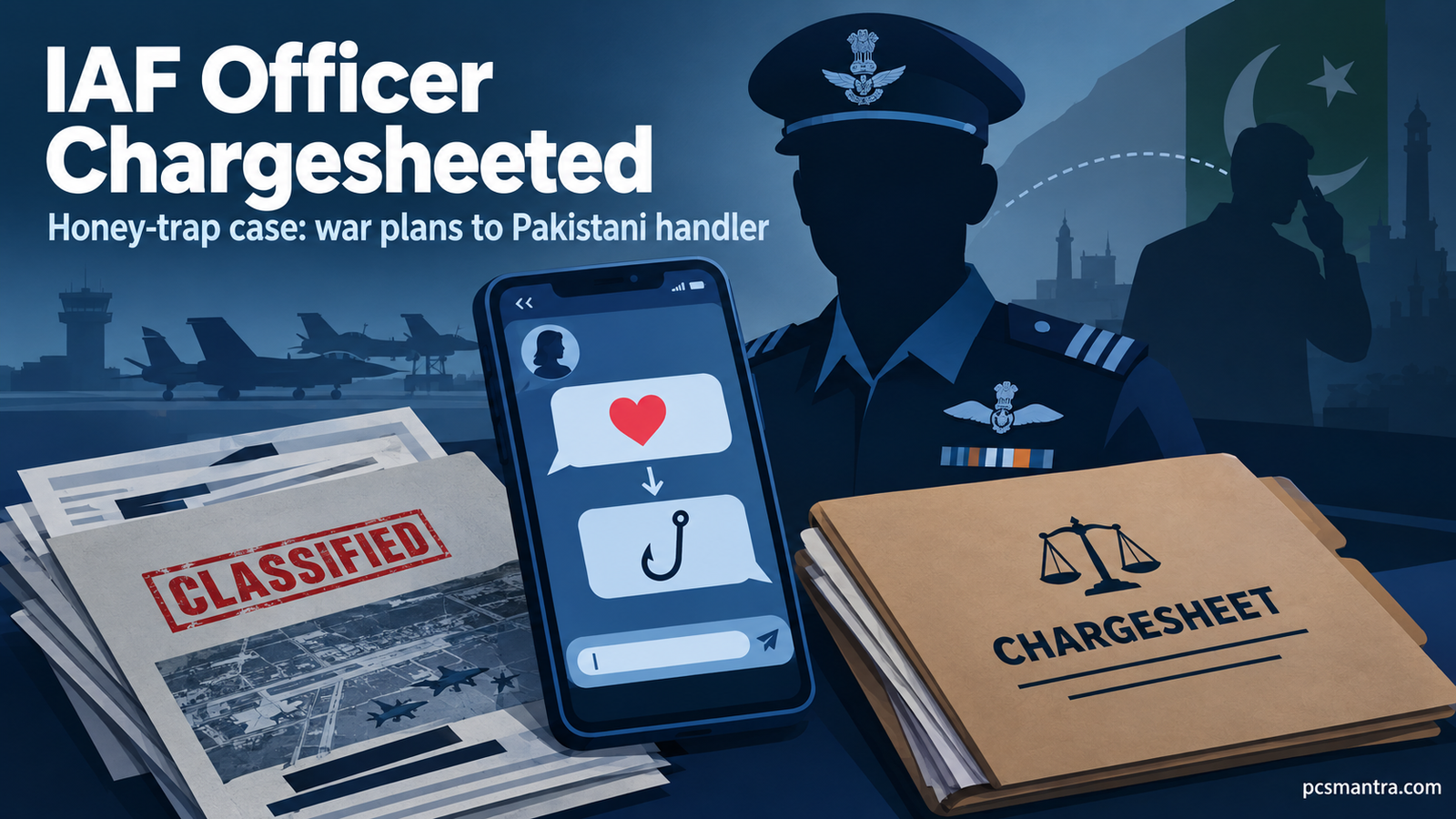
November 13, 2026: The Delhi Police Special Cell has filed a chargesheet in a Delhi court accusing a serving Wing Commander of the Indian Air Force of sharing sensitive information with a Pakistani intelligence operative (PIO). According to the police, the officer was made a victim through a "honey-trap", that is an online trap of allurement, between January and April 2026. The case raises again the questions of internal security in the armed forces, the counter-intelligence mechanism and the misuse of social media. Note, a chargesheet is a document of the police's allegations - there has been no verdict or conviction yet; the case will be decided only after the evidence is tested in court.
What the chargesheet says (police claims)
According to reports, the chargesheet contains these main allegations -
The officer's posting: The accused Wing Commander (a senior officer rank of the Air Force) was posted in a classified covert unit, that is a secret special unit, which gave him access to sensitive information.
Allegation of sharing information: According to the police, between January and April 2026 he sent the Pakistani handler war plans, deployment details and information related to equipment locations.
Benefits in return: It is alleged that in return he received money and photos.
Arrest: He was arrested on 30 May 2026 on a complaint by the Air Force.
The danger: The police say that the disclosure of information put critical military assets and operational security at risk. Operational security means the protection of information from which an enemy could learn the army's plans, capabilities and weaknesses.
All these points are allegations of the police and the chargesheet; the officer's reply to these allegations will come in the court proceedings.
What is a honey-trap
Introduction: A honey-trap is a prevalent method of espionage (tradecraft) in which an intelligence operative builds an emotional or attraction-based relationship with a targeted person, online or in person, and then gradually extracts confidential information from them or blackmails them.
Main part: In the digital age this method works even without physical contact, through social media and messaging apps. That is why the armed forces and sensitive institutions have strict rules on social-media discipline, device rules and security vetting. Counter-intelligence agencies carry out surveillance and internal audits to detect such cases.
What is the Official Secrets Act, 1923
The Official Secrets Act, 1923 is India's principal anti-espionage law. Under it, action can be taken against any person who unauthorisedly obtains, shares or passes to a foreign power confidential information, documents or location details related to the country's security. It provides for rigorous imprisonment if the charge is proved. The law is also criticised from time to time for the breadth of its provisions, so it is the role of the courts to ensure that its use remains confined to genuine national-security cases.
Implications for internal security
Such cases raise three big questions. First - how effective are the regular security vetting and cyber hygiene of personnel posted in sensitive positions. Second - how fast is the mechanism of information-sharing and internal surveillance between the armed forces and intelligence agencies; in this case the action began on the Air Force's own complaint. Third - the importance of a free and fair trial while preserving the distinction between allegation and conviction, because holding any citizen guilty before the country without testing the evidence is against the principles of justice.
The way ahead
The court will now take cognisance of the chargesheet and the case will move to the trial stage, where the police will have to prove their allegations with evidence. At the policy level, this episode is an occasion to review social-media discipline, psychological-security counselling and the counter-intelligence mechanism in the armed forces.
Mains practice question
In the digital age, "honey-trapping" is an evolving threat to national security. Evaluate the nature of this threat and the countermeasures, in the context of the recent Air Force case. (250 words, 15 marks)
Answer outline:
In the introduction: Define a honey-trap and briefly mention the Delhi Police Special Cell's recent chargesheet (as allegations).
In the body: Show how social media has freed this method from physical contact; place the risk factors for personnel in sensitive postings; analyse the modus operandi described in the chargesheet (information in exchange for money and photos); explain the countermeasures - regular security vetting, social-media discipline, counter-intelligence surveillance and internal reporting; also place the distinction between allegation and conviction and the importance of a fair trial.
In the conclusion: Conclude by emphasising a balance of technological surveillance and human awareness.
Prelims practice questions
Question 1. Consider the following statements regarding the Official Secrets Act:
1. This Act was made in 1923.
2. It provides for action against the unauthorised obtaining or sharing of confidential information related to national security.
(a) Only 1
(b) Only 2
(c) Both 1 and 2
(d) Neither 1 nor 2
Answer and explanation
Answer: (c)
The Official Secrets Act, 1923 is India's principal anti-espionage law, which acts against the unauthorised collection of confidential information, documents or location details, or their communication to a foreign power. Hence both statements are correct.
Question 2. Consider the following statements regarding a "honey-trap":
1. It is a method of espionage in which confidential information is extracted through an emotional or attraction-based relationship.
2. It is possible only through physical contact, not through digital means.
(a) Only 1
(b) Only 2
(c) Both 1 and 2
(d) Neither 1 nor 2
Answer and explanation
Answer: (a)
Statement 1 is correct - in a honey-trap an intelligence operative builds a relationship to extract information or blackmail. Statement 2 is wrong - in the digital age it works through social media and messaging apps even without physical contact.
Question 3. Consider the following statements regarding the recent Air Force officer case (as per the police allegations):
1. The chargesheet has been filed by the Delhi Police Special Cell.
2. It is alleged that the information-sharing took place between January and April 2026 and the officer was arrested in May 2026.
3. The court has found the officer guilty.
(a) Only 1 and 2
(b) Only 2 and 3
(c) Only 1 and 3
(d) 1, 2 and 3
Answer and explanation
Answer: (a)
The chargesheet has been filed by the Delhi Police Special Cell in a Delhi court, the alleged period is January-April 2026 and the arrest was on 30 May 2026. Statement 3 is wrong - a chargesheet is only an allegation; there has been no verdict or conviction yet.
Frequently Asked Questions (FAQ)
Summary answer: The Delhi Police Special Cell has filed a chargesheet against a serving Air Force Wing Commander alleging that war plans and deployment details were sent to a Pakistani operative through a honey-trap; the case is still at the stage of allegations, and the final decision will be made by the court.
Question: What are the main allegations in the chargesheet?
According to the police, between January and April 2026 the officer sent a Pakistani intelligence operative war plans, deployment details and information about equipment locations, in return for which he received money and photos.
Question: Under which law have the charges been brought?
Under the Official Secrets Act, 1923.
Question: Has the officer been found guilty?
No. A chargesheet is only a document of the police's allegations; the officer was arrested on 30 May 2026 on the Air Force's complaint, and the case will be decided after the evidence is tested in court.
Sources
- [Press] Indian Express - IAF officer accused of leaking war plans to Pakistani operative (13 November 2026)
- [Press] The Statesman - Chargesheet details on targeting of IAF Wing Commander (13 November 2026)
Download this article: PDF
