
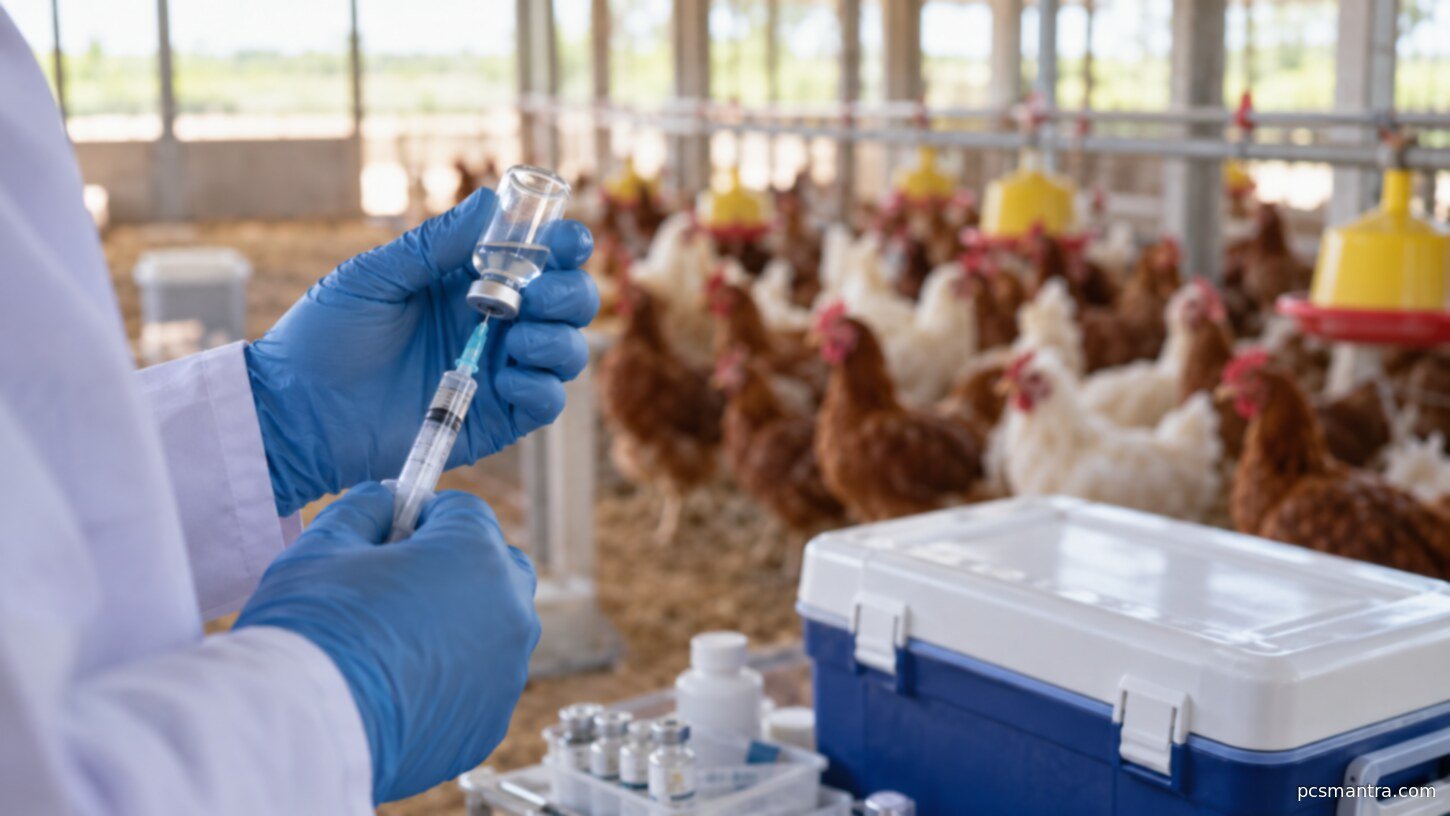
18 November 2026: According to a Press Information Bureau (PIB) release, Union Agriculture and Farmers Welfare Minister Shivraj Singh Chouhan will dedicate India's first indigenous inactivated H5N1 (Clade 2.3.2.1a) vaccine for chickens to the nation on 20 November 2026 at the ICAR-National Institute of High Security Animal Diseases (ICAR-NIHSAD) in Bhopal. Developed by ICAR-NIHSAD, it is the country's first vaccine designed specifically to protect chickens against the H5N1 Highly Pathogenic Avian Influenza (HPAI) virus of Clade 2.3.2.1a.
Key points from the release
- Vaccine: indigenous, inactivated; for chickens against the H5N1 virus of Clade 2.3.2.1a.
- Developer: ICAR-NIHSAD, Bhopal - ICAR's high bio-security animal-disease institute.
- Dedication: 20 November 2026, by Agriculture Minister Shivraj Singh Chouhan, at ICAR-NIHSAD, Bhopal.
- The gap it fills: per PIB, no specific commercial vaccine is currently available against the H5N1 virus of Clade 2.3.2.1a.
- Current context: per an NDTV report, fresh bird flu outbreaks have been reported in Tamil Nadu and Andhra Pradesh.
HPAI: figures and background (PIB)
- Highly Pathogenic Avian Influenza (HPAI) is a serious infectious disease of poultry; outbreaks can kill nearly 100% of infected birds, causing heavy losses to farmers through mass culling and trade restrictions.
- Since the disease was first detected in India in 2006, more than 500 combined outbreaks of the H5N1 and H5N8 subtypes have been reported in the country.
- Per PIB, a major outbreak could reduce India's GDP growth by up to 1.5%; more than 20% of the country's poultry population could be at risk if the disease spreads unchecked. The 2006 outbreak caused estimated direct and indirect losses of Rs 2,200-3,000 crore; an outbreak in Manipur caused losses equal to 0.5% of that state's GDP.
- Public health: per the WHO, 1,003 human cases of H5N1, including 479 deaths, have been reported across 25 countries, including India, since 2003.
- Studies identify the Clade 2.3.2.1a strain as responsible for most bird flu outbreaks in chickens; in recent years it has also been detected in several mammal species and in three human cases.
Permanent exam facts
- Avian influenza is a viral disease with zoonotic potential - it can pass from birds to other animals and humans.
- H5N1 is named after two surface proteins of the virus - hemagglutinin (H5) and neuraminidase (N1); a "clade" is a genetic branch of the virus.
- An inactivated vaccine contains killed virus; it does not cause the disease but produces immunity.
- ICAR-NIHSAD, Bhopal is India's leading high bio-security animal-disease research institute.
- Animal diseases are notified internationally to the WOAH (World Organisation for Animal Health).
Introduction: the exam angle
- Syllabus link: science and technology - biotechnology, vaccines; agriculture - the poultry sector; health - zoonotic diseases.
- Key: the vaccine type (inactivated), the target (Clade 2.3.2.1a, chickens) and the institution (ICAR-NIHSAD, Bhopal) - all three are direct prelims facts.
- Common confusion: this is a chicken vaccine, not a human one; and it is specific to Clade 2.3.2.1a, not all H5N1 strains.
Prelims Practice Questions
Question 1
Which institution has developed India's first indigenous H5N1 chicken vaccine?
Answer and Explanation
Correct answer: (b)
According to PIB, the vaccine has been developed by the ICAR-National Institute of High Security Animal Diseases (NIHSAD), Bhopal.
Question 2
The new vaccine targets which clade of H5N1?
Answer and Explanation
Correct answer: (c)
The vaccine is against the H5N1 virus of Clade 2.3.2.1a - studies link most chicken outbreaks to this strain.
Question 3
According to the PIB release, when was bird flu first detected in India?
Answer and Explanation
Correct answer: (c)
Bird flu was first detected in India in 2006; since then more than 500 outbreaks of H5N1 and H5N8 have been reported.
Frequently Asked Questions (FAQ)
Who is this vaccine for?
It is for chickens, not humans. It protects against the H5N1 virus of Clade 2.3.2.1a.
What is an inactivated vaccine?
It contains killed (inactivated) virus, which does not cause the disease but builds immunity.
How big is bird flu's economic impact?
Per PIB, a major outbreak could cut India's GDP growth by up to 1.5%; the 2006 outbreak caused estimated losses of Rs 2,200-3,000 crore.
Can bird flu infect humans?
Per the WHO, 1,003 human H5N1 cases and 479 deaths have been reported across 25 countries since 2003. It is primarily a disease of birds but has zoonotic potential.
Sources
Download this article: PDF