
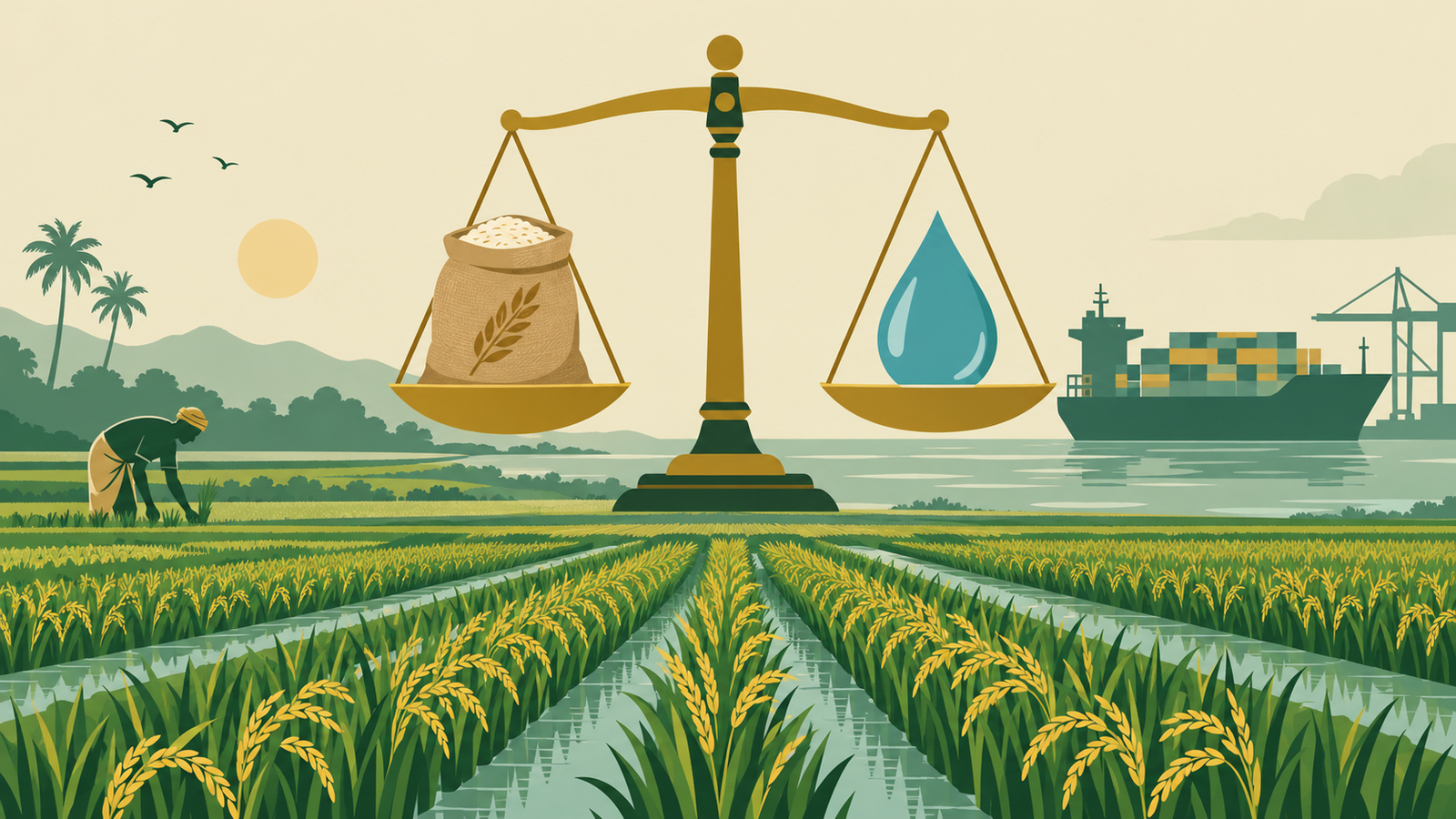
Why in the News
The Hindu's 15 November 2026 analysis ("Rebalancing India's rice economy") raises a key question: India is the world's largest rice exporter, but is that export coming at the cost of our water and climate? In 2025-26, India's rice production was an estimated 154.02 million tonnes and exports 21.57 million tonnes (earning $11.54 billion) - yet non-Basmati rice, at more than twice the export volume of Basmati, earned only marginally more. The analysis argues the yardstick must now shift from volume to water-carbon-value.
India's Position in the Global Market
- Top exporter since 2012: India's share of global rice exports has been roughly 30-35% in recent years.
- Export momentum: from 17.73 million tonnes ($8.82 billion) in 2020-21 to 21.57 million tonnes ($11.54 billion) in 2025-26.
- Basmati vs non-Basmati (2025-26): Basmati 6.52 million tonnes, Rs 50,138 crore ($5.67 billion); non-Basmati 15.04 million tonnes, Rs 51,892 crore ($5.86 billion) - pointing to large headroom in quality, branding and value addition.
- Major producing States: Uttar Pradesh, Telangana, West Bengal, Punjab, Chhattisgarh, Odisha, Madhya Pradesh, Bihar, Andhra Pradesh and Tamil Nadu.
Virtual Water: The Hidden Cost of Exports
The water used to produce a good is "exported" with it - that is virtual water trade. Two kinds of water matter: green water (rainwater stored in soil - low pressure on local resources) and blue water (irrigation water from rivers, reservoirs and groundwater - heavy use depletes scarce resources). The pressure is sharpest in Punjab, Haryana and western Uttar Pradesh; groundwater-fed paddy in parts of West Bengal, Bihar, Odisha, Chhattisgarh, Telangana, Andhra Pradesh, Tamil Nadu and Karnataka also adds to water stress. Export success must therefore be measured not just by earnings and volume but by blue-water consumption per tonne.
Paddy and the Climate: The Emissions Side
- Methane: flooded paddy fields create anaerobic conditions that activate methane-producing microorganisms - paddy is a major agricultural methane source.
- Nitrous oxide: excessive or improper use of nitrogen fertilisers raises N2O emissions.
- Solution techniques: Alternate Wetting and Drying (AWD) - periodically drying fields instead of continuous flooding; Direct-Seeded Rice (DSR) - direct sowing instead of nursery transplantation; Integrated Nutrient Management - combining organic and inorganic sources. Their effectiveness varies with agro-climatic and soil conditions; context-specific assessment of emission trade-offs is essential.
From Volume to Value: The Policy Direction
- Crop diversification: incentives to shift to less water-intensive crops in severely water-stressed regions.
- Irrigation efficiency: better water management and efficient systems to ease groundwater pressure.
- Quality and branding: competitiveness built on processing, traceability and geographical indications (GI) - not just higher volumes.
- A water-carbon-value framework: proposed indicators - export value per tonne; export value per cubic metre of blue water; groundwater used per tonne; irrigation water productivity; greenhouse gas emissions per kg; farmer income per unit of water; groundwater trends in major rice-producing districts.
Exam Pointers
The issue links three GS-III chapters: farm economy, water resources and climate. The goal is not "export less rice" but higher-value rice with lower water and emission costs - that sentence is the core of a Mains answer.
Prelims Practice Questions
Q1: In virtual water terms, what is "blue water"?
(a) Rainwater stored in soil and used by crops
(b) Irrigation water drawn from rivers, reservoirs and groundwater
(c) Polluted water after industrial use
(d) Surface water harvested from rainfall
Answer and Explanation
Answer: (b) Blue water is freshwater drawn from rivers, reservoirs and aquifers for irrigation; rainwater stored in soil is "green water".
Q2: Why do flooded paddy fields emit methane?
(a) Excessive use of organic manure
(b) Anaerobic conditions activating methane-producing microorganisms
(c) Deep penetration of rice roots
(d) Use of warm water for irrigation
Answer and Explanation
Answer: (b) Continuously flooded fields lack oxygen, favouring methane-producing microorganisms; AWD is the technique to reduce this.
Mains Practice Question
Question: "The success of India's rice exports must now be assessed through a water-carbon-value framework rather than volume." Critically examine. (250 words)
Outline: Introduction - top exporter since 2012, 2025-26 figures; problem - Basmati/non-Basmati value gap, blue-water stress (Punjab-Haryana), methane/N2O; solutions - AWD, DSR, crop diversification, GI branding, water-carbon-value indicators; caution - farmer incomes, regional variation; conclusion - a balanced shift from volume to value.
Frequently Asked Questions (FAQ)
Short answer: India has been the world's largest rice exporter since 2012 (2025-26: 21.57 million tonnes, $11.54 billion). The concern: scarce "blue water" is exported along with rice, and paddy emits methane and N2O; the answer is quality-led exports and a water-carbon-value framework.
Q: What does the Basmati vs non-Basmati comparison teach?
In 2025-26 non-Basmati volume (15.04 million tonnes) was more than double Basmati (6.52 million tonnes), yet earnings were nearly equal ($5.86 billion vs $5.67 billion). More earnings can come from quality, branding and value addition than from volume.
Q: What are AWD and DSR?
AWD (Alternate Wetting and Drying) dries fields periodically instead of continuous flooding - saving both water and methane. DSR (Direct-Seeded Rice) sows directly in the field instead of transplanting from nurseries - saving labour and water.
Q: What indicators does the water-carbon-value framework include?
Export value per tonne, export value per cubic metre of blue water, groundwater per tonne, water productivity, emissions per kg, farmer income per unit of water, and groundwater trends in major districts.
Sources
- The Hindu (15 November 2026): Rebalancing India's rice economy - data and analysis (based on DGCIS/APEDA data; no single official document carries all the figures)
- APEDA (official body): source of category-wise agricultural export data
Download this article: PDF (English)