
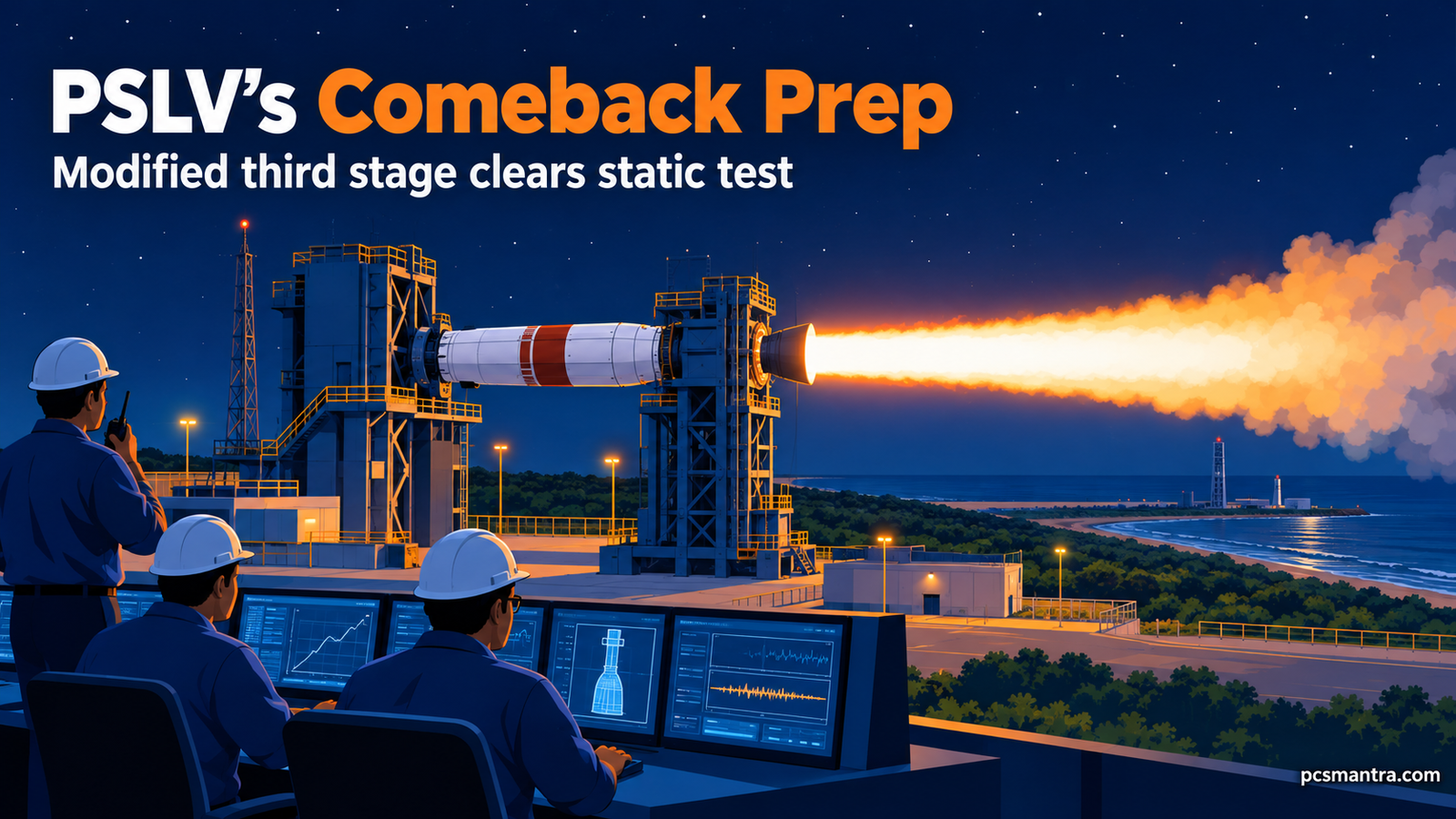
Why in the news
November 13, 2026: On November 12, 2026, ISRO successfully carried out a static ground test of the PSLV's third stage (PS3) at the Static Test Facility of the Satish Dhawan Space Centre (SDSC SHAR), Sriharikota. This test is special because the glitches in both PSLV-C61 (May 2025) and PSLV-C62 (January 2026) had occurred in this very third stage. The successful test of the modified stage is being seen as the first big step towards restoring the PSLV's reliability. According to ISRO, further tests will be conducted after a detailed analysis and review of the test data.
Introduction: the PSLV and its third stage
The PSLV (Polar Satellite Launch Vehicle) is ISRO's four-stage launch vehicle, called its 'workhorse' - that is, the rocket used most often and most dependably. The technology of its stages is as follows -
- First and third stages: based on solid propellant - the solid fuel is pre-loaded and, once ignited, burns for a controlled duration.
- Second and fourth stages: based on liquid propellant - liquid fuel allows the thrust to be controlled more precisely.
A static test is a ground test in which a rocket stage is fired while strapped to a test stand, without being flown, so that its performance, sealing and structural strength can be checked under real combustion conditions.
Main part: two failures and the modifications
- PSLV-C61 (May 18, 2025): this was the PSLV's 101st launch. The flight was normal up to the second stage, but a glitch occurred in the third stage and the EOS-09 satellite was lost.
- PSLV-C62 (January 12, 2026): in this mission too, an anomaly occurred in the final phase of the PS3 stage; the EOS-N1 satellite and 15 co-passenger satellites were lost. ISRO had begun a detailed analysis.
After these two events, ISRO carried out a comprehensive review of the PS3 stage's configuration. According to official information, improvements were made to increase the design margin in the nozzle configuration, and changes were made in the raw-material acceptance process, assembly processes and quality checks. Mechanical interfaces were strengthened in the sealing systems with additional safety (redundancy), and Non-Destructive Tests (NDT) were applied during integration and transportation. It is this modified solid motor stage that has been built and successfully tested.
Significance for the exam
From the Prelims point of view: the PSLV's four stages, the sequence of solid-liquid propulsion, the role of SDSC SHAR Sriharikota and the meaning of a static test - all are direct question topics.
From the Mains point of view: the process of technical improvement from failure analysis (anomaly analysis, design margin, redundancy) demonstrates the institutional maturity of India's space programme - a useful example for GS-III (science and technology).
Way forward
ISRO has made it clear that further tests will follow after a detailed analysis and review of the test data. In other words, several more layers of reliability will be checked before the PS3 returns to flight; only then will the PSLV return to regular missions.
Prelims practice questions
Question 1. Consider the following statements with reference to the stages of the PSLV rocket:
I. The first and third stages are based on solid propellant
II. The second and fourth stages are based on liquid propellant
Which of the above statements is/are correct?
(a) I only
(b) II only
(c) Both I and II
(d) Neither I nor II
Answer and explanation
Answer: (c) Both I and II
Explanation:
Statement I is correct: the PSLV's first (PS1) and third (PS3) stages run on solid propellant.
Statement II is correct: the second (PS2) and fourth (PS4) stages are based on liquid propellant. The PSLV is a four-stage rocket.
Question 2. On November 12, 2026, ISRO successfully conducted the static ground test of what?
(a) The PSLV's first stage (PS1)
(b) The PSLV's third stage (PS3)
(c) The LVM3's cryogenic stage
(d) Gaganyaan's service module
Answer and explanation
Answer: (b) The PSLV's third stage (PS3)
Explanation: ISRO conducted a successful static test of the PSLV's modified third stage (PS3) at the Static Test Facility of the Satish Dhawan Space Centre, Sriharikota. The glitches in the PSLV-C61 and PSLV-C62 missions had occurred in this very stage.
Question 3. Consider the following statements with reference to the PSLV-C61 and PSLV-C62 missions:
I. In PSLV-C61, the EOS-09 satellite was lost due to a glitch in the third stage
II. In PSLV-C62, EOS-N1 and 15 co-passenger satellites were lost
Which of the above statements is/are correct?
(a) I only
(b) II only
(c) Both I and II
(d) Neither I nor II
Answer and explanation
Answer: (c) Both I and II
Explanation:
Statement I is correct: in PSLV-C61 (May 18, 2025), the flight was normal up to the second stage, but a third-stage glitch led to the loss of EOS-09.
Statement II is correct: in PSLV-C62 (January 12, 2026), an anomaly occurred in the final phase of the PS3 stage; EOS-N1 and 15 co-passenger satellites were lost.
Mains practice question
After two consecutive PSLV failures, how does ISRO's successful static test of the modified third stage demonstrate the reliability-restoration process of India's space programme? Analyse. (General Studies-III; 250 words, 15 marks)
Answer outline:
In the introduction: Introduce the successful PS3 static test of November 12, 2026; describe the PSLV as ISRO's 'workhorse'.
In the body: Briefly describe the third-stage glitches of PSLV-C61 (EOS-09) and PSLV-C62 (EOS-N1 + 15 co-passenger satellites). Analyse the modifications - design margin in the nozzle configuration, raw-material acceptance, assembly processes, quality checks, redundancy in sealing and NDT; show that this demonstrates the institutional capability of systematic improvement based on failure analysis.
In the conclusion: Conclude that one successful static test is the first step; only after data review and upcoming tests will the PSLV's flight reliability be fully restored.
Frequently Asked Questions (FAQ)
Summary answer: On November 12, 2026, ISRO successfully conducted a static test of the PSLV's modified third stage (PS3) at Sriharikota; this same stage was at the centre of the glitches in the PSLV-C61 and PSLV-C62 missions.
Question: What is a static test?
In a static test, a rocket stage is fired while strapped to a test stand, without being flown, so that its performance, sealing and structural strength can be checked under real combustion conditions.
Question: What happened in the PSLV-C61 and PSLV-C62 missions?
In PSLV-C61 (May 2025), a third-stage glitch led to the loss of the EOS-09 satellite, while in PSLV-C62 (January 2026), an anomaly in the final phase of the PS3 stage led to the loss of EOS-N1 and 15 co-passenger satellites.
Question: What changes were made in the modified PS3 stage?
According to ISRO, the design margin in the nozzle configuration was increased, the raw-material acceptance process, assembly and quality checks were improved, additional safety (redundancy) was added to the sealing systems and Non-Destructive Tests (NDT) were applied.
Sources
- [Primary] ISRO - Ground test of third stage of PSLV (PS3) conducted successfully (November 12, 2026)
- [Press] The Hindu - ISRO carries out ground static test of PSLV third stage
- [Press] Times of India - ISRO tests modified PSLV third stage
Download this article: PDF
