
Why in News
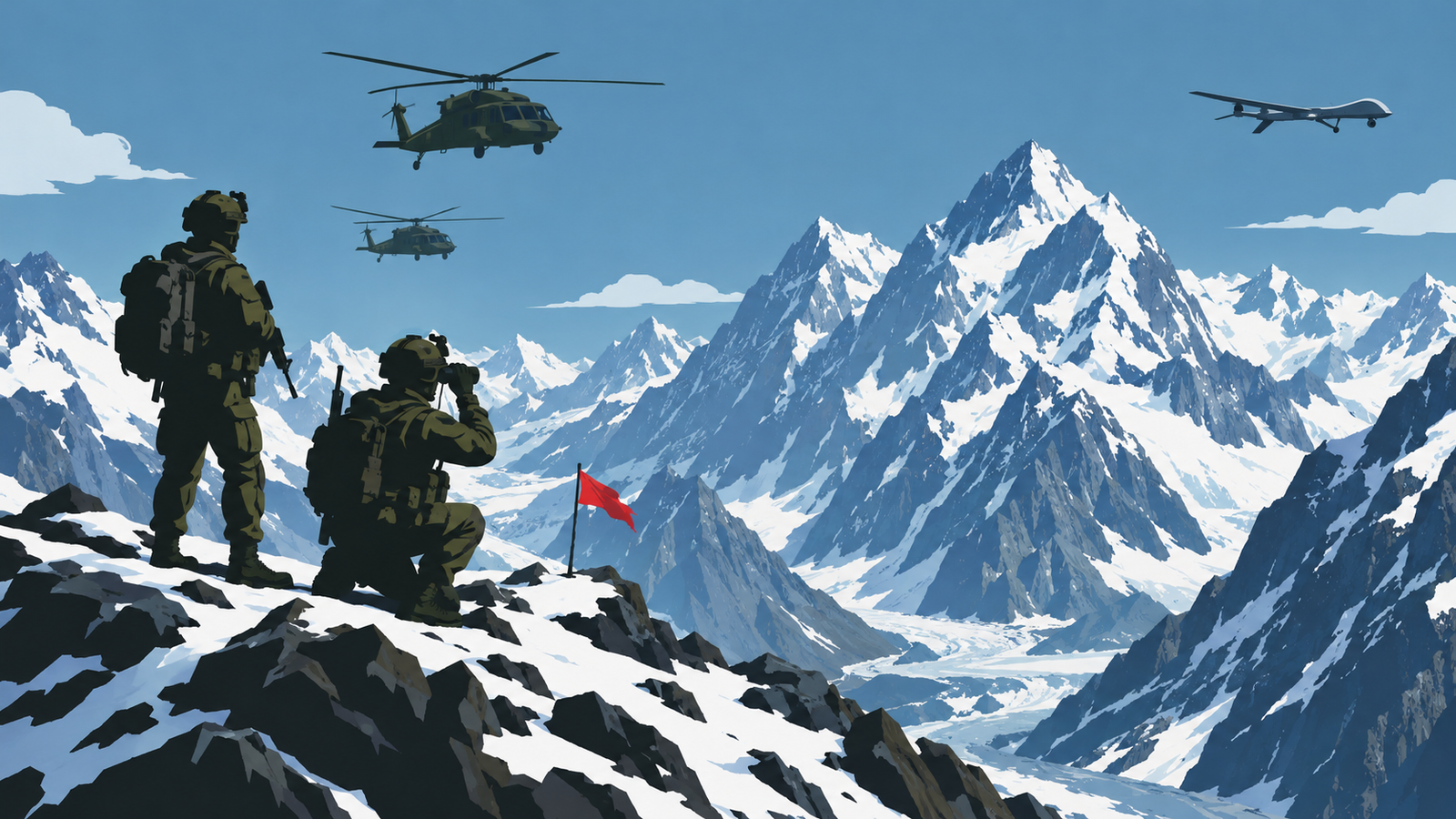
China and Pakistan conducted the Karakoram-2026 joint military exercise in the Xinjiang Uyghur Autonomous Region on 14-22 October 2026 - the first joint-army-level exercise involving regular army formations of both countries. According to an Indian Express analysis (Major-General (retd) G G Dwivedi), bilateral military cooperation is moving beyond a buyer-supplier arrangement towards functional integration and interoperability - compounding India's security challenge on the Northern border.
The Exercise at a Glance
- Location and scope: Xinjiang - bordering Jammu & Kashmir and Ladakh; a focus on demanding high-altitude operations relevant to the PLA's Western Theatre Command, which oversees the border with India.
- Two phases: Phase One (until 19 October) - specialised tactics, close-quarter combat, UAV/drone operations; Phase Two - joint command, mixed formations, counterterrorism clearance operations, joint manoeuvres and coordinated fire drills.
- Equipment: entirely Chinese - small arms, armoured assault vehicles, infantry fighting vehicles, artillery, drones and anti-drone systems.
- Expanding series: beyond the earlier naval (Sea Guardian), air (Shaheen) and counterterrorism (Warrior) exercises - now at army level. A joint patrol at Mantika Pass (4,700 m) in upper Hunza, Gilgit-Baltistan, preceded it.
Pillars of the China-Pakistan Nexus
- Origins: the 1963 boundary agreement under which Pakistan ceded the Shaksgam Valley (part of Gilgit-Baltistan) to China - cementing the strategic alignment.
- Arms supplies: China accounts for roughly 70-80% of Pakistan's imported military hardware - J-10C/JF-17 fighters, Type 054 A/P frigates, Hangor-class submarines, HQ-9/16/17 air defence, Wing Loong drones.
- Co-production: JF-17s, Al-Khalid tanks, missiles, naval platforms - technology access for Pakistan, defence-industrial outreach for China.
- Information and space: intelligence sharing, BeiDou navigation, the "China-Pakistan Information Corridor".
- Infrastructure: CPEC and Gwadar port under the BRI.
- Operation Sindoor (May 2025): during the crisis, China reportedly accelerated deliveries of PL-15E air-to-air missiles and air-defence/electronic platforms; the ISPR chief claimed Chinese systems "performed extremely well" in the four-day conflict.
- The Bangladesh dimension: Dhaka plans J-10CE purchases, with pilots to be trained by Pakistan at Jessore airbase near the Siliguri corridor.
- Integration signals: intelligence reports suggest Pakistan Army officers are posted in key PLA Western Theatre Command formations and the CMC's Joint Staff Department.
Implications for India
- An integrated two-front challenge: the issue is no longer two adversarial neighbours separately but converging capabilities - joint training of mixed formations, integration of Chinese platforms into Pakistan's inventory, and a growing military presence in the Xinjiang-Karakoram region.
- GS-III Security: a live case study of border security and alliance analysis; India needs a "coherent national security strategy" addressing the convergence.
Prelims Practice Questions
Q1. The Karakoram-2026 joint exercise was held in:
(a) Tibet
(b) Xinjiang
(c) Gilgit-Baltistan
(d) Sichuan
Answer and Explanation
Answer: (b) In the Xinjiang Uyghur Autonomous Region - bordering J&K and Ladakh; within the PLA Western Theatre Command area.
Q2. Under the 1963 China-Pakistan boundary agreement, Pakistan ceded which area to China?
(a) Aksai Chin
(b) Shaksgam Valley
(c) Hunza Valley
(d) Siachen
Answer and Explanation
Answer: (b) The Shaksgam Valley (part of Gilgit-Baltistan) - the foundation of the strategic alignment; India regards the cession as illegal.
Mains Practice Question
Q: "China-Pakistan military cooperation is evolving from a buyer-supplier arrangement into strategic integration." Analyse this statement in the context of Karakoram-2026 and discuss India's strategic options. (250 words)
Outline: Introduction - the first army-level exercise; evidence of integration - joint command, equipment standardisation, patrols, postings; pillars - arms, CPEC, information; for India - the two-front convergence; options - Northern-border modernisation, surveillance capability, diplomacy; conclusion - a coherent national security strategy.
FAQ
Short answer: Karakoram-2026 (14-22 October, Xinjiang) was the first joint-army exercise between China and Pakistan - focused on drone warfare, joint command and mixed formations. It signals deepening military integration, sharpening India's two-front challenge.
Q: How is Karakoram-2026 different from earlier exercises?
For the first time, regular army formations of both countries trained at the army level; earlier cooperation was limited to the naval (Sea Guardian), air (Shaheen) and counterterrorism (Warrior) series.
Q: How much of Pakistan's weaponry is Chinese?
Roughly 70-80% of Pakistan's imported military hardware - J-10C/JF-17 fighters, frigates, submarines, air-defence systems and drones - plus extensive co-production.
Q: What should India do?
Analysts say India must treat the China-Pakistan military relationship as an integrated two-front challenge - with Northern-border surveillance, modernisation and a coherent national security strategy.
Sources
- Indian Express Explained (11/15 November 2026): Karakoram-2026 - how China and Pakistan are deepening military ties
- SCMP: Beijing offers to boost corridor safety amid terror threat
- Note: exercise details are based on the IE analysis (author: Major-General (retd) G G Dwivedi); the Chinese defence ministry's original statements were not independently verified
Download this article: PDF (English)