
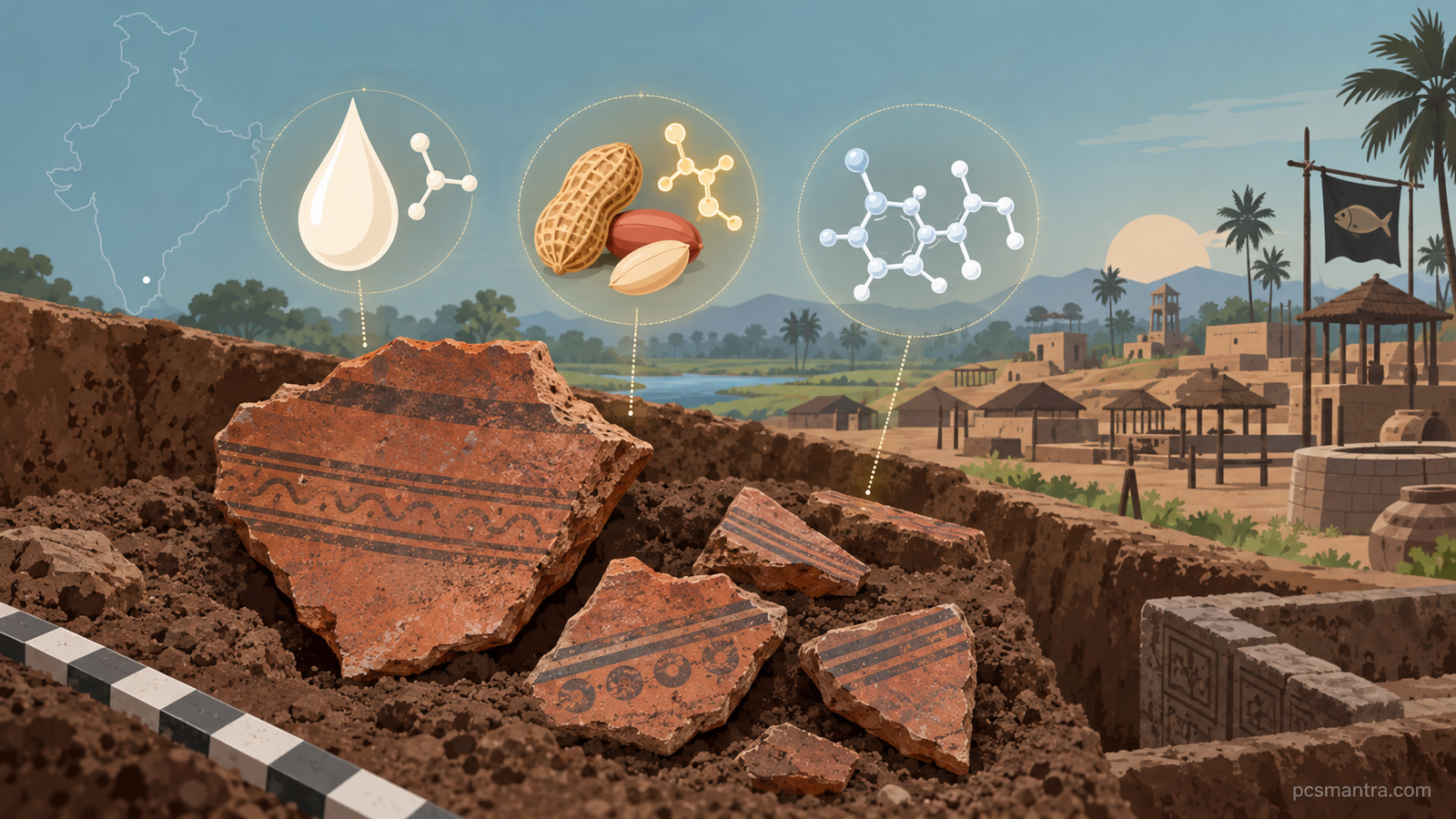
15 November 2026: Unglazed potsherds from Keeladi (Tamil Nadu) and Gottiprolu (Andhra Pradesh), dated between 600 BCE and 100 BCE, have yielded chemical traces of cow's milk and plant foods such as peanuts - the first direct biomolecular evidence of diet from South India, published in the journal npj Heritage Science. Until now, such residue data came mainly from North India, especially the Indus Valley Civilisation.
The study: key points
- Team: Researchers from VIT Vellore, the Archaeological Survey of India (ASI), PSGR Krishnammal College for Women and the Tamil Nadu Archaeology Department; paper "Biomolecular evidence of early dairying and plant processing in 600 BCE-100 BCE South India" (published 29 October 2026).
- Technique: UPLC-Q-ToF-MS/MS (liquid chromatography-mass spectrometry) and non-destructive X-ray micro-computed tomography - conventional GC-MS misses high-molecular-weight markers.
- Find 1: A complex plant molecule - a linear A-type procyanidin tetramer - pointing to peanuts (or similar nuts), matched against modern peanut skin; the first recovery of this molecule from an archaeological context.
- Find 2: Lipid residues carrying six distinct biomarkers of cow's milk; Bos indicus (desi cattle) remains dominate both sites - a society built on farming, animal husbandry and dairying.
- Caution: The researchers themselves note that four potsherds cannot represent the whole society's diet - the study demonstrates the technique's capability.
Why it matters
Food molecules trapped in the microscopic pores of unglazed pottery can survive for thousands of years - these "biomarkers" reveal ancient meals, cooking practices and trade routes. For Keeladi - a Sangam-era urban settlement on the Vaigai river - this is the first direct chemical testimony of South Indian prehistoric food culture, and a showcase of India's Organic Residue Analysis (ORA) capability in archaeology.
Quiz: Test your knowledge
Q1: Consider the following about the Keeladi-Gottiprolu biomolecular study (2026): 1. Cow-milk biomarkers were found in potsherds 2. UPLC-Q-ToF-MS/MS was used 3. The potsherds date between 600 CE and 100 CE. Which are correct?
(a) 1 and 2 only
(b) 2 and 3 only
(c) 1 and 3 only
(d) 1, 2 and 3
Answer and explanation: (a) Statements 1 and 2 are correct; the sherds date between 600 BCE and 100 BCE (Before Common Era), not CE.
Q2: The linear A-type procyanidin tetramer molecule recovered from the potsherds points to which food?
(a) Rice
(b) Peanuts
(c) Wheat
(d) Pulses
Answer and explanation: (b) Peanuts - the molecule was matched against the mass spectra of modern peanut skins; it is the molecule's first recovery from an archaeological context.
Frequently Asked Questions (FAQ)
In short: Keeladi and Gottiprolu potsherds have yielded the first direct chemical evidence of cow's milk and peanut-like foods in South India between 600-100 BCE.
Question: What was found in the Keeladi potsherds?
Six biomarkers of cow's milk and a linear A-type procyanidin tetramer indicating peanut-like nuts - both firsts in an archaeological context of this kind in South India.
Question: Which institutions conducted the study?
VIT Vellore, the ASI, PSGR Krishnammal College for Women and the Tamil Nadu Archaeology Department; published in npj Heritage Science.
Question: How do food molecules survive in pottery for thousands of years?
Molecules released during cooking get trapped and tightly bound in the microscopic pores of unglazed clay, shielding them from groundwater and microbial decay.
Sources:
- https://www.nature.com/articles/d44151-026-00210-w
- https://www.newindianexpress.com/amp/story/states/tamil-nadu/2026/Nov/02/tamil-nadus-keeladi-potsherds-offer-clues-to-sangam-age-diets
Download this article: PDF (English)