
Why in News
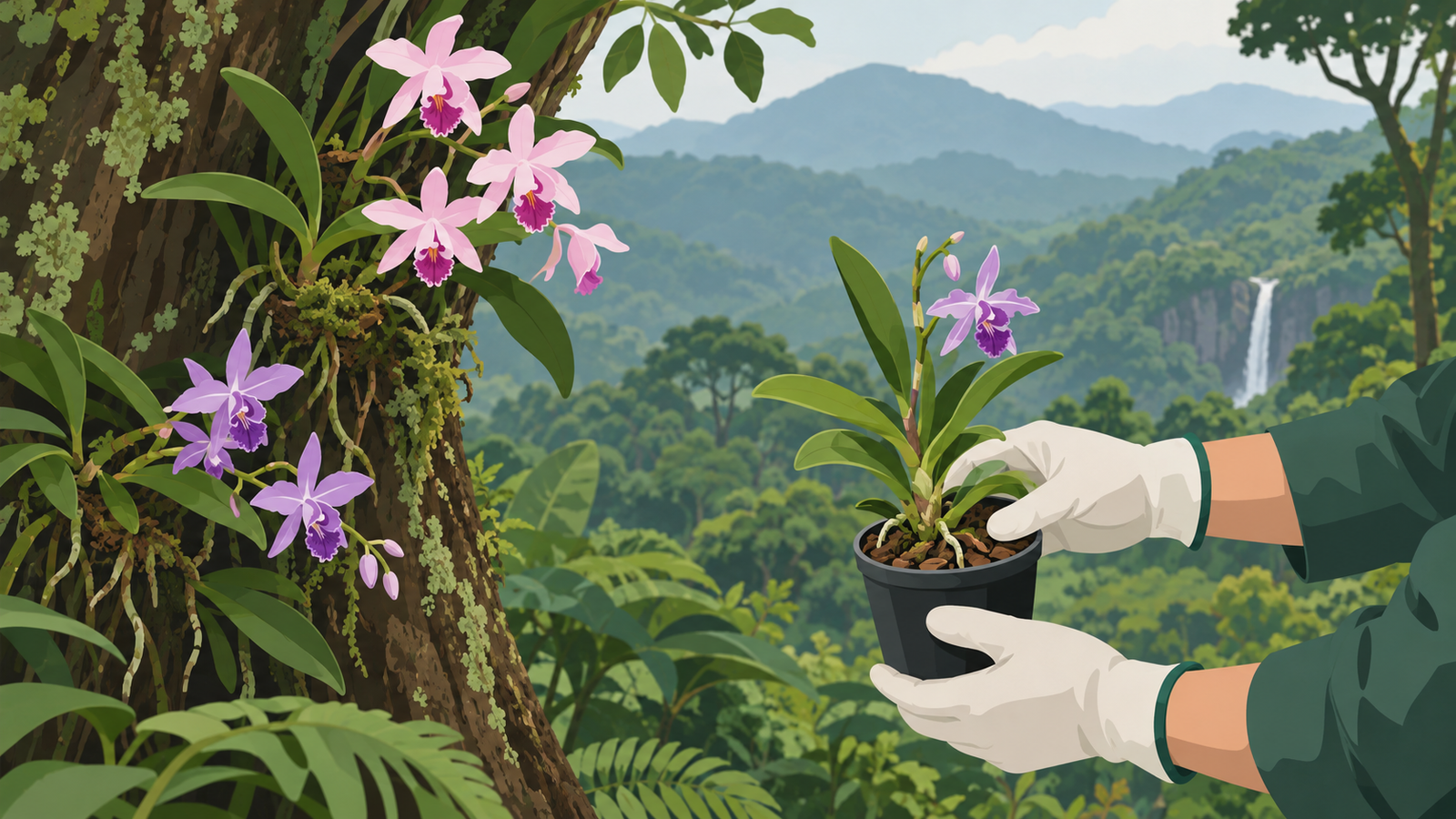
The Hindu (16 November 2026) highlights Keralam's orchid diversity and conservation efforts. According to associated reports (Mongabay/ToI), 27,324 orchids rescued from trees felled for road development were translocated to suitable habitats, with about 71% survival after two years - the Malabar Botanical Garden (Kozhikode) led the effort. The underlying rescue-translocation model is described in a peer-reviewed paper in the journal Plants.
Key Facts
- Rescue and translocation: 27,324 orchids living on trees cleared for highway widening were moved to suitable habitats; around 71% were alive two years on, some flowering.
- Habitat range: from hill epiphytes to species tolerating salt spray on the coast - a wide ecological amplitude.
- Institution: the Malabar Botanical Garden and Institute of Plant Sciences (Kozhikode) leads conservation, research and propagation.
- Diversity: India has roughly 1,200+ orchid species; the Western Ghats are a major hotspot with many endemics.
Ecological and Legal Context
- Family: Orchidaceae - among the largest flowering-plant families; most Indian orchids are epiphytes (growing on trees without parasitising them).
- Protection status: orchids are listed in CITES Appendices I/II - international trade is regulated; several protected plants figure in Schedule III of the Wildlife (Protection) Act, 1972; access and benefit-sharing fall under the Biological Diversity Act, 2002.
- Threats: habitat loss, illegal collection and smuggling, and climate-driven micro-climate shifts.
- Indicator role: epiphytic orchids are sensitive indicators of air quality and forest health.
Why It Matters
- Conservation science (GS-3): a translocation-based model shows how green mitigation can be built into development projects.
- Environmental compliance: making flora translocation part of the EIA process alongside compensatory afforestation.
- Bio-economy: orchids link to horticulture, tourism and bio-resource-based livelihoods.
Prelims Practice Questions
Q1. Orchids belong to which family?
(a) Asteraceae
(b) Orchidaceae
(c) Poaceae
(d) Fabaceae
Answer and Explanation
Answer: (b) Orchidaceae is among the largest flowering-plant families; India has 1,200+ species, most of them epiphytes.
Q2. The Malabar Botanical Garden is located in:
(a) Kochi
(b) Thiruvananthapuram
(c) Kozhikode
(d) Thrissur
Answer and Explanation
Answer: (c) The Malabar Botanical Garden and Institute of Plant Sciences is in Kozhikode, Keralam - a leading centre for orchid conservation and translocation.
Mains Practice Question
Q: "Species translocation can be a practical middle path amid the twin challenge of development and conservation." Comment in the context of Keralam's orchid translocation initiative, noting the limits of such efforts. (250 words)
Outline: Introduction - 27,324 orchids translocated, ~71% survival; benefits - species rescue, green mitigation, research; limits - micro-climate dependence, long-term monitoring, cost; way forward - translocation protocols in EIA, community participation, CITES compliance; conclusion - build conservation into the development process itself.
FAQ
Short answer: 27,324 orchids rescued from road development in Keralam were translocated, with ~71% survival after two years; the Malabar Botanical Garden (Kozhikode) led the effort. International orchid trade is regulated under CITES; plants listed in Schedule III of the Wildlife (Protection) Act, 1972 also receive protection.
Q: What is the orchid translocation initiative?
27,324 orchids growing on trees felled for highway widening were rescued and moved to suitable habitats; ~71% survived after two years - led by the Malabar Botanical Garden.
Q: What legal protection do orchids have?
Listing in CITES Appendices I/II (regulated international trade); several plants in Schedule III of the Wildlife (Protection) Act, 1972; access and benefit-sharing under the Biological Diversity Act, 2002.
Q: Why are orchids environmental indicators?
Epiphytic orchids are highly sensitive to changes in air quality and forest health, so their presence or absence is a living signal of ecosystem condition.
Sources
- The Hindu (16 November 2026): Keralam's orchids endure - from highway trees to salt-sprayed shores
- Primary research paper (Plants journal): When Roads Remove Trees, Conservation Must Move Fast - a rescue-translocation model for Keralam's native epiphytic orchids
- Mongabay (November 2026): tens of thousands of orchids saved from road development
Download this article: PDF (English)