
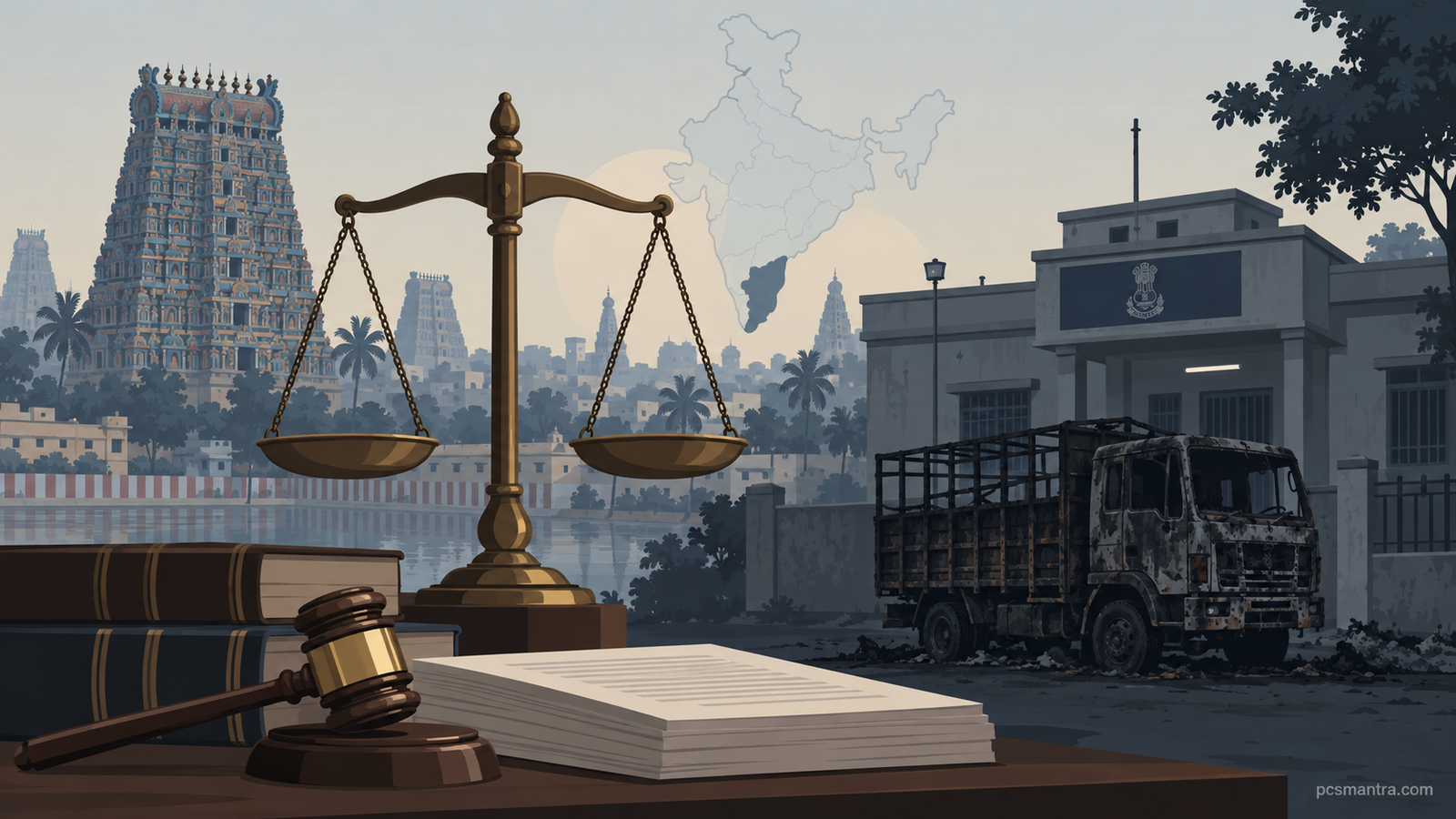
15 November 2026: A truck driver, R. Balakrishnan, died in the custody of the Chekkanoorani police station in Madurai, Tamil Nadu, during the investigation of a 3 November fire in a cardamom-laden truck. He was found unconscious in the station's restroom at about 6 am on 14 November and was later declared dead. Police claim suicide, but this is unverified - the case has revived questions about custodial deaths and police investigation procedures.
The case: key points
- Sequence: A cardamom-laden truck caught fire on 3 November; driver Balakrishnan was brought to the Chekkanoorani station for questioning. On the morning of 14 November he was found unconscious in the restroom and died.
- Action: Inspector Muthu and two head constables have been suspended; a judicial inquiry has been ordered and the case handed to the CB-CID.
- Contested claim: Police say it was suicide, but there is no official confirmation - the post-mortem and judicial inquiry reports are awaited.
Custodial death: the legal and constitutional framework
- Constitution: Article 21 (life and personal liberty) and Article 22 (protection against arrest); the state is responsible for the safety of every person in custody.
- DK Basu v. West Bengal (1997): Supreme Court guidelines - arrest memo, informing relatives, medical examination, police identification tags; violation amounts to contempt of court.
- CrPC Section 176(1A) (now BNSS): A judicial magistrate's inquiry is mandatory for every death or rape in police custody.
- NHRC directions: Every custodial death must be reported to the National Human Rights Commission within 24 hours; the Commission can take suo motu cognisance.
- Suspension versus punishment: Suspension is an administrative step; prosecution under the BNS follows a separate criminal process if guilt is established.
The larger question
NCRB data shows custodial deaths are recorded every year, but conviction rates remain extremely low - because investigations are run by the same department, evidence disappears and witnesses face pressure. Suggested reforms include an independent investigation agency, mandatory CCTV (Paramvir Singh v. Baljit Singh, 2020 - the Supreme Court ordered CCTV in all police stations), and time-bound judicial inquiries.
Quiz: Test your knowledge
Q1: Consider the following about custodial deaths: 1. CrPC 176(1A) mandates a judicial magistrate's inquiry into custodial deaths 2. DK Basu guidelines cover arrest procedures 3. Custodial deaths must be reported to the NHRC within 72 hours. Which are correct?
(a) 1 and 2 only
(b) 2 and 3 only
(c) 1 and 3 only
(d) 1, 2 and 3
Answer and explanation: (a) Statements 1 and 2 are correct; NHRC reporting must happen within 24 hours, not 72.
Q2: The Supreme Court's order on CCTV cameras in police stations is linked to which case?
(a) DK Basu v. State of West Bengal
(b) Paramvir Singh v. Baljit Singh
(c) Kedar Nath Singh v. State of Bihar
(d) Prakash Singh v. Union of India
Answer and explanation: (b) Paramvir Singh v. Baljit Singh (2020) - CCTV with night recording in all police stations, footage preserved for 18 months. DK Basu deals with arrest guidelines and Prakash Singh with police reforms.
Mains Practice Question
Deaths in police custody are a direct blow to the rule of law and citizens' trust. In the context of the Madurai incident, examine the causes, legal remedies and the path of reform. (Answer in 250 words - 15 marks)
Answer outline:
Introduction: The driver's custodial death in Madurai and the action of suspensions and a judicial probe; the wider nature of the problem.
Main body:
- Causes: third-degree interrogation methods, low conviction rates, departmental inquiries, destruction of evidence.
- Legal framework: Articles 21/22, DK Basu guidelines, CrPC 176(1A)/BNSS, NHRC oversight, CCTV orders (Paramvir Singh).
- Reforms: an independent investigation agency, scientific interrogation methods, police reforms (Prakash Singh case), time-bound judicial inquiry, a compensation mechanism.
Conclusion: Safety in custody is the state's non-negotiable duty; without accountability, the rule of law remains incomplete.
Frequently Asked Questions (FAQ)
In short: A truck driver died in police custody in Madurai; three policemen suspended, judicial inquiry and CB-CID probe under way - the police claim of suicide is unverified.
Question: What action has been taken in the Madurai custodial death case?
An inspector and two head constables have been suspended, a judicial inquiry ordered, and the case transferred to the CB-CID; the post-mortem and inquiry reports are awaited.
Question: What are the DK Basu guidelines?
Arrest memo, informing relatives, medical examination at the time of arrest, police identification tags, and display of rights in the lock-up - violation is contempt of court.
Question: Who investigates a death in police custody?
Under CrPC Section 176(1A), a judicial magistrate's inquiry is mandatory; the NHRC must be informed within 24 hours, and the state can hand the case to an independent agency like the CB-CID or CBI.
Sources:
Download this article: PDF (English)