
Why in the news
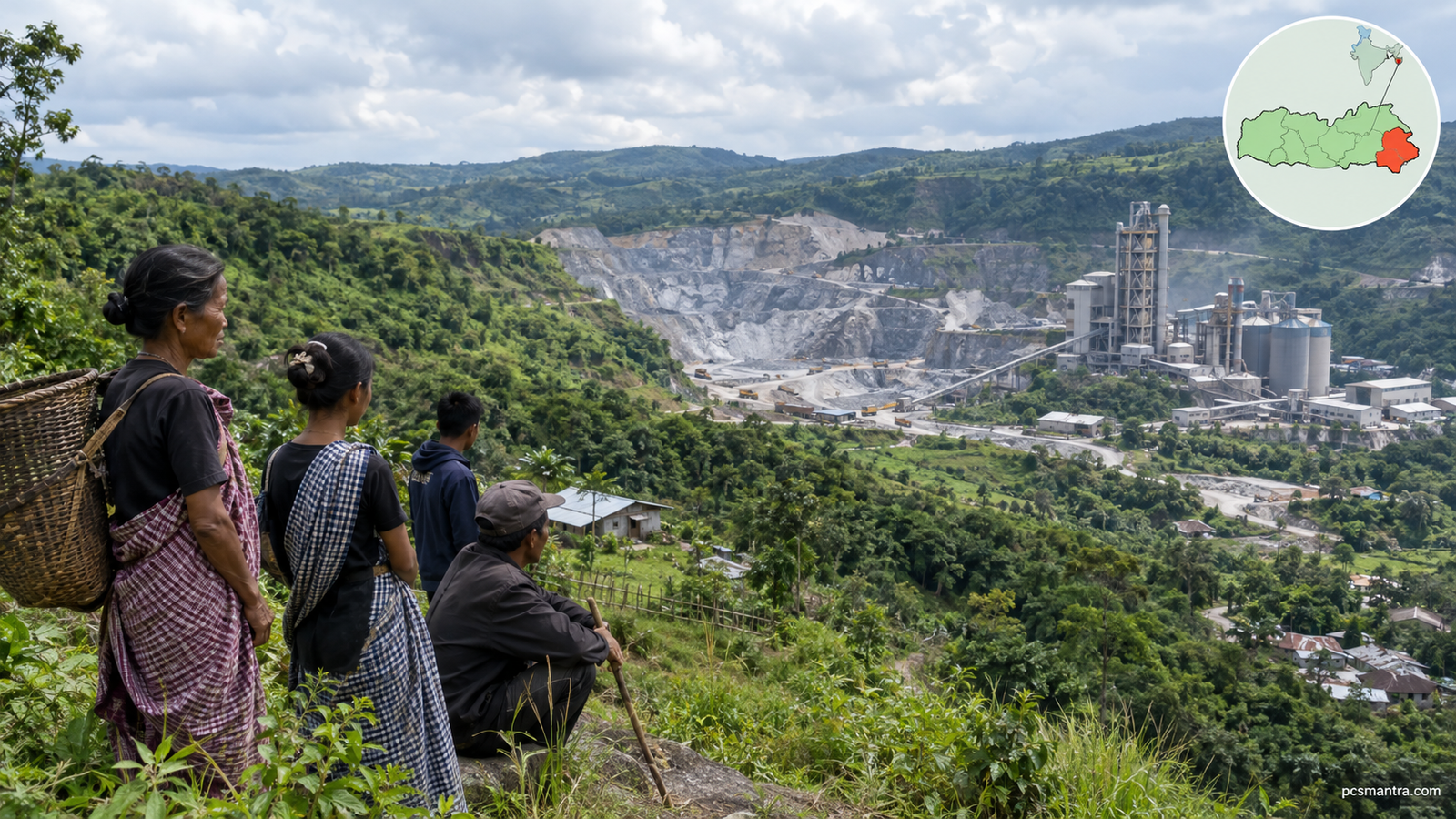
November 13, 2026: The Jaintia National Council (JNC) has objected to the proposed transfer of about 232.899 hectares of tribal land at Umkyrpong in Elaka Sumer, East Jaintia Hills district, to a private cement company - Kopili Cement (I) Private Limited. In a representation submitted on 12 November 2026 to the Revenue and Disaster Management Department, the JNC asked that the transfer process be kept on hold until its concerns are examined. The case is significant also because the land belongs to Wom Chyrmang, a tribal woman of Jalaphet village, and the area is believed to hold potential limestone reserves.
Key facts of the case
Land and notices: The two Form-D notices issued by the Deputy Commissioner's office cover two parcels. The first notice, dated 28 August 2026, concerns 15,24,990 square metres for Rs 8,17,21,000; the second, dated 1 September 2026, concerns 8,04,000 square metres for Rs 3,71,08,453. Together the proposed consideration comes to roughly Rs 11.88 crore.
Process so far: On 8 October 2026 the JNC had asked the Deputy Commissioner to defer the process, extend the period for tribal buyers to respond and publicise the notices more widely; in a later meeting it was told the matter would be taken up with the Additional Deputy Commissioner.
Direct demands: An immediate hold on the transfer and any pending sanction; a reasonable extension of the Form-D period; wider publication through local newspapers and other platforms; transparency over the valuation; and an examination of the complete records.
What the law says: the 1971 Act
The Meghalaya Transfer of Land (Regulation) Act, 1971 was enacted to protect tribal land. Some of its provisions sit at the centre of this dispute:
- Section 3: Transfer of Scheduled Tribe land to a non-tribal is generally prohibited; under Section 3(2), a transfer made in contravention is void and unenforceable.
- Section 4(1)(b): Before sanctioning a transfer, the competent authority must consider whether any other tribal person is willing to take the land at market value.
- Section 4(1)(d): It must also consider whether the transfer will promote the economic interests of the Scheduled Tribes in the area.
- Rule 6(1) of the 1974 Rules: A public notice in Form-D is issued, giving interested tribal buyers 30 days from publication to come forward.
The JNC's argument is that merely pinning a notice on an office board is not effective communication - in a transaction of this scale the information must actually reach potential tribal buyers, otherwise the Section 4(1)(b) opportunity becomes an empty formality. Given the limestone potential and long-term economic value, it also calls the Rs 11.88 crore valuation questionable.
Background: mining, cement and the Sixth Schedule
- Sixth Schedule: Meghalaya's Jaintia, Khasi and Garo Hills fall under the Sixth Schedule of the Constitution, where autonomous district councils hold special powers over land and administration, and the protection of tribal land is part of the constitutional commitment.
- The limestone economy: Jaintia Hills is rich in limestone, the raw material of cement; that is why large cement plants and quarries are concentrated in the area.
- Old disputes: Mining-related disputes are not new here - the National Green Tribunal's 2014 ban on illegal rat-hole coal mining and cases of environmental damage are part of that history. The JNC has also long objected to another proposed transfer involving Shree Cement Limited.
Way forward
Resolving this dispute calls for honouring both the letter and the spirit of the law. The administration must ensure that the Form-D process runs with genuine publicity, interested tribal buyers get a meaningful opportunity, valuation is transparent, and the long-term value of mineral-bearing land is counted. Giving the district council and local institutions a substantive role in the process would be in keeping with the spirit of the Sixth Schedule. Tribal land is not merely property but the economic foundation of generations to come - that is the core of the JNC's argument and, for examination purposes, the heart of the issue.
Prelims practice questions
Question 1. With reference to the Meghalaya Transfer of Land (Regulation) Act, 1971, consider the following statements:
1. Under this Act, the transfer of Scheduled Tribe land to a non-tribal is regulated subject to certain rules
2. A transfer made in contravention of Section 3 can be validated through subsequent approval
Which one of the following is correct in respect of the above statements?
(a) Statement 1 is correct, but Statement 2 is not correct
(b) Statement 1 is not correct, but Statement 2 is correct
(c) Both Statement 1 and Statement 2 are correct
(d) Neither Statement 1 nor Statement 2 is correct
Answer and explanation
Answer: (a)
Statement 1: The 1971 Act regulates the transfer of tribal land to non-tribals and lays down conditions such as the competent authority's sanction, so this statement is correct. Statement 2: Under Section 3(2), a transfer made in contravention of Section 3 is void and unenforceable, so this statement is not correct.
Question 2. Which of the following areas fall under the Sixth Schedule of the Constitution? 1. Jaintia Hills 2. Khasi Hills 3. Garo Hills How many of the above statements are correct?
(a) Only one
(b) Only two
(c) All three
(d) None
Answer and explanation
Answer: (c)
Jaintia Hills, Khasi Hills and Garo Hills are all areas of Meghalaya that come under autonomous district councils constituted under the Sixth Schedule. Hence all three statements are correct.
Mains practice question
"Legal procedure in the transfer of tribal land is meaningful only when it delivers a real opportunity to interested tribal buyers." Examine this statement in the context of the recent land-transfer dispute in Meghalaya. (250 words, 15 marks)
Answer outline:
In the introduction: The Umkyrpong transfer proposal and the JNC's objection; the purpose of the 1971 Act.
In the body: The legal framework - Sections 3, 4(1)(b), 4(1)(d), Rule 6(1) and Form-D. Core issues - inadequate publicity, valuation transparency, mineral potential, formality versus substantive opportunity. Wider context - the Sixth Schedule, the mining-based economy, environment and inter-generational interest.
In the conclusion: A transparent process, the role of the district council, primacy of tribal interest.
Frequently Asked Questions (FAQ)
Summary answer: November 13, 2026: The Jaintia National Council (JNC) has objected to the proposed transfer of about 232.899 hectares of tribal land at Umkyrpong in Elaka Sumer, East Jaintia Hills district, to a private cement company - Kopili Cement (I) Private Limited.
Question: What is a Form-D notice?
A public notice issued under Rule 6(1) of the Meghalaya Transfer of Land (Regulation) Rules, 1974, giving interested tribal buyers 30 days from publication to come forward.
Question: What does Section 4(1)(b) of the 1971 Act say?
Before sanctioning a transfer, the competent authority must consider whether any other tribal person is willing to take the land at market value.
Question: Under which constitutional provision do the Jaintia Hills fall?
The Sixth Schedule - like the Khasi and Garo Hills, autonomous district councils hold special powers here.
Sources
- [Press] https://www.indiatodayne.in/meghalaya/story/why-deprive-tribal-people-meghalaya-council-flags-land-transfer-to-cement-firm-in-jaintia-hills-1474850-2026-11-13
- [Press] https://highlandpost.com/jnc-opposes-transfer-of-232-899-ha-of-tribal-land-to-cement-firm/
- [Press] https://megrevenuedm.gov.in/acts/land-transfer-act-1971.pdf
Download This Article: PDF
