
Why in the News
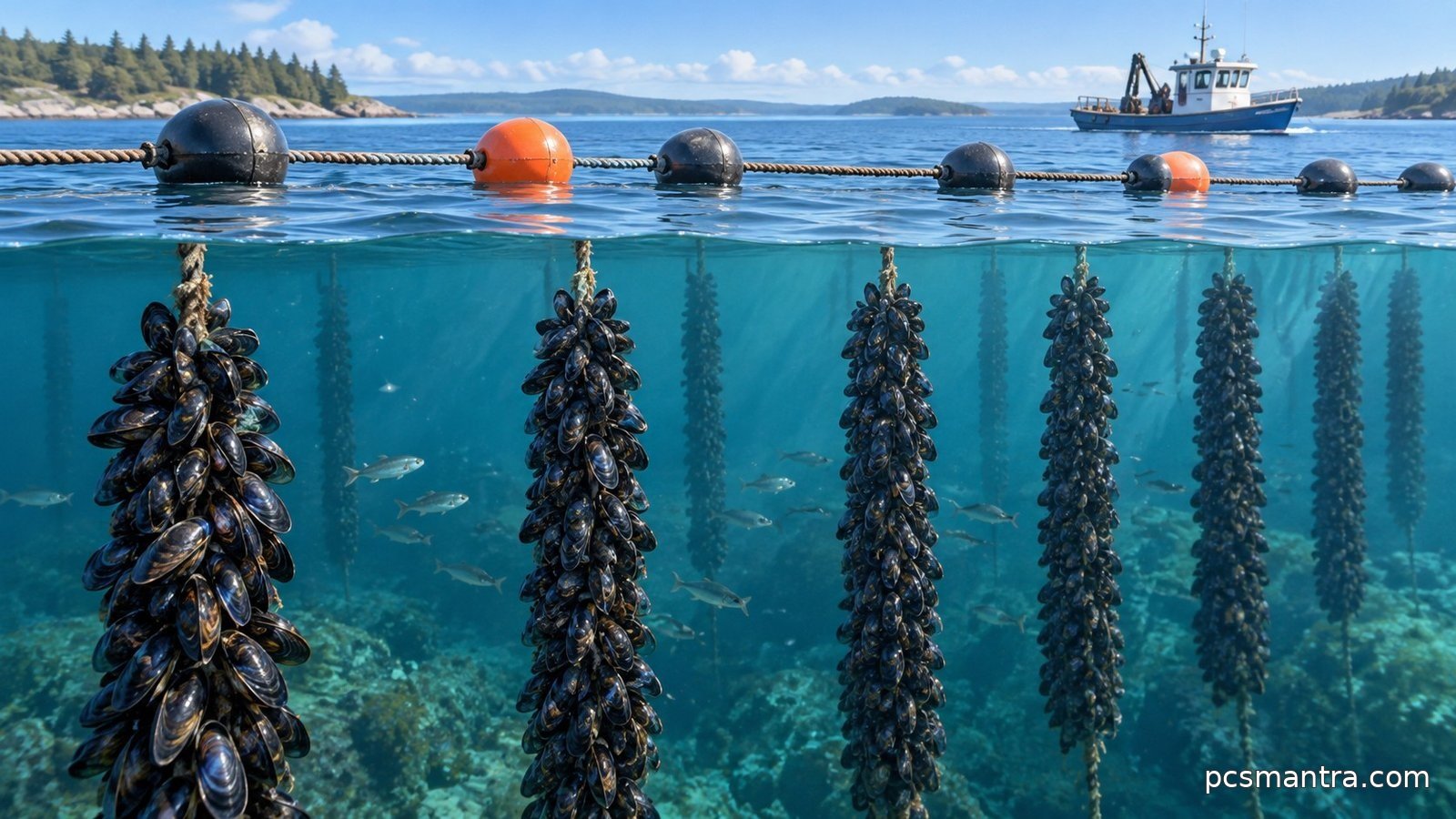
The Vizhinjam unit of the ICAR-Central Marine Fisheries Research Institute (CMFRI) has started its first full open-sea mussel longline farming unit (The Hindu).
Key Facts (Static)
- Mussels are bivalve molluscs - the marine family Mytilidae and the freshwater family Unionidae; more common in colder seas.
- Usually 5-15 cm, wedge/pear-shaped shells; dark blue/greenish-brown outside, pearly sheen inside.
- They attach to hard surfaces with protein-rich threads called byssus; they live in dense groups.
- Filter-feeders: They take food by filtering water, so pollutants including microplastics accumulate in their tissues - used for decades as bioindicators of marine pollution.
- Uses: Nutritious food (protein, omega-3), pearl production from freshwater mussels.
Exam Utility
Blue Revolution, mariculture, ecology.
Prelims Style: Practice Questions
Question 1. Mussels are organisms of which class?
(a) Arthropods
(b) Bivalve molluscs
(c) Reptiles
(d) Shrimp
Answer and Explanation
Answer: (b) Bivalve molluscs.
Question 2. By what do mussels attach to hard surfaces?
(a) Paddle
(b) Byssus threads
(c) Clamp
(d) Sticky fluid
Answer and Explanation
Answer: (b) Byssus threads.
Question 3. Why are mussels considered useful in pollution studies?
(a) Fast swimmer
(b) Pollutant accumulation from filter-feeding
(c) Deep pits
(d) Colour change
Answer and Explanation
Answer: (b) Pollutant accumulation from filter-feeding.
Context and Detailed Explanation
See mussel farming in connection with the larger change in India's fisheries sector. In the era of the "Blue Revolution", India is moving beyond traditional fish-catching towards mariculture (marine aquaculture) - this reduces pressure on natural stocks and gives coastal communities a sustainable livelihood. CMFRI (under ICAR, headquartered in Kochi) is the country's leading marine fisheries research institution; this unit at Vizhinjam (Kerala coast) is a technical laboratory in the same direction.
Understand the longline method: long ropes/lines are floated in the sea, from which mussel seed (spat) is attached and hung; the mussels cling to the rope with their byssus threads and grow by filtering natural suspended food (phytoplankton) - they need neither external feed nor fertiliser. This is what makes it "low-cost, eco-friendly" farming.
Ecologically, mussels play a dual role: on one hand they clean the water through filter-feeding; on the other, because of this very trait, pollutants (heavy metals, microplastics) accumulate in their tissues - which is why they are considered a "bioindicator" of marine pollution. Nutritionally they are a cheap source of protein and omega-3, and freshwater mussels also yield pearls. In the exam, "Blue Revolution + mariculture + bioindicator" - this triad is the essence of this article.
Sources
- The Hindu (21 October 2026): https://www.thehindu.com/news/cities/Thiruvananthapuram/cmfri-launches-open-sea-mussel-longline-farming-unit-at-vizhinjam/article71608419.ece
Download This Article: PDF

PCSMANTRA Editorial Team
Research and Editing
We prepare current affairs analysis, exam updates and study material in Hindi and English for UPSC, State PCS, PCS-J and other competitive examinations. Every article is verified against official sources before publication; sources are listed at the end of each article.
Read our editorial policy