
Rural development / social security / federalism | News context: Lok Sabha answer on the National Family Benefit Scheme (NFBS), PIB 28 July 2026 | Published: 18 October 2026
Later Government Information: The 14 October 2026 Approval
In the Cabinet approval of 14 October 2026, NSAP's new name is accepted as Pradhan Mantri Samajik Sahayata Yojana and the National Family Benefit Scheme's new name as Pradhan Mantri Parivar Labh Yojana. The family benefit scheme is stated to continue in its existing form. Changes in the disability pension are separate; do not read them as changes in this family benefit scheme's assistance. Per the release, the amended guidelines are to be issued and applied within three months. The historical analysis below of July's released amounts, state ceilings and the Rs 20,000 vs Rs 10,000 difference across sources stands as it is; this approval does not by itself resolve that old source difference.
Source of this update: PIB, Cabinet decision, 14 October 2026. The original article's historical figures and source limits stand below as they are.
Background and Context
The National Family Benefit Scheme (NFBS) is a component of the National Social Assistance Programme (NSAP). Per PIB's 7 November 2025 release, a below-poverty-line family receives a one-time assistance of Rs 20,000 on the death of the main earning member (aged 18 to 59); the same release states NFBS's 2025-26 budget as Rs 659.00 crore and NSAP's total budget as Rs 9,652 crore. On the NSAP website's FAQ page the same amount is written as Rs 10,000 and the age band as 18 to 65 years, with no date on the page.
Why in the News
Per PIB's 28 July 2026 release, Minister of State for Rural Development Kamlesh Paswan gave a written Lok Sabha answer. Question 1596 asked for the budget allocated and used in the last five years and the number of benefited beneficiaries, state- and year-wise. The answer's annexure instead gives state/UT-wise "amount released" and "state ceiling (in numbers)". Per the answer, the Centre releases assistance on the basis of states' proposals, within state-wise beneficiary ceilings; from 2026-27 the amount is being released through the SNA-SPARSH system, and a "mother sanction" of Rs 369.25 crore for the first instalment has been given to states.
Core Concept: Allocation, Release, Utilisation and Beneficiaries Are Separate Measures
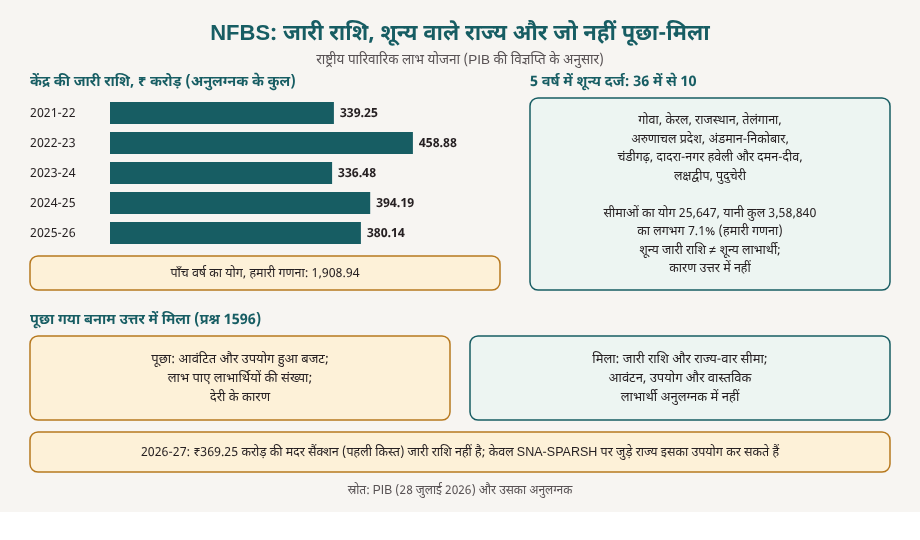
The annexure's "amount released" is money gone from the Centre to states; it is not an allocation, nor does it tell how much reached families. PIB's sentence calls the annexure the "number of beneficiaries (state/UT ceiling)", but per the answer the release is "subject to the state-wise beneficiary ceiling"; i.e. the ceiling is the permitted maximum number, not the count of actual recipients (this is our text-based reading). So these figures do not tell how many families received the benefit.
Key Facts and Figures
| Amount released, Rs crore (PIB 28 July 2026, annexure totals) | 2021-22: 339.25; 2022-23: 458.88; 2023-24: 336.48; 2024-25: 394.19; 2025-26: 380.14. Five-year sum by our calculation: 1,908.94. |
|---|---|
| State ceiling (same annexure's total) | 3,58,840; largest: Uttar Pradesh 73,075, Bihar 35,859, Maharashtra 34,987, Madhya Pradesh 30,826. |
| Budget 2025-26 (PIB, 7 November 2025) | NFBS Rs 659.00 crore; NSAP total Rs 9,652 crore. |
| 2026-27 first instalment (answer 1596) | Mother sanction of Rs 369.25 crore for states/UTs under SNA-SPARSH; only those states/UTs already onboarded on SNA-SPARSH can use it. This is not the same thing as an amount released. |
| Tamil Nadu (answer 1596 and answer 410, 21 July 2026) | In both answers: Rs 8.17 crore in 2024-25, Rs 12.06 crore in 2025-26, ceiling 18,445; 2026-27 first-instalment mother sanction Rs 18.99 crore. |
Checking the Figures: What Matches and What Is Not Comparable
What matches (our calculation): the sum of states' ceilings, 3,58,840, matches the annexure's total exactly. The annual totals for 2021-22 to 2025-26 in the annexure are 339.25, 458.88, 336.48, 394.19 and 380.14; the sum of rows differs from these by 0.01 to 0.03 crore, which is at rounding level. Answer 410's (21 July 2026) 2024-25 and 2025-26 NFBS totals (394.19 and 380.14) and Tamil Nadu's figures match the same annexure.
What looks different but is not comparable: the ratio of the 2025-26 budget Rs 659.00 crore and that year's release Rs 380.14 crore is about 57.7% by our calculation, but this is not a utilisation rate: we have not read the budget figure's distinction between estimate and revised estimate, and an amount released is not a payment. Similarly the 2026-27 mother sanction of Rs 369.25 crore is an authorisation under a new system, so we do not compare it directly with the 2025-26 release.
What we have not resolved: there are two figures for the per-family amount: Rs 20,000 (PIB, November 2025) and Rs 10,000 (NSAP FAQ page, undated). Also whether the "ceiling" means an annual ceiling or a total is not in the answer, and a release is not a payment. So we neither convert releases into a number of families nor say how much of the ceiling was filled.
Significance: Centre and State Roles in Social Security
Proposal-based releases: per the answer, amounts are released on states' proposals, within the ceiling. In the annexure, releases look uneven and in patches (reason not in the answer, only our description): Karnataka zero in 2023-24 and 2024-25, then Rs 47.15 crore in 2025-26; Maharashtra amounts in 2021-22 and 2022-23, then three years of zero. The answer does not state the reason for the zeros.
Those who received nothing in five years: 10 of 36 states/UTs recorded zero in all five years: Goa, Kerala, Rajasthan, Telangana, Arunachal Pradesh, Andaman & Nicobar, Chandigarh, Dadra & Nagar Haveli and Daman & Diu, Lakshadweep, Puducherry. Their ceilings sum to 25,647 (our calculation: about 7.1% of the total ceiling). "Zero released" cannot be derived as "zero beneficiaries", because the answer does not state the reason for zero (no proposal, incomplete proposals or other).
The Centre-state split: per answer 410, under NSAP guidelines the responsibility for identifying/verifying beneficiaries, payment, closure and annual verification lies with the states/UTs concerned. Uttar Pradesh's share of the five-year release is about 36.2% by our calculation, while its ceiling is about 20.4% of the total; this compares two different measures, it is not a measure of performance.
Challenges and What We Have Not Read
What was asked and what came in the answer: the question asked for allocated and utilised budget and the actual number of beneficiaries. The answer has only released amounts and ceilings; allocation, utilisation and actual beneficiaries are not in the annexure. One part of the question asked about reasons for payment delays; the answer says the Centre disposes of complete proposals promptly and requests states to send complete proposals on time, and that remaining states are being helped to onboard SNA-SPARSH. How many proposals are pending is not stated.
Unresolved points: the two per-family amounts, the definition of "ceiling", the reasons for zero releases, and state-wise actual payments are not in the sources. Nor have we read whether the budget figure is an estimate or a revised estimate.
What we have not read: we read the 28 July 2026 PIB release and the official texts of Lok Sabha answers 1596 and 410 (with annexures) in full. We read the NFBS and budget portions of the 7 November 2025 PIB release and the NFBS questions of the NSAP FAQ. NSAP guidelines, the SNA-SPARSH process and state-level payment data were not read.
The Road Ahead
Treat this as dated government information up to 28 July 2026; for actual beneficiaries and utilisation, further information from the NSAP portal or states' data will need to be seen.
Distinction of Concepts
Keep four things separate: (1) budget allocation, the Centre's release, mother sanction and actual payment; (2) a state's ceiling and actual beneficiaries; (3) zero released and zero beneficiaries; (4) PIB's numbers and our calculations.
Mains View
GS-II: welfare schemes, Union-state relations and social security; GS-III: inclusive growth.
UPSC CSE Mains Style: Original Practice Question
What can and cannot be drawn from the Centre's release and state-wise ceiling figures for the National Family Benefit Scheme? What data will be needed to evaluate social security schemes?
(Answer in 150 words) | 10 marks
Outline of the Answer
Introduction: NFBS and NSAP. Main body: the difference between release, ceiling, allocation and utilisation; the five-year trend and inequality across states; the limits of explaining zero releases; Centre-state responsibilities and SNA-SPARSH; needed data. Conclusion: do not treat the Centre's release as proof of actual use or of assistance reaching beneficiaries; test social security's effect by adding the reasons for zero amounts, state-wise utilisation and beneficiary detail.
Frequently Asked Questions (FAQ)
Short answer: in the Cabinet approval of 14 October 2026, NSAP's new name is accepted as Pradhan Mantri Samajik Sahayata Yojana and the National Family Benefit Scheme's new name as Pradhan Mantri Parivar Labh Yojana. The family benefit scheme is stated to continue in its existing form.
Question: What does the article say about the 14 October 2026 approval?
In the Cabinet approval of 14 October 2026, NSAP's new name is accepted as Pradhan Mantri Samajik Sahayata Yojana and the National Family Benefit Scheme's new name as Pradhan Mantri Parivar Labh Yojana. The family benefit scheme is stated to continue in its existing form. Changes in the disability pension are separate; do not read them as changes in this family benefit scheme's assistance. Per the release, the amended guidelines are to be issued and applied within three months.
Question: Why are allocation, release and utilisation kept separate in the National Family Benefit Scheme?
The annexure's "amount released" is money gone from the Centre to states; it is not an allocation, nor does it tell how much reached families. PIB's sentence calls the annexure the "number of beneficiaries (state/UT ceiling)", but per the answer the release is "subject to the state-wise beneficiary ceiling"; i.e. the ceiling is the permitted maximum number, not the count of actual recipients (this is our text-based reading). So these figures do not tell how many families received the benefit.
Question: What is the significance of this subject?
Proposal-based releases: per the answer, amounts are released on states' proposals, within the ceiling. In the annexure, releases look uneven and in patches (reason not in the answer, only our description): Karnataka zero in 2023-24 and 2024-25, then Rs 47.15 crore in 2025-26; Maharashtra amounts in 2021-22 and 2022-23, then three years of zero. The answer does not state the reason for the zeros.
Sources
- https://www.pib.gov.in/PressReleasePage.aspx?PRID=2290671&lang=1®=48 - PIB, status of the National Family Benefit Scheme (Lok Sabha, 28 July 2026)
- https://sansad.in/getFile/lsapps/loksabhaquestions/annex/188/AU1596_7uqFRV.pdf - Lok Sabha unstarred question 1596 and answer, 28.07.2026 (official Parliament PDF; annexure)
- https://sansad.in/getFile/lsapps/loksabhaquestions/annex/188/AU410_fWDCPO.pdf - Lok Sabha unstarred question 410 and answer, 21.07.2026 (official Parliament PDF; annexure III)
- https://pib.gov.in/PressNoteDetails.aspx?ModuleId=3&NoteId=155928 - PIB, press note on the social security framework (7 November 2025; budget 2025-26)
- https://nsap.nic.in/circular.do?method=faq - NSAP portal, FAQ (undated; NFBS question)
- https://www.pib.gov.in/PressReleasepage.aspx?PRID=2323264&lang=1®=48 - PIB, Cabinet decision (14 October 2026)
Download this article: PDF (English)