
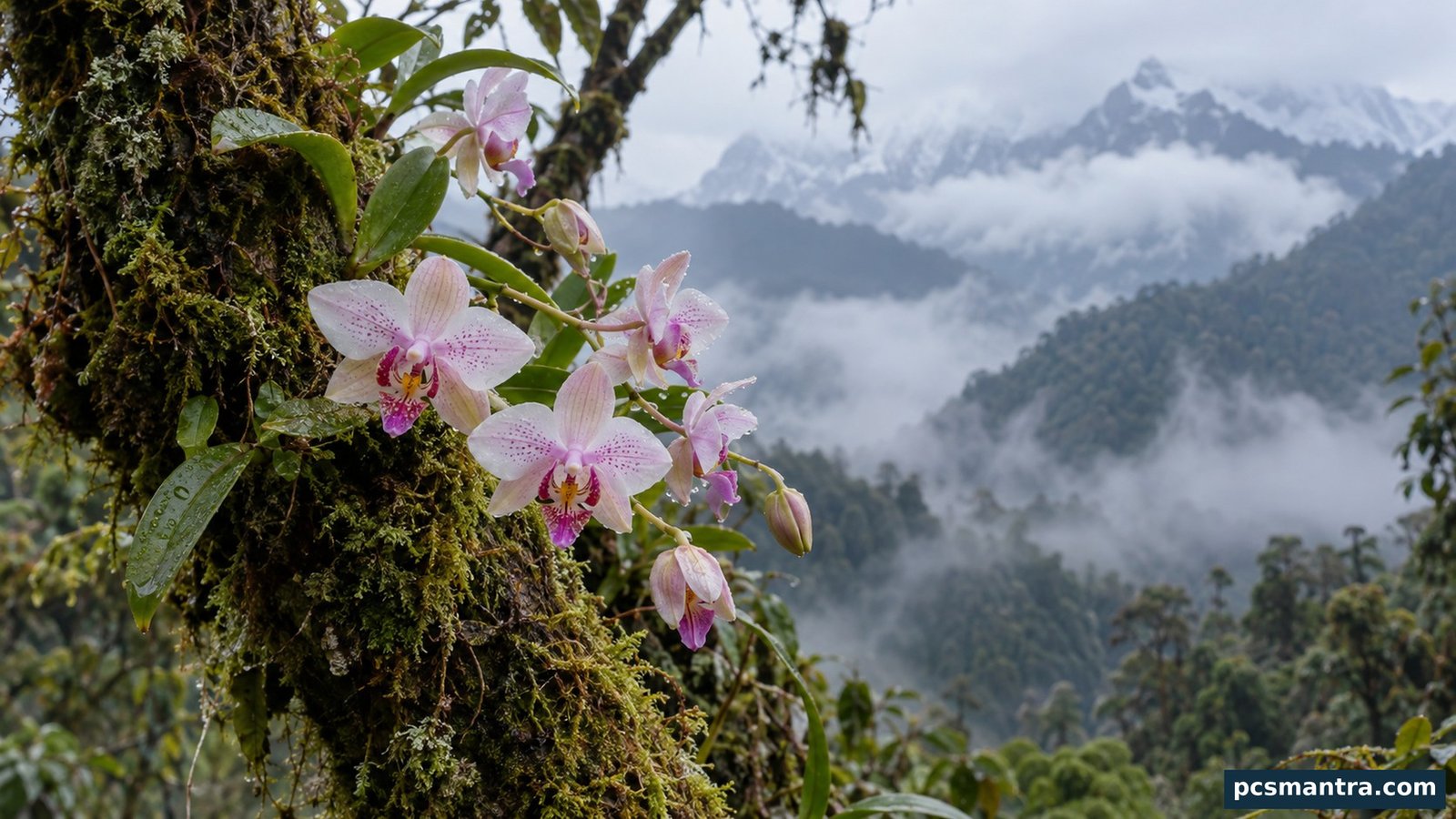
Why in the news
According to organiser Annapurna Research Centre, Nepal's first Orchid Expo is being held from 18 to 20 November 2026 at Park Village Resort, Budhanilkantha, Kathmandu. The centre lists the Orchid Floriculture Group as its collaborator. The fifth International Orchid Symposium is also scheduled in Kathmandu on those dates, as confirmed by the International Society for Horticultural Science, ISHS.
The exhibition and scientific symposium should not be treated as identical programmes with interchangeable organiser lists. The expo connects growers and the wider public; the symposium provides a forum for research. A planned closing declaration should not be reported as an adopted outcome before the event concludes.
Nepal on the map
The Embassy of Nepal in New Delhi identifies Nepal as a South Asian country with land borders with India and China, and Kathmandu as its capital. Nepal does not have a direct land border with Bhutan or Bangladesh.
Kathmandu is the news location. A national estimate of orchid diversity should not be presented as the number of species within Kathmandu city. This article does not fix a single national orchid-species total, since organiser accounts and other compilations can use different counts and scopes.
Conservation and livelihoods
The symposium organisers identify habitat loss, illegal collection and demand for horticultural and medicinal uses as concerns. The announced scientific areas include ecology, pollination, biotechnology, conservation, trade and mycorrhiza.
The policy question has two sides: protecting wild populations and their habitats, and supporting lawful cultivation and trade that can provide livelihoods without encouraging wild collection. Expansion of cultivation does not by itself prove that wild populations are protected. Plant origin and supply-chain monitoring also matter. This is an analytical framework, not a claim that the expo has already delivered measured conservation gains.
CITES: regulation is not always prohibition
CITES regulates international trade. Its official explanation says Appendix II can include species not necessarily threatened with extinction, but for which trade must be controlled to prevent use incompatible with survival. Listing should not be translated into a universal ban in every circumstance.
For a real orchid shipment, the species, appendix, product and applicable annotation or exemption must be checked. Describing a plant as nursery-grown does not automatically remove every requirement.
Prelims practice
Question 1
Consider the following statements about Nepal:
Statement 1: It shares land borders with India and China.
Statement 2: Kathmandu is its capital.
Statement 3: It shares a direct land border with Bangladesh.
Which statements are correct?
Answer and Explanation
Correct answer: (b)
The Embassy of Nepal identifies India and China as its land neighbours and Kathmandu as its capital. Statement 3 is incorrect.
Question 2
Which statement about CITES is correct?
Answer and Explanation
Correct answer: (c)
The official CITES explanation describes necessary trade controls, not an unconditional ban in all circumstances.
Sources
- Organiser, expo and venue: https://www.annapurnaresear.ch/about-1-1
- Organiser, scientific symposium: https://www.annapurnaresear.ch/internationalorchidsymposium
- ISHS event dates and listing: https://ishs.org/symposium/815/
- Embassy of Nepal, country introduction: https://in.nepalembassy.gov.np/content/11/about-nepal/
- CITES appendices and trade procedure: https://cites.org/eng/disc/how.php
Frequently asked questions
Which countries share Nepal's land borders?
Nepal shares land borders with India and China. Kathmandu is its capital.
Does CITES Appendix II always mean a complete trade ban?
No. It concerns necessary trade controls and should not be read as an unconditional total ban in every situation.
Download this article: PDF

PCSMANTRA Editorial Team
Research and Editing
We prepare current affairs analysis, exam updates and study material in Hindi and English for UPSC, State PCS, PCS-J and other competitive examinations. Every article is verified against official sources before publication; sources are listed at the end of each article.
Read our editorial policy