
Why in News
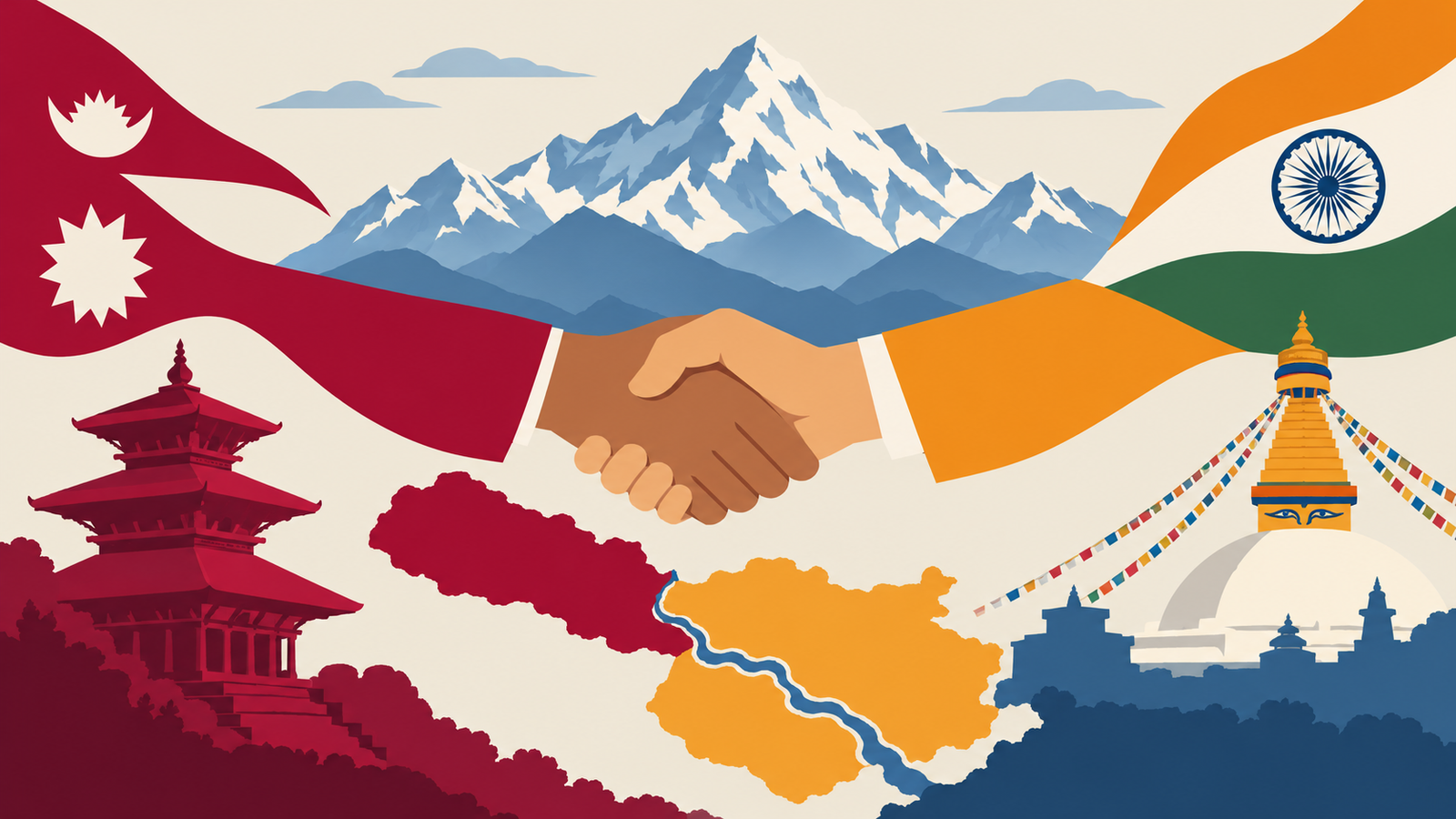
Nepal's Prime Minister Balendra Shah begins a three-day visit to India on 22 November 2026 - his first bilateral trip since taking office in March. Ahead of the visit, former diplomats and border experts in Kathmandu have urged Shah to make the long-stalled Kalapani, Lipulekh, Limpiyadhura and Susta border disputes a priority in talks with the Indian leadership (OnlineKhabar, 16 November 2026).
Background to the Visit
- How it was decided: during Indian Foreign Secretary Vikram Misri's Kathmandu visit (5-6 November), Shah accepted Prime Minister Modi's invitation, saying he wants a "result-oriented" visit - a U-turn from his earlier decision not to travel abroad in his first year.
- Agenda: review of regular talks on water resources, energy, trade, transit and aviation; possible agreements on new initiatives. Shah thanked India and PM Modi for being the "first responder" during Nepal's destructive August flash floods.
- Nepal's wishlist: former ambassador Dinesh Bhattarai has advised putting five issues on the visit agenda; the border dispute is the most sensitive.
The Border Dispute: Two Distinct Layers
- Territorial claims: under the 1816 Treaty of Sugauli, land east of the Kali (Mahakali) river is Nepal's; Nepal holds the river originates at Limpiyadhura and claims the Limpiyadhura-Kalapani-Lipulekh area; India disagrees on the river's source, and Indian security forces are stationed in Kalapani. After India's new political map (November 2019) and the Lipulekh road inauguration (May 2020), Nepal's Parliament endorsed a revised map.
- Encroachment / no-man's land: damaged or missing boundary pillars and encroachment into no-man's land - these can be settled by the joint-secretary-level Joint Working Group on Border Management; experts warn against conflating the two categories.
- A stalled mechanism: the foreign-secretary-level mechanism agreed during PM Modi's first Nepal visit in 2014 has never met. Signing of the 182 jointly prepared strip maps remains pending; experts say formalising them could resolve ~98% of boundary issues.
- Tri-junction: after the India-China agreement (April) to reopen the Kailash Mansarovar route via Lipulekh, fixing the Nepal-India-China tri-junction is a priority - Nepal was not consulted.
Why It Matters
- GS-II International: a 1,751-km border according to India's Ministry of Home Affairs, deep people-to-people ties and demands to review the 1950 Treaty - a standing UPSC dimension of India-Nepal relations.
- The China factor: the Kalapani-Lipulekh tri-junction and Nepal's absence from India-China arrangements add diplomatic complexity.
- Resolution models: the India-Bangladesh Land Boundary Agreement (2015) and the Nepal-China boundary treaty (1961) show sustained high-level dialogue can settle disputes.
Prelims Practice Questions
Q1. The Limpiyadhura-Kalapani-Lipulekh dispute is tied to the origin of which river?
(a) Gandak
(b) Kosi
(c) Kali (Mahakali)
(d) Karnali
Answer and Explanation
Answer: (c) Under the Treaty of Sugauli (1816), territory east of the Kali is Nepal's; Nepal holds the river originates at Limpiyadhura, India disagrees.
Q2. Which treaty underlies the delineation of the India-Nepal boundary?
(a) Treaty of Peace and Friendship, 1950
(b) Treaty of Sugauli, 1816
(c) Nepal-Britain Treaty, 1923
(d) Boundary Treaty, 1961
Answer and Explanation
Answer: (b) The 1816 Treaty of Sugauli fixed Nepal's boundaries after the Anglo-Nepalese war; the Kali river became the border. (The 1961 treaty is Nepal-China.)
Mains Practice Question
Q: "India-Nepal relations are bigger than their border disputes, but the disputes cannot be wished away." Comment in the context of PM Balendra Shah's India visit and suggest a path to resolving the boundary question. (250 words)
Outline: Introduction - the 22 November visit and expectations; layers of the dispute - Kalapani claims vs encroachment; mechanisms - foreign-secretary mechanism, strip maps, JWG; lessons - Bangladesh LBA 2015, Nepal-China 1961; the China factor; conclusion - evidence-based, sustained dialogue through a time-bound mechanism.
FAQ
Short answer: Nepal PM Balendra Shah visits India for three days from 22 November - his first bilateral trip in office. Experts want the Kalapani-Lipulekh-Limpiyadhura-Susta dispute prioritised; the 2014 foreign-secretary-level mechanism has never met.
Q: Why is Shah's visit significant?
It is his first bilateral foreign visit since taking office in March; he had earlier said he would not travel abroad in his first year. The visit was firmed up after Foreign Secretary Misri carried PM Modi's invitation to Kathmandu.
Q: What are the main border disputes?
Kalapani, Lipulekh, Limpiyadhura (territorial claims over the Kali river's origin under the Sugauli Treaty) and Susta; plus no-man's-land encroachment and damaged boundary pillars. The 182 strip maps await formal signing.
Q: What resolution examples exist?
The India-Bangladesh Land Boundary Agreement (2015, including enclaves) and the Nepal-China boundary treaty (1961) - both settled through sustained high-level diplomacy; experts say signing the strip maps could resolve about 98% of boundary issues.
Sources
- OnlineKhabar (16 November 2026, Kathmandu): border dispute back in focus ahead of Shah's India visit
- Indian Express (6 November 2026): Nepal PM Balendra Shah to visit India from November 22
- Kathmandu Post (15 November 2026): Bhattarai's five-issue advice
Download this article: PDF (English)