
Polity and elections | News context: Supreme Court decision, 16 July 2026 | Published: 18 October 2026
Background and Context
Some members of a state's Legislative Council are elected from an electorate of local authorities. Article 171(3)(a) of the Constitution calls this electorate "members of municipalities, district boards and such other local authorities as Parliament may by law specify" (text of the Constitution, version up to May 2022). The question was whether government-nominated members also count in this.
Why in the News
In a decision delivered on 16 July 2026 (P.M.K. v. A.V. Gayatri Shantegowda, 2026 INSC 716), the Supreme Court said nominated members appointed under Section 352(1)(b) of the Karnataka Municipalities Act were not entitled to be included in the electoral roll of the local authorities' constituency. The case was the 2021 Legislative Council election from the Chikmagalur local authorities' constituency; appeals against the Karnataka High Court's order were dismissed (the text of the decision was read from the Supreme Court's site).
Core Concept: Elected vs Nominated Members
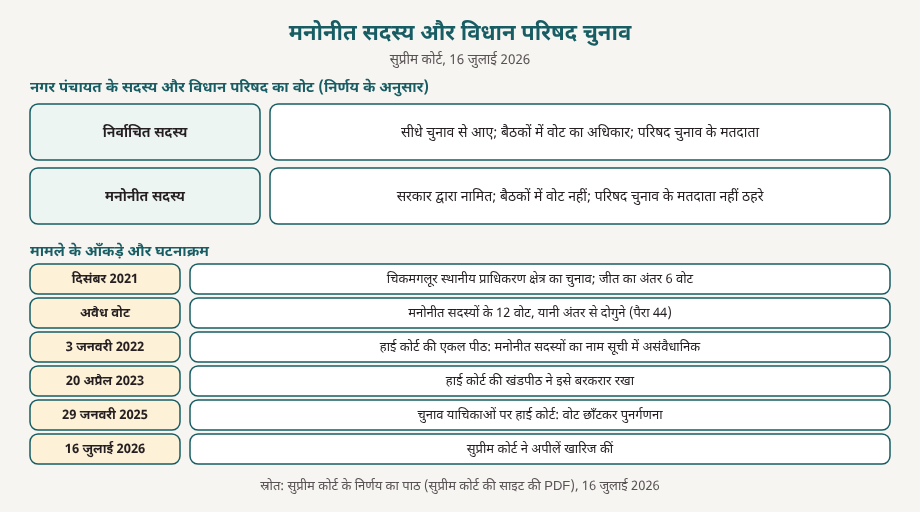
Under Article 243-R(1), the seats of a municipality, except the exception in clause (2), are filled by direct election; persons with special knowledge or experience under clause (2)(a)(i) do not have the right to vote in the municipality's meetings. The same point is in the proviso of the Karnataka Municipalities Act quoted in the decision for nominated members of town panchayats. The Court said a person who cannot vote in the municipality's own decisions cannot be a voter electing a member of the Legislative Council. So "members" in Article 171(3)(a) means elected representatives with voting rights.
Key Facts and Figures
| Decision | P.M.K. v. A.V. Gayatri Shantegowda and Others, Civil Appeals Nos. 9032-9034 and 9035-9037/2026, 16 July 2026, 2026 INSC 716; judgment written by Justice Vipul M. Pancholi (PDF from the Supreme Court's site) |
|---|---|
| Bench | Per the decision's signature section, Chief Justice Suryakant, Justice Joymalya Bagchi and Justice Vipul M. Pancholi |
| Election and margin | December 2021, Chikmagalur local authorities' constituency (Karnataka Legislative Council); victory margin 6 votes, nominated members' 12 votes (para 44 of the decision) |
| Appellants' argument | Article 171(3)(a) and Section 27(2)(b) of the Representation of the People Act, 1950 use the word "members", with no elected-nominated distinction; the electoral roll had become final; and sifting nominated members' votes would breach secrecy |
| Court's reasoning | Article 171 read with 243-R; by the literal meaning a nominated member would get more power than the municipality itself (in para 36's words, an "unreasonable consequence") |
| The finality argument | The Court said past decisions dealt with ordinary errors; here inclusion was unconstitutional and void from the start, touching the composition of the electorate (para 40) |
| Material effect | Section 100(1)(d)(iii) of the Representation of the People Act, 1951: margin 6 and invalid votes 12, so a "material effect" on the result was held proved (para 44) |
| Order | Appeals dismissed; the sealed recount report and the corrected result to be sent to the High Court's Registrar General, with a direction to act on the High Court's directions within 30 days (paras 49-50) |
Three Separate Things: Text, Purpose and Process
Text vs coherence: the literal text of Article 171(3)(a) says "members". The Court read it with Article 243-R and took "members" to mean only elected members. This is an example of purposive and harmonious interpretation.
Time and the courts: per the decision, keeping nominated members on the electoral roll was held unconstitutional by a single bench of the High Court on 3 January 2022 and by a division bench on 20 April 2023, and no stay operated on it. In the 29 January 2025 order on the election petitions, the High Court directed a recount after sifting out the nominated members' votes.
Secrecy: the Court said the secrecy of voting is not absolute and cannot be invoked to protect unconstitutionality; the recount is confined to removing the void votes (paras 45-46).
Why This Subject Matters
Local self-government and the Council: the Legislative Council's local-authorities constituencies are the institutional link between local bodies and the state legislature. The decision fixes who that link's voter is: an elected representative accountable to the people, not an appointee of the government.
The doctrine of voidness in elections: where an illegality touches the electorate's composition itself, neither the finality of the roll nor the secrecy of the vote shields it. In mains this is a clean example of the constitutional supremacy over electoral process technicalities.
Distinction of Concepts
(1) Nominated member vs elected member - one is appointed, the other chosen by direct election; only the second has voting rights in the body and, per this decision, in the Council electorate. (2) Error in the roll vs unconstitutional composition - the first can survive finality; the second is void from the start. (3) Secrecy of vote vs validity of vote - secrecy protects choice, not an invalid voter.
Mains View
GS-II: state legislatures, local self-government (73rd/74th amendments), elections and the RP Acts. In answers keep the facts (2026 INSC 716; margin 6, votes 12; Articles 171(3)(a), 243-R) with the interpretation method.
UPSC CSE Mains Style: Core Practice Question
Reading Article 171(3)(a) with Article 243-R, the Supreme Court held nominated members of municipalities ineligible for the Legislative Council's local-authorities electorate. Discuss the interpretive method and its implications for the link between local bodies and state legislatures.
(Answer in 150 words) | 10 marks
Outline of the Answer
Introduction: the 2026 INSC 716 decision and its question. Main body: the harmonious-reading method (171 + 243-R); voting rights as the test; void composition vs finality/secrecy; implications - elected accountability in Council electorates; limits (state-law specific). Conclusion: interpretation that keeps the democratic chain intact.
Frequently Asked Questions (FAQ)
Short answer: per the text of the decision, nominated members of a town panchayat will not count in the local-authorities electorate of a Legislative Council election; the scope has been read as confined to Karnataka's law.
Question: What did the Supreme Court say on nominated members' voting right?
In its 16 July 2026 decision (P.M.K. v. A.V. Gayatri Shantegowda, 2026 INSC 716), the Supreme Court said nominated members appointed under Section 352(1)(b) of the Karnataka Municipalities Act were not entitled to be included in the electoral roll of the local authorities' constituency. The case was the 2021 Legislative Council election from the Chikmagalur local authorities' constituency; appeals against the Karnataka High Court's order were dismissed.
Question: What is the difference between elected and nominated members' voting rights in Council elections?
Under Article 243-R(1) a municipality's seats are filled by direct election, barring the clause (2) exception; persons with special knowledge or experience under clause (2)(a)(i) have no vote in the municipality's meetings. The Court said one who cannot vote in the municipality's own decisions cannot be a voter electing a Council member. So "members" in Article 171(3)(a) means elected representatives with voting rights.
Question: Why did the vote-secrecy and final-roll arguments fail?
The Court held the inclusion of nominated members unconstitutional and void from the start, which touches the electorate's composition; neither the roll's finality nor voting secrecy protects a void inclusion (paras 40, 45-46).
Download this article: PDF (English)