
Why is this in the news?
An Indian Express report on November 17 said Indian Oil's commercial-scale sustainable aviation fuel unit at its Panipat refinery was ready for production. Citing the IOC chairman, it reported annual capacity of 30,000 tonnes, a first batch on November 16 and the required DGCA approvals. These plant details are attributed to the company's statements in the report.
The development matters alongside India's indicative SAF blending targets for international flights and the international aviation framework CORSIA. Annual installed capacity should not be confused with actual production in a particular year.
What is SAF?
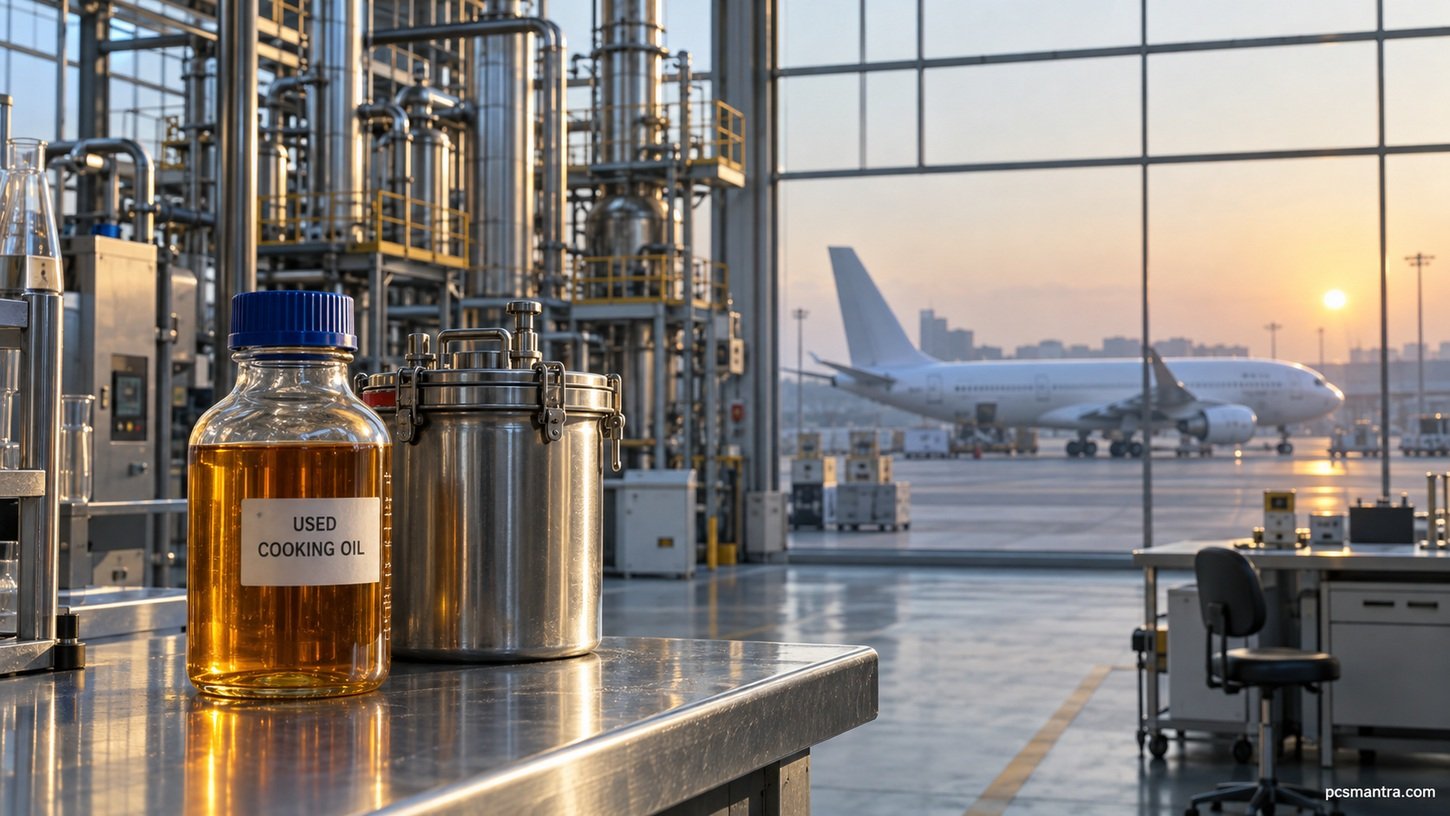
Sustainable Aviation Fuel consists of specially processed aviation-grade hydrocarbons chemically similar to conventional Aviation Turbine Fuel. Alternative feedstocks can include biogenic residues, waste materials and other suitable sources. The Panipat unit reportedly uses used cooking oil.
SAF does not mean pouring raw biological oil directly into an aircraft. Processing, quality testing, approved production pathways and standards-compliant blending are necessary. Safety and engine compatibility depend on certified properties, not a green label.
Why used cooking oil matters
Used cooking oil can serve as an input in a waste-based supply chain. Converting it into a higher-value fuel can support a circular economy. Collection, source verification, quality and adequate availability nevertheless remain practical requirements.
Waste is not a synonym for unlimited or costless feedstock. Traceable supply, processing capacity and credible certification are needed. Life-cycle emissions also depend on the feedstock and production pathway, rather than being established by the SAF label alone.
India's indicative blending targets
A PIB release of April 23, 2026 lists indicative SAF blending targets in ATF for international flights:
- 1% in 2027
- 2% in 2028
- 5% in 2030
These should not be described as an immediate general obligation for all domestic flights. India's blending policy and CORSIA's international offsetting framework are related but distinct. CORSIA does not itself impose a universal 1% SAF blend on every aircraft worldwide.
The ATF Control Order change
PIB says an April 17, 2026 notification expanded the Aviation Turbine Fuel (Regulation of Marketing) Order, 2001 to cover SAF-blended fuel. It includes SAF co-processed with ATF in refineries and qualifying SAF blended with ATF under the specified standards.
The official account refers to IS 1571 and IS 17081. Meeting fuel-quality standards and meeting CORSIA sustainability criteria are separate tests. Approval for aviation use does not automatically make a fuel a CORSIA-eligible fuel.
CORSIA: purpose, phases and baseline
The Carbon Offsetting and Reduction Scheme for International Aviation is ICAO's market-based framework for international aviation. Eligible emissions units offset emissions that cannot be reduced through technology, operational improvements and eligible fuels.
ICAO's FAQ lists a pilot phase in 2021-2023, a first phase in 2024-2026 and a second phase in 2027-2035. State participation in the first two is voluntary. The second has wider mandatory participation, subject to the applicable criteria and exemptions. India's government has stressed preparedness for January 1, 2027.
Exam caution: the baseline for 2021-2023 is covered international aviation CO₂ emissions in 2019. For 2024-2035 it is 85% of those covered 2019 emissions. Describing the current baseline as 2020 emissions is inconsistent with ICAO's FAQ. CORSIA should not be treated as a scheme covering all domestic flights.
Opportunity and constraints
SAF can create an industrial opportunity around fuel production, waste collection and certification. Cost, sustainable feedstock availability, fuel quality, life-cycle accounting and airline affordability still have to be balanced. Planned future units mentioned in a report should not be counted as operating production today.
Aviation decarbonisation also requires more efficient aircraft, operational improvements and credible carbon accounting. SAF is better understood through its certified life-cycle benefits and eligibility conditions than described as a zero-emission fuel.
Prelims Practice Questions
Question 1. Consider the following statements about Panipat SAF and India's targets:
Statement 1: The plant reportedly uses used cooking oil as feedstock.
Statement 2: India's indicative SAF blending target for international flights is 5% in 2030.
Statement 3: SAF must meet the prescribed quality and safety requirements for aviation use.
How many of the above statements are correct?
Answer and Explanation
Correct answer: (c)
All three are correct. Used cooking oil is the reported Panipat feedstock. PIB lists a 5% indicative target for international flights in 2030. Aviation use remains subject to standards and certification.
Question 2. Consider the following statements about CORSIA:
Statement 1: It is an ICAO framework relating to international aviation.
Statement 2: Its baseline for 2024-2035 is 85% of covered international aviation CO₂ emissions in 2019.
Statement 3: It automatically mandates a 1% SAF blend for every domestic flight.
Which of the statements given above are correct?
Answer and Explanation
Correct answer: (a)
Statements 1 and 2 follow ICAO's FAQ. Statement 3 is incorrect: CORSIA relates to international aviation; India's indicative blending targets are not a universal CORSIA rule applying to every domestic flight.
Mains Practice Question
Discuss the opportunities and constraints in developing India as a production hub for sustainable aviation fuel. (150 words)
Answer Outline
Growing interest in aviation decarbonisation creates an opportunity for SAF production and clean industrial supply chains in India.
Opportunities: waste-based value chains, refinery capabilities and international demand.
Constraints: cost, sustainable feedstock supply, collection and traceability, quality and life-cycle accounting.
Policy: connect indicative targets with reliable supply, certification and affordability; distinguish domestic blending policy from CORSIA compliance.
Success depends on certified emissions benefits, sustainable resources and economic viability, rather than installed capacity alone.
Frequently Asked Questions (FAQ)
What feedstock does the Panipat unit use?
The Indian Express, citing IOC's chairman, reports used cooking oil and capacity of 30,000 tonnes per year.
Is SAF the same as raw bio-oil?
No. It is processed aviation-grade fuel subject to prescribed quality, safety and certification requirements.
What is India's 2030 SAF target?
PIB lists an indicative 5% SAF blend in ATF for international flights in 2030.
Is CORSIA's current baseline 2020 emissions?
No. ICAO's FAQ states that the 2024-2035 baseline is 85% of covered international aviation CO₂ emissions in 2019.
Sources
Download this article: PDF