
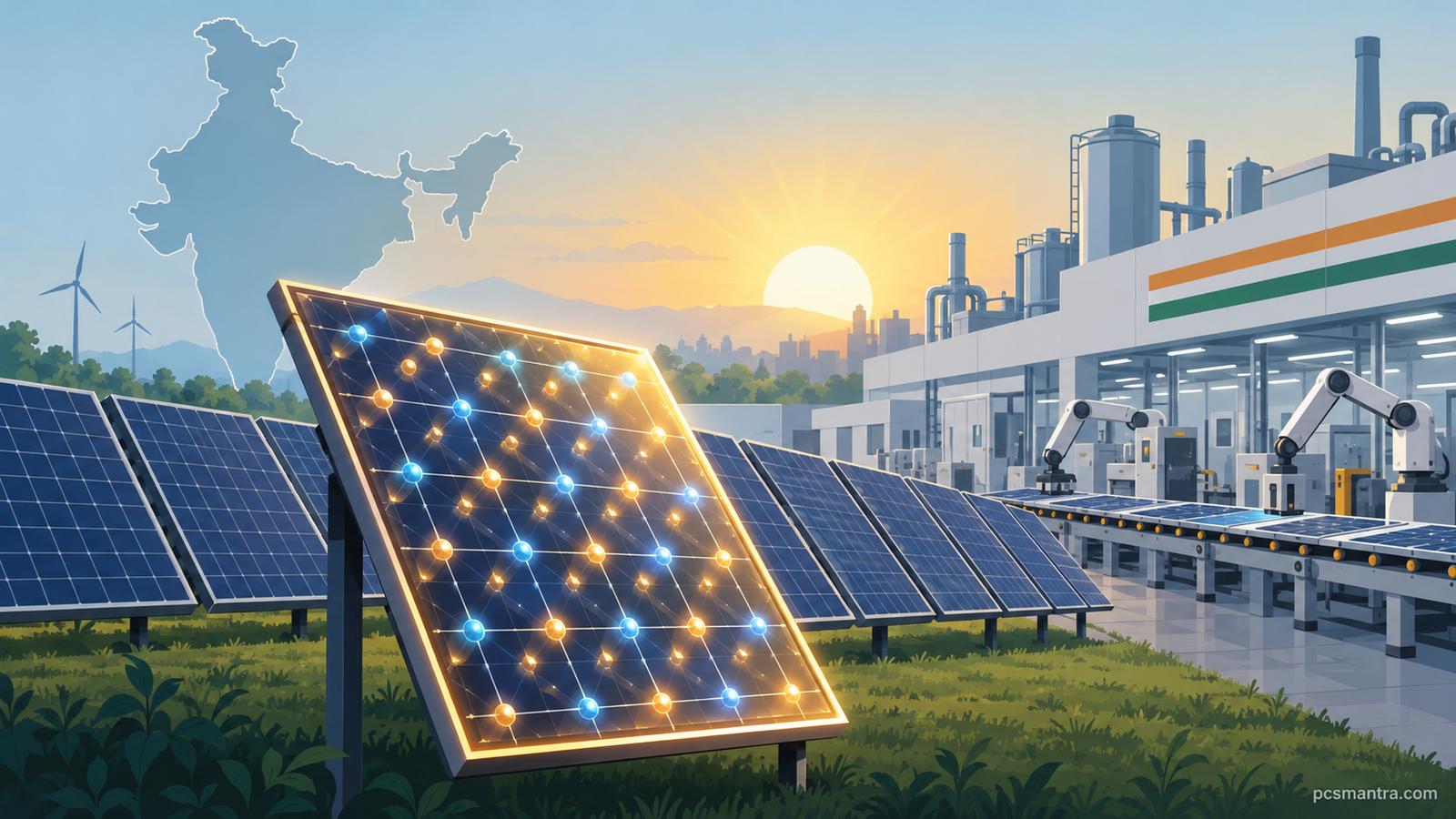
15 November 2026: An analysis in The Hindu (13 November 2026) argues that despite the competitiveness of perovskite solar technology, India must now move towards domestic manufacturing - especially as China tightens controls over technologies in this field. Metal-halide perovskites are seen as the "next generation" of solar cells, but India remains import-dependent.
Why perovskite technology is special
- Structure: The active layer of metal-halide perovskite is just a few hundred nanometres thick (versus about 180 microns for conventional silicon cells) - far less raw material.
- Low-temperature processing: Can be made below 200 degrees Celsius; silicon needs over 1,000 degrees - cutting energy costs.
- Flexibility: Thin, light, semi-transparent and flexible panels are possible - usable on building facades, vehicles and wearables.
- Efficiency: Lab-scale perovskite-silicon tandem cells have crossed silicon's theoretical single-junction limit (about 29%).
- Challenges: Durability (degradation from moisture, heat and UV), lead toxicity, and uniformity at manufacturing scale - commercial lifespans still lag silicon.
The strategic context for India
- China's controls: China has tightened export controls on perovskite and advanced solar technologies - the supply-chain risk is clear.
- Domestic position: India's solar manufacturing is confined to silicon modules; in the global perovskite race, institutions like IIT Bombay's NCPRE (National Centre for Photovoltaic Research and Education) are setting efficiency records, but there is no industrial-scale production.
- What is needed: Government backing (R&D funding, PLI-type incentives), testing and certification facilities, and industry-academia partnerships - so that lab success reaches the factory.
- Energy security: Next-generation cell technology is decisive for the 500 GW non-fossil target for 2030 and for cutting import dependence.
Quiz: Test your knowledge
Q1: Consider the following about perovskite solar cells: 1. Their active layer is much thinner than that of conventional silicon cells 2. They must be manufactured above 1,000 degrees Celsius 3. Flexible and semi-transparent panels are possible. Which are correct?
(a) 1 and 2 only
(b) 2 and 3 only
(c) 1 and 3 only
(d) 1, 2 and 3
Answer and explanation: (c) Statements 1 and 3 are correct; perovskite cells can be made below 200 degrees Celsius - high temperatures are needed for silicon.
Q2: NCPRE (National Centre for Photovoltaic Research and Education) is located at:
(a) IIT Delhi
(b) IIT Madras
(c) IIT Bombay
(d) IISc Bengaluru
Answer and explanation: (c) IIT Bombay - funded by the Ministry of New and Renewable Energy; it has driven notable gains in perovskite cell efficiency.
Frequently Asked Questions (FAQ)
In short: Perovskite is next-generation solar technology - thin, cheap and flexible; amid Chinese controls, India needs investment in domestic manufacturing, R&D and testing facilities.
Question: What is a perovskite solar cell?
A solar cell made from metal-halide perovskite material - an active layer only a few hundred nanometres thick, manufacturable below 200 degrees Celsius, with the possibility of flexible and semi-transparent panels.
Question: Why should India push perovskite manufacturing?
China has tightened export controls on related technologies; without domestic manufacturing, India's solar supply chain stays at risk - government support, PLI and testing facilities are essential.
Question: What are the main weaknesses of perovskite cells?
Degradation from moisture, heat and UV (durability), lead toxicity, and uniformity in large-scale production - commercial lifespan still trails silicon.
Sources:
- https://www.thehindu.com/sci-tech/science/potent-perovskites-demand-india-make-domestic-manufacturing-push/article71687229.ece
- https://www.ncpre.iitb.ac.in/ncpre/highlights-link/NCPRE-advances-perovskite-solar-cell-efficiency-towards-commercialization-with-cost-effective-innovations.php
Download this article: PDF (English)