
Why in the news
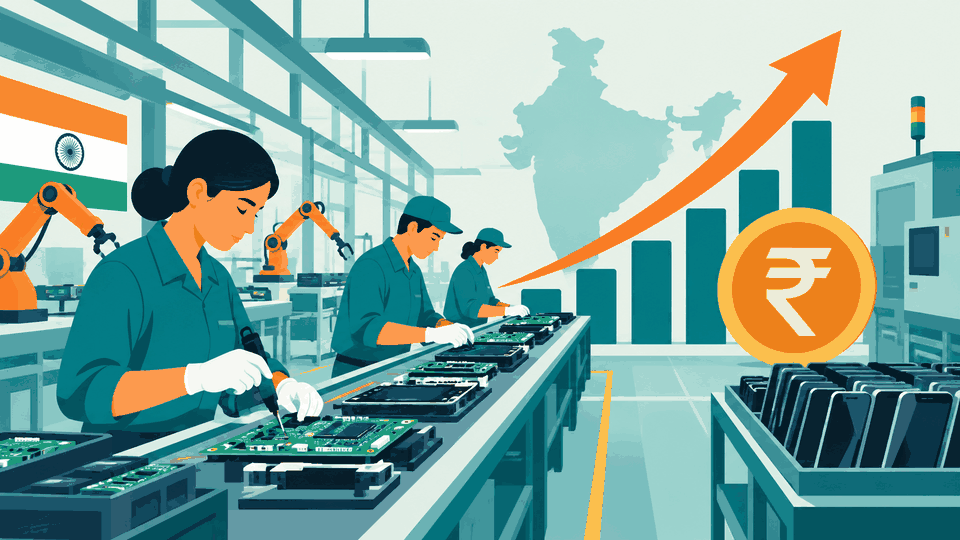
12 November 2026: NITI Aayog and the Indian Institute of Management (IIM) Ahmedabad released an impact assessment of the Production-Linked Incentive (PLI) schemes. According to the report, cumulative incentive disbursals under the 14 PLI schemes notified in 2020 stood at just 18.51 per cent of the total outlay as of March 2026 - about Rs 35,354 crore out of roughly Rs 1.91 lakh crore. At the same time, the schemes have attracted Rs 2.40 lakh crore of investment, generated production worth Rs 22.66 lakh crore and created employment for over 8.49 lakh people. The assessment is in the news because PLI is regarded as the foundation of India's manufacturing-led growth strategy.
The PLI scheme: design and objectives
Launch: Beginning in 2020 with mobile phones and bulk drugs, the PLI schemes gradually expanded to 14 sectors - electronics, pharmaceuticals, telecom, textiles, automobiles, steel, drones, food processing, solar modules, batteries and more. The total outlay is about Rs 1.91 lakh crore.
Design: The incentive is not paid as a front-loaded amount. A company must first achieve specified investment, production and other eligibility thresholds; only then is a fixed percentage of incentive released on incremental sales or production. This performance-linked design separates the scheme from older subsidy programmes.
Goals: Build domestic manufacturing capacity, cut import dependence, raise India's share in global value chains and create jobs.
Key findings of the assessment
Investment and production: As of March 2026, the schemes had attracted Rs 2.40 lakh crore of actual investment - about 76 per cent of the target - and production worth Rs 22.66 lakh crore, roughly 64 per cent of the production goal. More than 8.49 lakh jobs were created.
Segments on track: According to the report, nearly 70 per cent of the targeted segments are broadly on track, with particularly strong outcomes in electronics, telecom and pharmaceutical drugs.
The disbursal picture: Nine of the 14 schemes - including bulk drugs, automobiles and textiles - saw disbursals of less than 10 per cent of their respective outlays. In contrast, the drones and drone-components, large-scale electronics manufacturing (LSEM) and food-products schemes saw disbursals between 25 and 77 per cent.
Why disbursals are modest
The report says the modest share of cumulative disbursal is consistent with the scheme's design, under which incentives are released only when specified thresholds are met, not in advance. As companies expand capacity and meet progressively higher performance thresholds, disbursals are expected to rise over the scheme tenures. Besides, not all schemes took effect in 2020; several have long gestation periods, so their disbursal cycle naturally lags.
Concerns and sectoral unevenness
The import question: The assessment also records the criticism that some schemes - electronics manufacturing in particular - have been accompanied by a sharp rise in component imports. The rapid growth of mobile-phone manufacturing has remained largely assembly-driven, limiting deeper value addition and employment generation.
Uneven performance: Long approval processes, an inadequate domestic component base and swings in global demand have kept performance slow in some sectors. This unevenness shows that one design does not work equally across sectors.
Way forward
The assessment recommends reforms: deepening the domestic base for components and raw materials, linking incentives to stages of value addition beyond assembly, reviewing the eligibility thresholds of slower schemes and placing special emphasis on export capability. The next test will be whether the pace of disbursals catches up with the pace of investment and production in the coming years.
Prelims practice questions
Question 1. With reference to the Production-Linked Incentive (PLI) schemes, consider the following statements:
1. These schemes were notified in 2020 and their total outlay is about Rs 1.91 lakh crore
2. As of March 2026, cumulative incentive disbursals under them exceeded 50 per cent of the total outlay
3. Disbursals under the drones, large-scale electronics manufacturing and food-products schemes stood between 25 and 77 per cent of their outlays
How many of the above statements are correct?
(a) Only one
(b) Only two
(c) All three
(d) None
Answer and explanation
Answer: (b)
Statement 1 is correct - the PLI schemes were notified in 2020 with a total outlay of about Rs 1.91 lakh crore. Statement 2 is not correct - as per the NITI Aayog-IIM Ahmedabad assessment, cumulative disbursals as of March 2026 were only 18.51 per cent of the outlay (Rs 35,354 crore). Statement 3 is correct - the drones, LSEM and food-products schemes saw disbursals of 25-77 per cent, while nine schemes remained below 10 per cent.
Question 2. With reference to the design of the PLI schemes, consider the following statements:
1. Incentives under these schemes are given to companies as front-loaded amounts
2. According to the NITI Aayog-IIM Ahmedabad assessment, nearly 70 per cent of the targeted segments are broadly on track
Which one of the following is correct in respect of the above statements?
(a) Statement 1 is correct, but Statement 2 is not correct
(b) Statement 1 is not correct, but Statement 2 is correct
(c) Both Statement 1 and Statement 2 are correct
(d) Neither Statement 1 nor Statement 2 is correct
Answer and explanation
Answer: (b)
Statement 1 is not correct - PLI incentives are performance-linked; a company must first achieve specified investment, production and eligibility thresholds before the incentive is released on incremental sales or production. Statement 2 is correct - the assessment finds nearly 70 per cent of targeted segments broadly on track, especially electronics, telecom and pharmaceutical drugs.
Mains practice question
Question: "The performance-linked design of the PLI scheme is both its greatest strength and the reason for its slow disbursals." Examine this statement in the light of the NITI Aayog-IIM Ahmedabad assessment and suggest measures to make the scheme more effective. (250 words, 15 marks)
Answer outline:
In the introduction: The 14 PLI schemes notified in 2020 - Rs 1.91 lakh crore outlay; disbursals at 18.51 per cent as of March 2026, yet Rs 2.40 lakh crore of investment and Rs 22.66 lakh crore of production.
In the body: Strengths of the design - incentives only after specified investment-production thresholds are met, curbing subsidy misuse and rewarding real performance; nearly 70 per cent of segments on track. The other side - nine schemes below 10 per cent disbursal; long gestation periods, rising component imports, assembly-led mobile manufacturing limiting value addition and jobs. Measures - deepen the domestic component base, link incentives to value-addition stages, review thresholds of slower schemes, focus on export capability.
In the conclusion: The design is ultimately vindicated by investment-production outcomes, but targeted corrections are essential to remove sectoral unevenness.
Frequently Asked Questions (FAQ)
Short answer: According to the NITI Aayog-IIM Ahmedabad assessment, cumulative disbursals under the 14 PLI schemes stood at 18.51 per cent of the outlay (Rs 35,354 crore) as of March 2026, while the schemes attracted Rs 2.40 lakh crore of investment and Rs 22.66 lakh crore of production.
Question: When was the PLI scheme launched and across how many sectors?
Notified in 2020, it gradually expanded to 14 sectors; the total outlay is about Rs 1.91 lakh crore.
Question: How much incentive had been disbursed under PLI as of March 2026?
18.51 per cent of the total outlay, about Rs 35,354 crore; nine schemes saw disbursals of less than 10 per cent.
Question: What explains the low disbursals?
The performance-linked design of the scheme - incentives are not front-loaded but released only when specified investment-production thresholds are achieved; several schemes also have long gestation periods.
Sources
- https://www.pib.gov.in/PressReleseDetailm.aspx?PRID=2335594&lang=1®=3
- https://indianexpress.com/article/business/pli-scheme-disbursals-below-20-percent-niti-report-10960635/
- https://economictimes.indiatimes.com/news/economy/policy/pli-schemes-achieve-76-of-investment-target-64-of-production-goal-niti-aayog/articleshow/135781420.cms