
Energy / housing / central financial assistance | News context: two Lok Sabha answers on PM Surya Ghar: Muft Bijli Yojana, 29 July 2026 | Published: 18 October 2026
Background and Context
Under PM Surya Ghar: Muft Bijli Yojana (PMSG: MBY), Central Financial Assistance (CFA) is given for installing rooftop solar (RTS) systems on homes. Per the answers the scheme began in February 2024, it is demand-based, and the process from application on the national portal to payment of assistance is online. This article rests on two Lok Sabha answers and their annexures.
Why in the News
On 29 July 2026, Minister of State for New and Renewable Energy and Power Shripad Yesso Naik answered Lok Sabha unstarred questions 1698 (Dr. Prabha Mallikarjun; "Review of Progress of Rooftop Solar Installations") and 1612 (Haribhai Patel and several members; "Implementation of PM-SGMBY"). The questions asked state-wise progress, the number of households, assistance released, obstacles and steps for improvement; question 1612 also asked for sanctioned assistance, the average disposal time for assistance, district-wise detail, the target timeline, emission reduction and the detail of the Sidhi Lok Sabha constituency.
Core Concept: The Counts of "Installations" and "Households" Are Not Alike
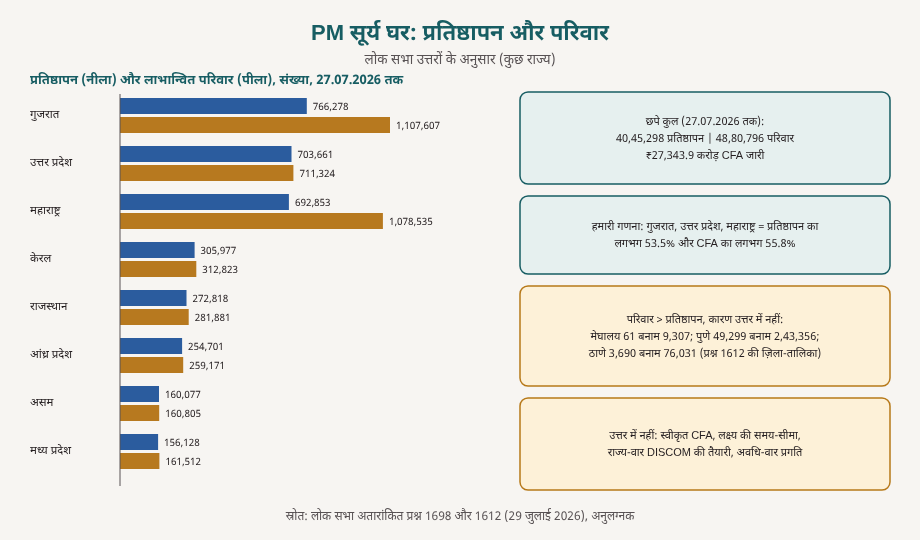
Both answers say: "a total of 40,45,298 RTS systems have been installed, benefitting 48,80,796 households, and an amount of Rs. 27,343.9 crore has been released as Central Financial Assistance (CFA) ... as on 27.07.2026." In the annexure the number of households is higher than the installations: for example Gujarat has 7,66,278 installations and 11,07,607 households, Maharashtra 6,92,853 and 10,78,535, Meghalaya 61 and 9,307. In the district-wise table, Pune has 49,299 installations and 2,43,356 households and Thane 3,690 and 76,031. The answers do not state the reason for these gaps and we have assumed none.
Key Facts and Figures
| National totals (answers, up to 27.07.2026) | Since the February 2024 start: 40,45,298 RTS installations; 48,80,796 households; Rs 27,343.9 crore CFA released. |
|---|---|
| Highest states (printed) | Installations: Gujarat 7,66,278; Uttar Pradesh 7,03,661; Maharashtra 6,92,853; Kerala 3,05,977; Rajasthan 2,72,818. CFA (Rs crore): Gujarat 5,597.04; Maharashtra 5,017.02; Uttar Pradesh 4,652.73; Kerala 2,043.61; Rajasthan 1,815.39. |
| Concentration (our calculation) | Gujarat, Uttar Pradesh and Maharashtra's installations sum to 21,62,792, about 53.5% of the total; the same three states' CFA sums to Rs 15,266.79 crore, about 55.8% of the total. This describes the state-wise distribution, not a comparison with states' populations or household counts. |
| Small figures (printed) | Arunachal Pradesh: 1 installation, 1 household, Rs 0.01 crore; Sikkim: 59, 59, Rs 0.37 crore; Meghalaya: 61 installations, 9,307 households, Rs 0.31 crore. |
| District-wise table (question 1612, six states) | Rows for Rajasthan 41, Uttar Pradesh 75, Maharashtra 36, Himachal Pradesh 12, Telangana 33 and Madhya Pradesh 55 districts. Districts where households exceed installations: Rajasthan 16, Uttar Pradesh 25, Maharashtra 30, Himachal Pradesh 9, Telangana 13, Madhya Pradesh 10 (our calculation). |
| Sidhi Lok Sabha constituency (answer, question 1612) | Up to 27.07.2026: 1,818 installations, 1,818 households and Rs 12.7 crore CFA. |
| Disposal time and estimates (answer, question 1612) | In the online process, when all details are entered correctly, the "average time taken in releasing the CFA is around 15 days after redemption request made by the consumer". Estimates: RTS systems in one crore households "may produce" 1,000 billion units of renewable electricity over the systems' 25-year life and "may result" in a reduction of 720 million tonnes of CO2 equivalent emissions; this is an estimate, not a measured outcome. |
| Steps taken (answer) | Online process on the portal; a 10-year collateral-free loan facility at repo rate plus 50 basis points (currently 5.75% per annum); removal of the technical feasibility condition and automatic load enhancement up to 10 kW; net metering agreement as part of the application; simpler vendor registration; training and awareness campaigns; monitoring and regional review meetings; grievance redressal (call centre 15555, in 12 languages). |
Checking the Figures: What Matches and What Does Not
What matches (our calculation, by two methods): the 36 rows of both answers' Annexure-1 are identical. They sum to 40,45,298 installations and 48,80,796 households, the printed totals. The CFA sum is Rs 27,343.88 crore, while the printed total rounded to one decimal is Rs 27,343.9 crore. In the district-wise tables, rows were fully counted; the sums of installations and households match the printed state totals exactly in all six states.
What does not match: the district-wise CFA sum differs slightly from the printed total in four states: Rajasthan 1,815.41 vs 1,815.39; Uttar Pradesh 4,652.76 vs 4,652.73; Himachal Pradesh 87.01 vs 87.00; Telangana 325.12 vs 325.11 (Rs crore). The printed text gives no reason and we are not calling it rounding. Maharashtra and Madhya Pradesh match exactly.
Asked vs given: question 1612 asked for sanctioned CFA, district-wise detail for the whole country, the target timeline and DISCOM readiness in low-performing states; the answer has released CFA, six states' districts, a list of general steps and estimates, but not the sanctioned amount, the target timeline or state-specific DISCOM detail.
The period: all figures are up to 27.07.2026 and both answers are dated 29.07.2026. This is a cumulative figure since the start; no year-wise or period-wise split is given.
Significance: A Difference of Units Within One Scheme
The counting unit: installations count systems and households count beneficiaries; deriving per-household assistance or average system size by treating the two as equal is not safe on the basis of these answers, so we built no such ratio.
Uneven distribution across states: three states hold more than half of both installations and CFA (our calculation), while Arunachal Pradesh has one installation. The answers state neither the reasons for the distribution nor the states' potential capacity.
Challenges and What Is Not in the Answers
Asked but not received: the amount of sanctioned CFA; district-wise figures for the whole country; the target timeline; state-wise DISCOM readiness and grid-connection status; the list of low-performing states; annual or period-wise progress.
Unresolved points: the reason for the gap between household and installation counts (Gujarat, Maharashtra, Meghalaya, Pune, Thane etc.); the 0.01 to 0.03 crore differences in the district-wise CFA sums; the method and period behind the "15 days" average.
What we have not read: we read only the official texts and annexures of Lok Sabha unstarred questions 1698 and 1612. The scheme's guidelines, the national portal's data and the Cabinet decision were not read.
The Road Ahead
Treat this as dated government information from the 29 July 2026 answers; the sanctioned assistance, the target timeline and the definition of the household-installation gap can be seen when the ministry publishes them.
Distinction of Concepts
Keep four things separate: (1) the count of installations; (2) the count of benefited households; (3) released CFA (the sanctioned amount is not in the answers); (4) the answers' figures and our calculations.
Mains View
GS-III: energy, renewable resources and infrastructure; GS-II: Centre-state relations and implementation of welfare schemes.
UPSC CSE Mains Style: Original Practice Question
What can and cannot be said about progress from PM Surya Ghar: Muft Bijli Yojana's state-wise and district-wise figures? What additional data will be needed to assess the scheme?
(Answer in 150 words) | 10 marks
Outline of the Answer
Introduction: the scheme and questions 1698, 1612 (29.07.2026). Main body: up to 27.07.2026, 40,45,298 installations, 48,80,796 households, Rs 27,343.9 crore CFA; more than half in three states (our calculation); the household-installation gap (Gujarat, Maharashtra, Meghalaya, Pune, Thane); differences in district-wise sums; asked vs given (sanctioned amount, target timeline, DISCOM); needed additional data. Conclusion: installations, households and released CFA are separate indicators of the scheme's progress; without clarified definitions, sanctioned assistance and target timelines, make no firm claim of target completion or state-wise success from their gaps.
Frequently Asked Questions (FAQ)
Short answer: under PM Surya Ghar: Muft Bijli Yojana (PMSG: MBY), Central Financial Assistance (CFA) is given for installing rooftop solar (RTS) systems on homes. Per the answers the scheme began in February 2024, it is demand-based, and the process from application on the national portal to payment of assistance is online.
Question: What is the central assistance process in the PM Surya Ghar scheme?
Under PM Surya Ghar: Muft Bijli Yojana (PMSG: MBY), Central Financial Assistance (CFA) is given for installing rooftop solar (RTS) systems on homes. Per the answers the scheme began in February 2024, it is demand-based, and the process from application on the national portal to payment of assistance is online. This article rests on two Lok Sabha answers and their annexures.
Question: What did the two parliamentary questions on rooftop solar ask?
On 29 July 2026, Minister of State Shripad Yesso Naik answered Lok Sabha unstarred questions 1698 (Dr. Prabha Mallikarjun; "Review of Progress of Rooftop Solar Installations") and 1612 (Haribhai Patel and several members; "Implementation of PM-SGMBY"). The questions asked state-wise progress, the number of households, assistance released, obstacles and steps for improvement; question 1612 also asked for sanctioned assistance, the average disposal time, district-wise detail, the target timeline, emission reduction and the Sidhi Lok Sabha constituency detail.
Question: How should the separate counts of RTS installations and benefited households be read?
Both answers say: "a total of 40,45,298 RTS systems have been installed, benefitting 48,80,796 households, and an amount of Rs. 27,343.9 crore has been released as Central Financial Assistance (CFA) ... as on 27.07.2026." In the annexure the number of households is higher than installations: Gujarat has 7,66,278 installations and 11,07,607 households, Maharashtra 6,92,853 and 10,78,535, Meghalaya 61 and 9,307. In the district-wise table, Pune has 49,299 installations and 2,43,356 households and Thane 3,690 and 76,031. The answers do not state the reason for these gaps and we have assumed none.
Sources
- https://sansad.in/getFile/lsapps/loksabhaquestions/annex/188/AU1698_2rIKl9.pdf - Lok Sabha unstarred question 1698 and answer, 29.07.2026 (official Parliament PDF; with annexure)
- https://sansad.in/getFile/lsapps/loksabhaquestions/annex/188/AU1612_Zzc0xr.pdf - Lok Sabha unstarred question 1612 and answer, 29.07.2026 (official Parliament PDF; with annexures I-II)
Download this article: PDF (English)