
Society / skill development | News context: Lok Sabha answer, 29 July 2026 | Published: 19 October 2026
Background and Context
Bringing employable skills to minority-community youth has long been a priority of the central Ministry of Minority Affairs. Taking the place of predecessor schemes like Seekho aur Kamao, Pradhan Mantri Virasat Ka Samvardhan (PM VIKAS) is being run as a Central Sector scheme, in which training happens through empaneled Project Implementing Agencies (PIAs). The scheme's design is such that funds are not allotted state-wise or Union-Territory-wise. Lok Sabha question 1701 asked about serious allegations tied to Maharashtra: fake or closed training centres, inflated billing, tampering with beneficiary records, misuse of Aadhaar and complaints of the same trainer at many centres; it also asked the government the status of audits, physical verification, vigilance inquiry, fund recovery and monitoring improvements.
Why in the News
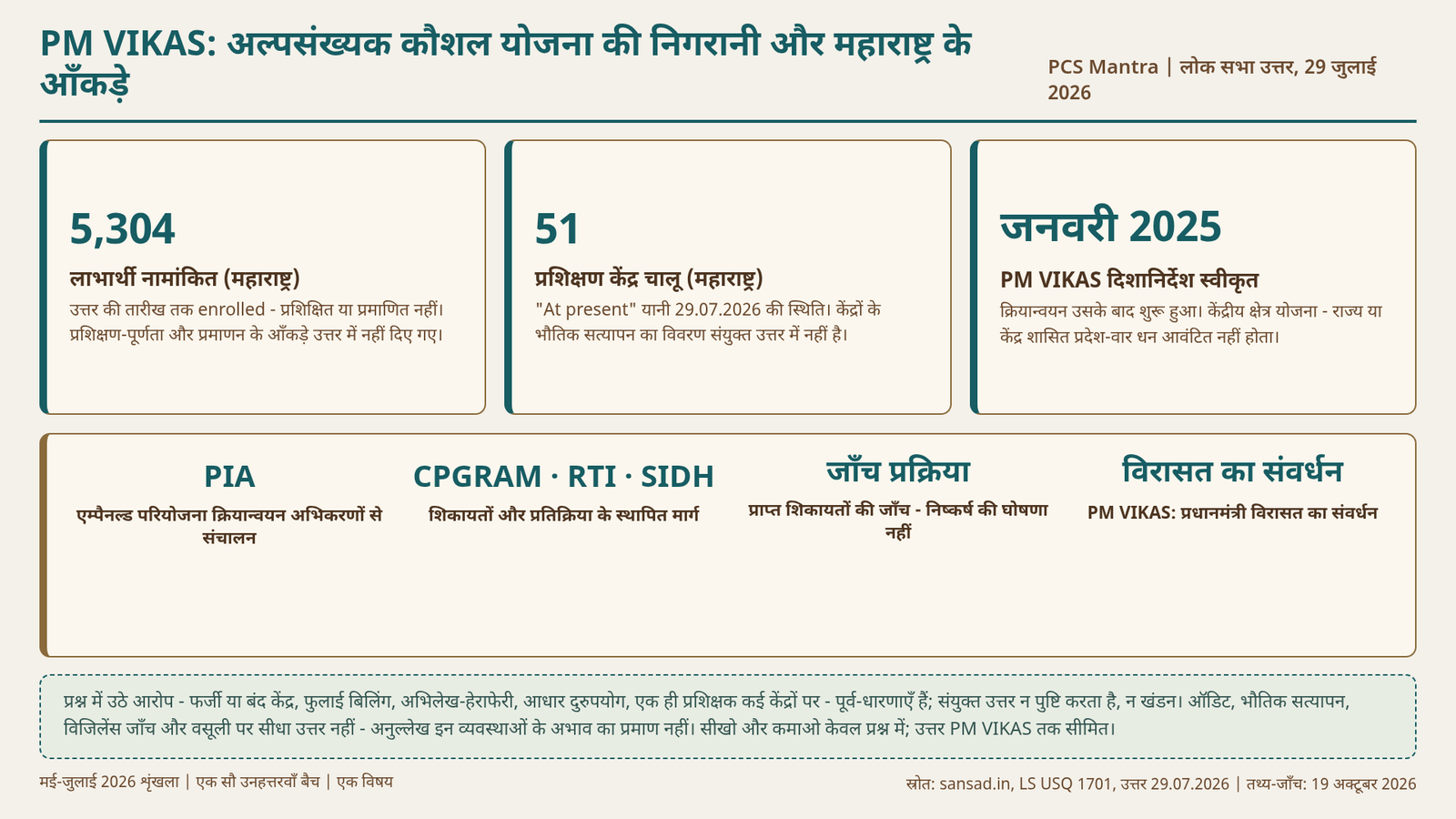
In the answer to Lok Sabha unstarred question 1701 (Dr Bachhav Shobha Dinesh) on 29 July 2026, Minister of Minority Affairs Kiren Rijiju gave a combined answer to parts (a) through (e): PM VIKAS guidelines were approved in January 2025 and implementation began thereafter; as of the answer's date, 5,304 beneficiaries are enrolled in Maharashtra and 51 training centres are operational; the ministry receives complaints, grievances and feedback on implementation of its schemes through established channels like CPGRAM, RTI and SIDH, and complaints received, including about PM VIKAS, are investigated for suitable necessary action.
The Answer's Scope, as the Answer Gave It
Five cautions: (1) 5,304 are enrolled beneficiaries - not trained, certified or employed; those figures are not in the answer; (2) 51 centres are stated as operational "at present", i.e. the 29.07.2026 position; (3) the combined answer neither confirms nor denies the question's allegations - "are investigated" is a process, not a conclusion; (4) there is no direct answer on audit, physical verification, vigilance inquiry, recovery and verification method - absence of mention is not absence of these arrangements; (5) Seekho aur Kamao is only in the question; the answer is limited to PM VIKAS.
Key Facts and Figures
| The answer's subject (as it is) | Lok Sabha unstarred question 1701, answered 29.07.2026; Ministry of Minority Affairs (Minister Kiren Rijiju); MP: Dr Bachhav Shobha Dinesh; question title: "Irregularities in the implementation of the PM-VIKAS scheme"; one page; combined answer to parts (a)-(e). |
|---|---|
| The scheme's form (as it is) | Pradhan Mantri Virasat Ka Samvardhan (PM VIKAS) is a Central Sector scheme; implementation through empaneled Project Implementing Agencies (PIAs); funds under the scheme are not allotted state-wise or Union-Territory-wise. |
| The timeline (as it is) | PM VIKAS guidelines were approved in January 2025; implementation began thereafter. |
| Maharashtra figures (as it is) | As of the answer's date (29.07.2026): 5,304 beneficiaries enrolled in Maharashtra; 51 training centres operational. |
| The complaint system (as it is) | The ministry receives complaints, grievances and feedback on implementation of its schemes and programmes through established channels like CPGRAM, RTI and SIDH; complaints received, including PM VIKAS, are investigated for suitable necessary action. |
| The question's allegations (premises) | Fake or non-operational training centres, inflated billing, tampering with beneficiary records, Aadhaar misuse, posting of the same trainer at many centres, complaints of fund misuse - these are possibilities asked in the question; the combined answer does not confirm or deny them. |
| State-wise funds (the answer's position) | Funds under the scheme are not allotted state or Union-Territory-wise - so an account of state-wise allotment like "how much money Maharashtra got" does not arise in the scheme design itself; nor does it mean expenditure in the state is zero. |
| Points not answered directly (the answer's position) | Details of audit, physical verification, vigilance inquiry, recovery of misuse and verification method are not given in the combined answer; absence of mention cannot be taken as proof of absence of these arrangements. |
How PM VIKAS Runs and How Complaints Are Investigated
What a Central Sector scheme means: all funds are the central government's; no quota-like allotment to states. Implementation is by empaneled PIAs - the organisations that run training centres on the ground. So when state-wise fund allotment is asked, the answer first clarifies the design: no such allotment happens at all.
The pipeline from enrolment to training: a beneficiary is first enrolled; the stages of training, assessment and certification follow. For Maharashtra the answer gave enrolment (5,304) and operational centres (51) - not trained or certified numbers; taking the two as one would be wrong.
Complaint channels: complaints and feedback reach the ministry through channels like CPGRAM (Centralised Public Grievance Redress and Monitoring System), RTI (Right to Information) and SIDH (Skill India Digital Hub). Per the answer, complaints received are "investigated for suitable necessary action" - this is a description of process, not the announcement of any conclusion.
Reading the Answer Correctly
Enrolled vs trained: 5,304 "enrolled" is the answer's own word. Reading it as trained, certified or employed would be over-extension - those figures are not given in the answer.
The date of "operational": 51 centres state the position "at present", i.e. 29.07.2026; no other date's number follows from this answer.
Investigation vs conclusion: "complaints ... are investigated for taking suitable necessary action" - this is a process detail. It neither proves the allegations nor has the ministry calling them baseless. An investigation existing is not a conclusion existing.
The combined answer's limit: parts (a)-(e) share one combined answer; it has no direct reply on audit, physical verification, vigilance inquiry, recovery and verification method. Absence of mention is not absence of arrangement - this formula does not cut in either direction.
Date scope: the figures are as of the 29.07.2026 answer; no claim of the October 2026 position follows from this answer.
Which Conclusions Should Be Avoided?
"5,304 youth trained in Maharashtra": over-extension. 5,304 are enrolled; trained or certified numbers are not in the answer.
"A scam was caught in the 51 centres": unsupported. 51 centres are stated as operational; the question's allegations are premises and the combined answer neither confirms nor denies them.
"The government dismissed the allegations": a misreading. The answer does not call the allegations wrong; it describes the process of investigating complaints.
"No audit or vigilance inquiry happened": conjecture. No direct answer was given on this; absence of mention is not proof of absence.
"Maharashtra was allotted so many crores": an impossible figure. There is no state-wise fund allotment in the scheme - such an amount is neither in the answer nor arises in the design; but it also does not mean zero spending in the state.
"The status of Seekho aur Kamao was also given": wrong. Seekho aur Kamao is only in the question; the answer is limited to PM VIKAS.
The Road Ahead
Our policy suggestions: (1) publish enrolled, training-completed and certified beneficiary figures separately, so every stage of the pipeline can be measured; (2) where there is no state-wise fund allotment, build a public dashboard of PIA-wise and centre-wise spending and achievement; (3) time-bound reporting of physical verification of training centres and Aadhaar-based duplicacy checks; (4) consolidated publication of complaint-investigation outcomes - findings, recovery, action - so transparency goes beyond "investigation is on"; (5) regular independent third-party evaluation, as is standard practice in skill schemes.
Distinction of Concepts
Enrolled is not trained is not certified; an operational centre is not a verified centre; complaint investigation is neither confirmation of allegations nor their denial; absence of mention is not absence of arrangement; no state-wise fund allotment is not zero spending in the state; the question's premise is not a proven fact; the 29.07.2026 answer is not the October 2026 position.
Mains View
GS-II (welfare schemes, governance, transparency and accountability): a skill scheme's design for minority welfare - Central Sector form, PIA-based implementation and the absence of state-wise allotment; the role of monitoring, accountability and grievance-redress systems (CPGRAM, RTI, SIDH). Keep in answers: PM VIKAS's full name and form, the January 2025 guidelines, Maharashtra's 5,304 enrolled beneficiaries and 51 operational centres (as of the answer's date), the language of the investigation process, and the enrolled-vs-trained difference.
UPSC CSE Mains Style: Original Practice Question
How does the absence of state-wise fund allotment in Central Sector schemes affect monitoring and accountability? Analyse with reference to PM VIKAS and suggest measures to increase transparency in PIA-based implementation.
(Answer in 150 words) | 10 marks
Outline of the Answer
Introduction: PM VIKAS, Ministry of Minority Affairs, Central Sector form. Main body: design analysis (PIA implementation, absence of state-wise allotment - benefits and costs); the monitoring system (CPGRAM, RTI, SIDH; investigation process); figures (Maharashtra: 5,304 enrolled, 51 operational centres, as of 29.07.2026); challenges (verification, audit transparency, duplicacy). Conclusion: keep beneficiary verification and audit transparency with the Central Sector's flexible implementation; do not take enrolment as a training outcome or complaint investigation as proof of guilt.
Read also: Skill development: from the count of training to durable employment.
Frequently Asked Questions (FAQ)
Short answer: implementation is by empaneled PIAs - the organisations that run training centres on the ground. So when state-wise fund allotment is asked, the answer first clarifies the design: no such allotment happens at all.
Question: Why is there no quota-like state-wise fund allotment in PM VIKAS?
What a Central Sector scheme means: all funds are the central government's; no quota-like allotment to states. Implementation is by empaneled PIAs - the organisations that run training centres on the ground. So when state-wise fund allotment is asked, the answer first clarifies the design: no such allotment happens at all.
Question: Why should Maharashtra's PM VIKAS enrolment not be taken as the trained number?
The pipeline from enrolment to training: a beneficiary is first enrolled; the stages of training, assessment and certification follow. For Maharashtra the answer gave enrolment (5,304) and operational centres (51) - not trained or certified numbers; taking the two as one would be wrong.
Question: Through which channels do PM VIKAS complaints arrive?
Complaint channels: complaints and feedback reach the ministry through channels like CPGRAM (Centralised Public Grievance Redress and Monitoring System), RTI (Right to Information) and SIDH (Skill India Digital Hub). Per the answer, complaints received are investigated for "suitable necessary action" - this is a description of process, not the announcement of any conclusion.
Sources
- https://sansad.in/getFile/lsapps/loksabhaquestions/annex/188/AU1701_yosW6o.pdf - Lok Sabha unstarred question 1701 and answer, 29.07.2026 (one page)
Download this article: PDF (English)