
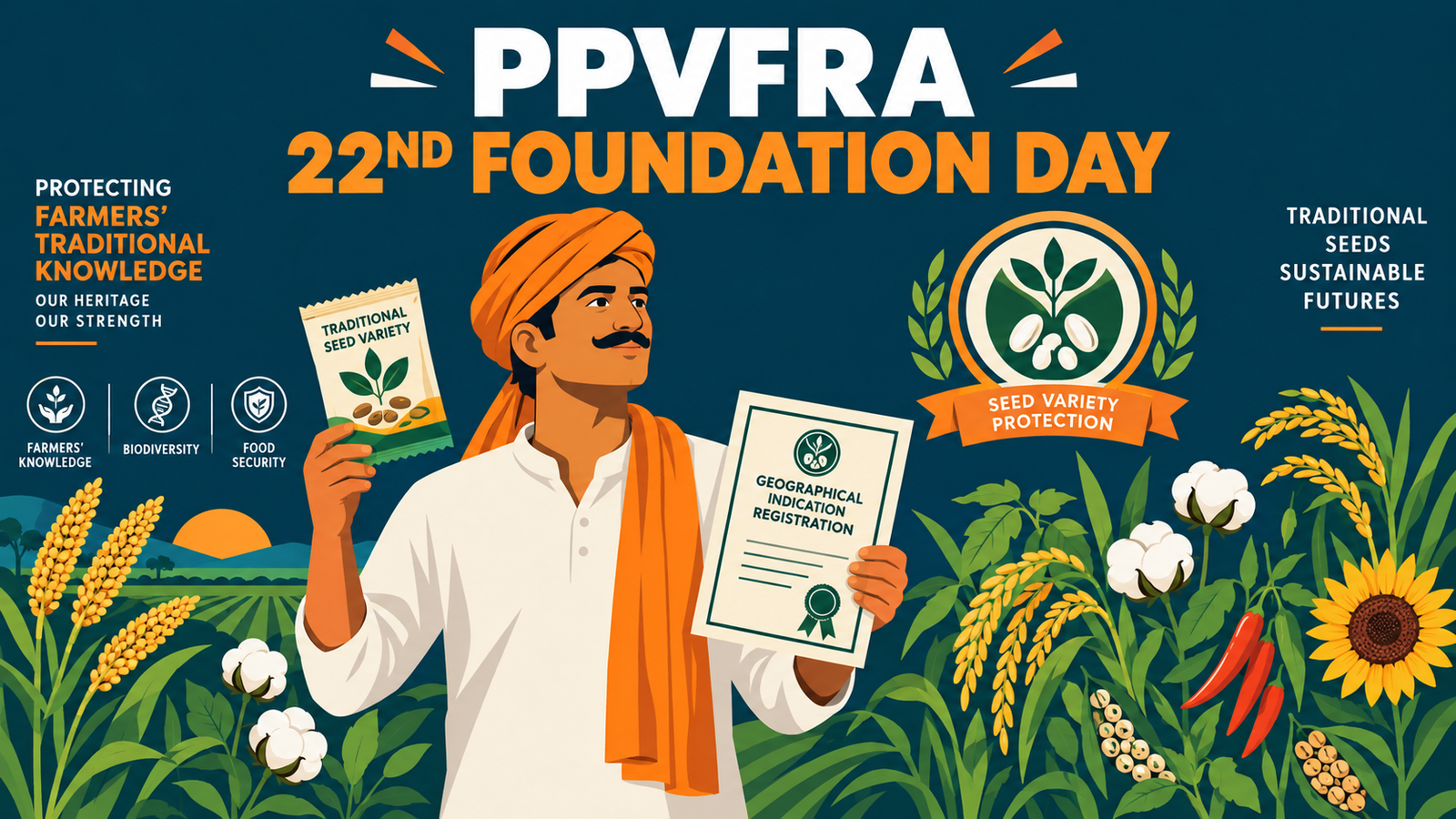
12 November 2026: The Protection of Plant Varieties and Farmers' Rights Authority (PPVFRA) celebrated its 22nd Foundation Day. Speaking at the event, Principal Secretary to the Prime Minister Dr P.K. Mishra called for linking farmers' traditional knowledge with scientific research and markets. 'Plant Genome Saviour' awards were also presented for outstanding contributions to the conservation of agricultural biodiversity.
What is PPVFRA?
- Introduction: A statutory body established on 11 November 2005 under the Protection of Plant Varieties and Farmers' Rights (PPV&FR) Act, 2001.
- Nodal ministry and headquarters: Ministry of Agriculture & Farmers' Welfare; New Delhi.
- Objectives: Grant intellectual property rights to plant breeders for new varieties; recognise and reward farmers and communities conserving traditional varieties and biodiversity; protect farmers' rights to save, use, sow, resow, exchange, share and sell farm-saved seed of registered varieties; encourage research and innovation in plant breeding; and maintain the National Register of Plant Varieties (NRPV) with documentation and conservation of valuable germplasm.
Structure and functions
- Structure: The Chairperson is the Chief Executive; the Authority has 15 members - eight ex-officio (from departments/ministries), three from State Agriculture Universities and state governments, and one representative each of farmers, tribal organisations, the seed industry and women's organisations, nominated by the Central Government. The Registrar General is the ex-officio Member Secretary.
- Key functions: Registration of new varieties, essentially derived varieties (EDV) and extant varieties; compulsory cataloguing of all plant varieties; preservation of plant genetic resources of economic plants and their wild relatives; maintenance of the National Register of Plant Varieties and the National Gene Bank.
Why it matters for exams
- Prelims facts: Establishment date (11 November 2005), parent Act (PPV&FR Act, 2001), ministry (Agriculture & Farmers' Welfare), member strength (15), the meaning of EDV, and the Plant Genome Saviour awards.
- Mains theme: India follows a sui generis plant-variety protection law (not UPOV) that balances breeders' rights with farmers' rights - a frequent GS-III question.
Quiz: Test your knowledge
Q1: Consider the following statements about PPVFRA: 1. It is a statutory body established under the PPV&FR Act, 2001. 2. It works under the Ministry of Commerce and Industry. 3. It is headquartered in New Delhi. How many of the above statements are correct?
(a) Only one
(b) Only two
(c) All three
(d) None
Answer and explanation: (b) Statements 1 and 3 are correct. Statement 2 is wrong - it works under the Ministry of Agriculture & Farmers' Welfare.
Q2: How many members does PPVFRA have?
(a) 10
(b) 12
(c) 15
(d) 20
Answer and explanation: (c) The Authority has 15 members - eight ex-officio, three from State Agriculture Universities/state governments, and four nominated (farmers, tribal organisations, seed industry, women's organisations).
Frequently Asked Questions (FAQ)
In short: PPVFRA is a statutory body set up on 11 November 2005 under the PPV&FR Act, 2001; it registers new plant varieties and protects farmers' rights over seeds.
Question: Under which Act was PPVFRA set up?
The Protection of Plant Varieties and Farmers' Rights (PPV&FR) Act, 2001; it was established on 11 November 2005.
Question: What rights do farmers get?
The right to save, use, sow, resow, exchange, share and sell farm-saved seed of registered varieties.
Question: What are the Plant Genome Saviour awards?
PPVFRA awards given to farmers and communities for outstanding contributions to conserving traditional varieties and agricultural biodiversity.
Sources:
- PIB: 22nd Foundation Day of PPVFRA (PRID 2335454), 12 November 2026
- PTI: Link farmers' traditional knowledge with scientific research, markets - Principal Secretary to PM (12 November 2026)
Download this article: PDF