
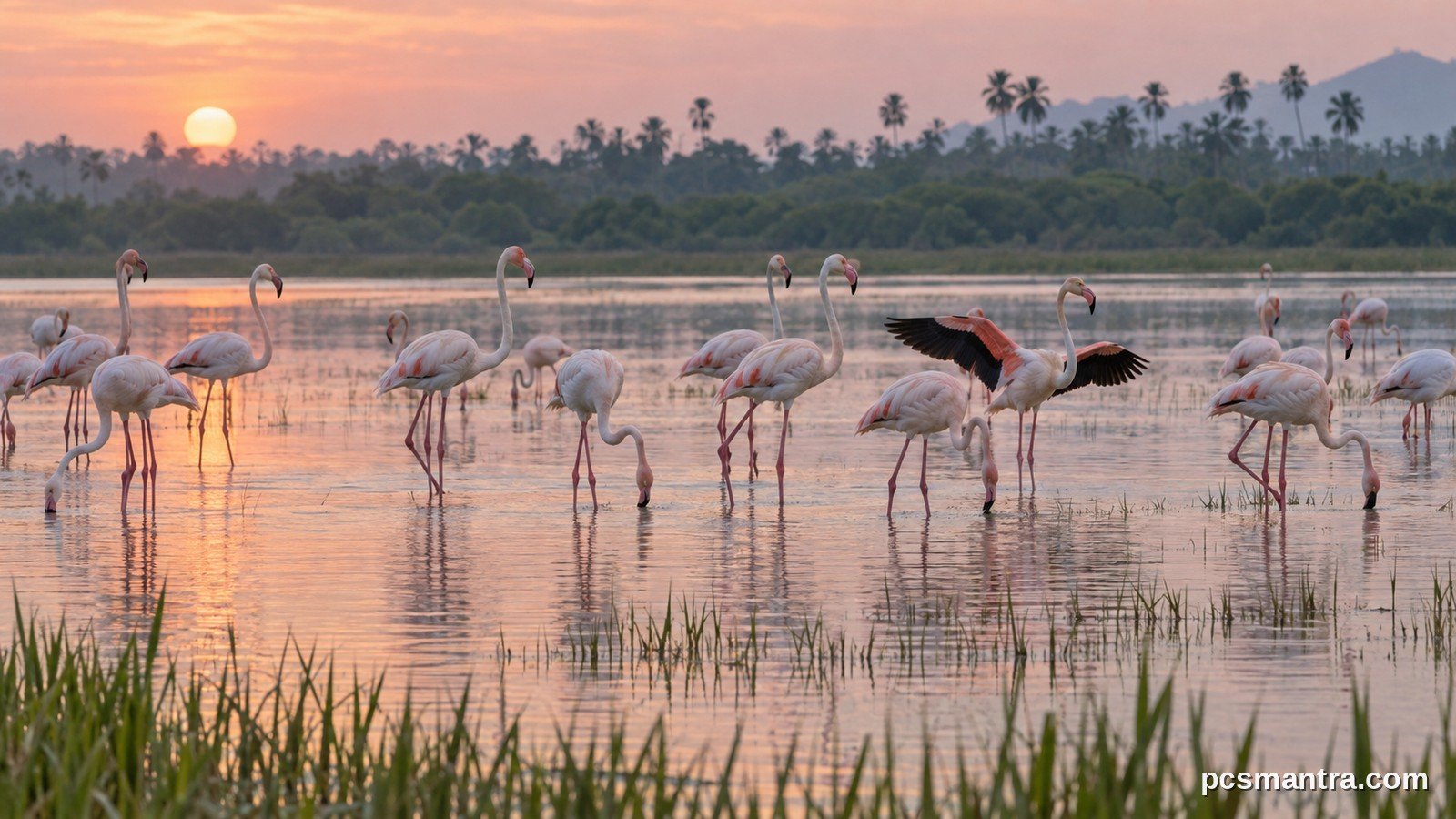
Why in the News
Greater Flamingos have been sighted at Veeranam Lake in Tamil Nadu's Cuddalore district. According to The Hindu's report of 27 October 2026, bird researcher J. Pandian of A.V.C. College and his team recorded 18 birds at this freshwater lake on 25 October. This is an unusual sight locally; it does not follow that this species visiting inland water bodies is entirely new.
Greater Flamingo: Key Facts
- Scientific name: Phoenicopterus roseus. Distinguish it from the Lesser Flamingo (Phoeniconaias minor).
- Distribution: found in Africa, the Mediterranean region, south-west Asia and South Asia.
- Habitat: shallow saline lakes, lagoons, salt pans and estuaries are important. According to BirdLife, it also uses inland dams. So describing it as limited only to sea coasts would be wrong.
- Food: it filters food with the fine sieve-like plates of its beak. The diet includes many items such as small crustaceans, molluscs, aquatic insects and algae.
- Movement: the birds' movement can change as the water level and food availability change. According to BNHS, flamingos are found in India both as resident birds and as winter visitors; all birds should not be bound to a single migration route.
- Conservation status: in BirdLife's global factsheet the IUCN category is Least Concern. This does not mean that every local habitat is safe or that conservation is not needed.
To understand the process of conserving a coastal wetland and its surroundings, also read our article on the Pulicat sanctuary. Veeranam and Pulicat are different water bodies.
Veeranam Lake: Facts for the Map
- A man-made lake in Tamil Nadu's Cuddalore district; its other name is Veeranarayana Lake.
- According to the district administration, it was built in the tenth century by the Chola prince Rajaditya.
- According to the Tamil Nadu Tourism Department, the Vadavar river connects it to the Kollidam river.
- Besides irrigation, it is also useful in Chennai's drinking-water supply.
Explaining the Change of Habitat: What Is Known and What Is Not?
In the news report, Pandian cited low rainfall, the Kaveri's reduced flow and a shortage of food in coastal areas as possible reasons. In his account, the lake's falling water level can create shallow feeding grounds. This is the researcher's interpretation, not an established cause-and-effect relationship from this one sighting. The report itself says further monitoring is necessary. Here, the birds' presence proves neither a breeding colony, nor a permanent change of migration route, nor the decisive role of any single climate factor.
Study diagram: how can the use of a wetland change?
Changes in rainfall and river flow
↓
Changes in water level, salinity and food availability
↓
Possible changes in the birds' feeding grounds and movement
This is a general ecological relationship, not proof of any particular cause at Veeranam.
What Is the Lesson for Conservation?
Management should not be limited to a one-day count of birds. Counts in different seasons and monitoring of water level, water quality and feeding grounds should go together. BirdLife states risks tied to disturbance at breeding sites, pollution and changes in water level. Ramsar's water-management guidance also emphasises understanding the wetland and the wider water cycle together. It is therefore useful to look at ecological needs along with the use for irrigation and drinking water.
Prelims Practice Questions
Question 1. What is the scientific name of the Greater Flamingo?
(a) Phoenicopterus roseus
(b) Phoeniconaias minor
(c) Ardea cinerea
(d) Pavo cristatus
See Answer and Reason
Answer: (a). The Greater Flamingo is Phoenicopterus roseus; option (b) is the Lesser Flamingo.
Question 2. Which statement about Veeranam Lake is correct?
(a) It is a natural glacial lake of Kerala
(b) It is a man-made lake in Tamil Nadu's Cuddalore district
(c) It is a harbour filled only with sea water
(d) It has no connection with Chennai's water supply
See Answer and Reason
Answer: (b). The district administration and the state tourism department confirm the location, the man-made origin and the water-supply role.
Question 3. Consider the following statements:
Statement 1: The Greater Flamingo is found only on sea coasts and does not use inland water bodies.
Statement 2: Its presence in any one lake is by itself proof of a breeding colony there.
(a) 1 only
(b) 2 only
(c) Both 1 and 2
(d) Neither 1 nor 2
See Answer and Reason
Answer: (d). BirdLife records diverse habitats including inland dams. Mere presence does not prove breeding; that needs separate evidence.
Mains Practice Question
Explain the limits of looking at the water management of wetlands and the conservation of migratory birds separately. Suggest measures for integrated monitoring. (150 words)
Sources and Limitations
- The Hindu, 27 October 2026: the sighting of 18 birds on 25 October and the researcher's interpretation. This is the direct news source, not a published causal study.
- BirdLife DataZone: Greater Flamingo: global status, habitat, diet and risks.
- BNHS: Flamingos: residents and winter visitors in India, and monitoring.
- Cuddalore district administration: Veeranam Lake: location, history and water supply.
- Tamil Nadu Tourism Department: the Vadavar-Kollidam connection. The page's undated current water level has not been taken here.
- Ramsar: integrated water-related guidance: the general framework of the water cycle and wetland management; no Ramsar status for Veeranam is implied from this.