
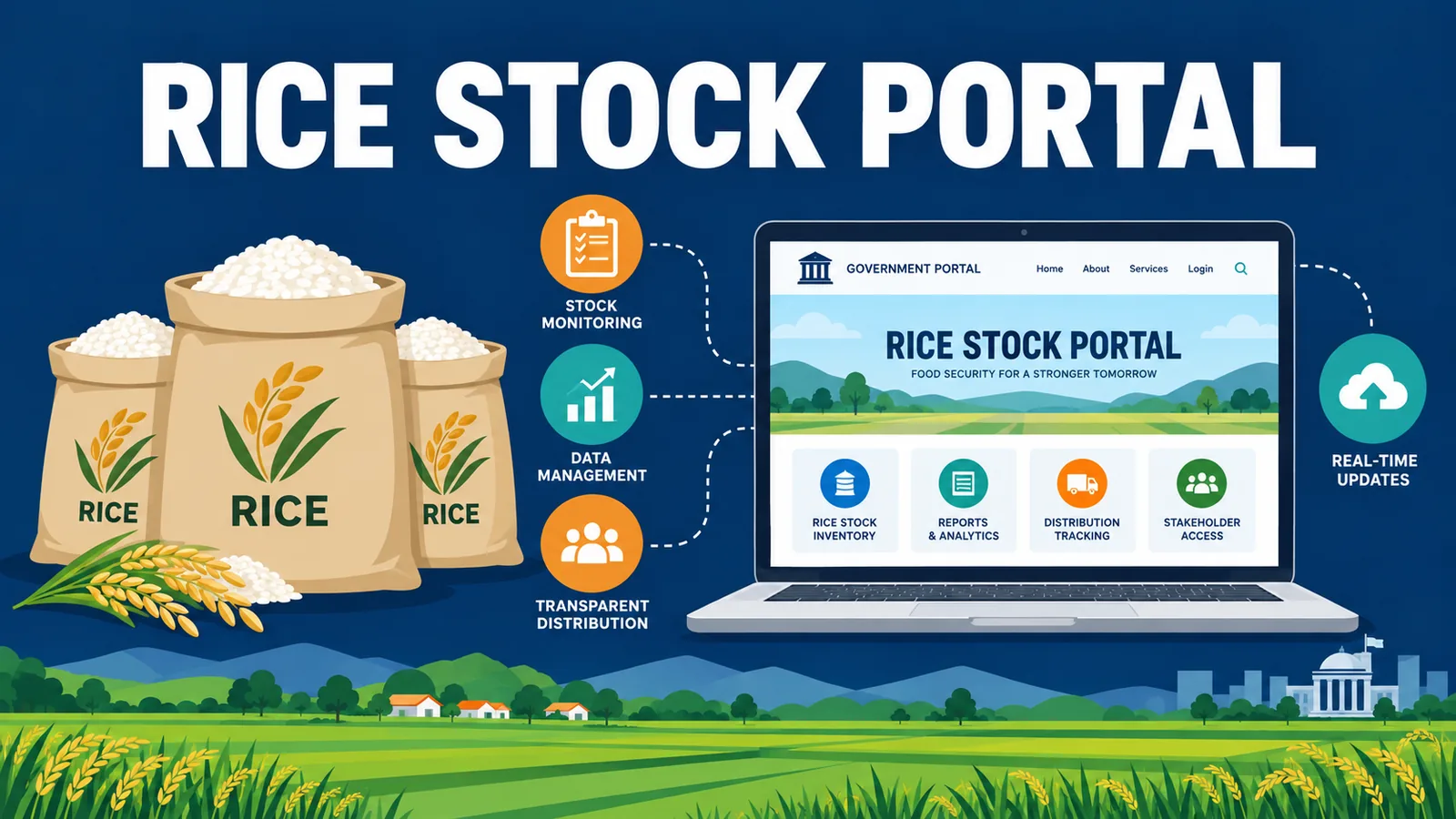
15 November 2026: The Food Ministry has operationalised a portal for online declaration of paddy/rice stocks (foodstock.dfpd.gov.in) for all traders, wholesalers, retailers, processors and millers. The aim is to prevent hoarding and check rice prices.
6 November 2026: The Centre has conveyed its concurrence to five southern states - Andhra Pradesh, Karnataka, Kerala, Tamil Nadu and Telangana - to impose stock limits on paddy and rice wherever considered necessary; the limits will remain in force up to 31 January 2027.
The 6 November order: who must declare what
- Coverage: traders, wholesalers, retailers, large retail chains, processors and millers in all states and union territories.
- Six categories: Basmati rice, non-Basmati premium rice, non-Basmati rice, parboiled rice, broken rice and paddy.
- Frequency: every unit must update its stock details on the portal every Friday.
- Penalty: units not registered on the portal or violating stock limits face action under Sections 6 and 7 of the Essential Commodities Act, 1955.
Why prices are rising
- Inflation: retail rice inflation rose to 8.25% in September (from 5.89% in August); average retail price about Rs 48.23/kg - roughly 12% higher year-on-year; deficient and uneven rainfall has hurt premium non-Basmati varieties the most.
- Output estimate: kharif paddy acreage declined about 4% to 42.68 million hectares in 2026-27; output is estimated at around 147 million tonnes, down from the record 154 million tonnes of 2025-26; experts say this is not a nationwide crisis, as government stocks are comfortable.
Supply-side steps
- Bharat Rice: additional rice stocks allocated to NAFED, NCCF and Kendriya Bhandar for retail sale, with directions to expand distribution channels especially in southern states.
- Open Market Sale Scheme (Domestic): the e-auction target for 2026-27 has been doubled from 25 lakh tonnes to 50 lakh tonnes; about 25 lakh tonnes had been sold by 31 October, against 11 lakh tonnes in the same period last year.
For the exam
- Questions can be asked on the portal (foodstock.dfpd.gov.in), the six categories, the weekly declaration rule, the Essential Commodities Act 1955 (Sections 6/7), the OMSS(D) and the Bharat Rice selling agencies (NAFED/NCCF/Kendriya Bhandar).
Quiz: Test your knowledge
Q1: Consider the following about the food stock declaration portal: 1. It is operated by the Food Ministry. 2. Stock declarations must be updated every Friday. 3. Violations attract action under the Essential Commodities Act, 1955. How many are correct?
(a) Only one
(b) Only two
(c) All three
(d) None
Answer and explanation: (c) All three are correct - under the 6 November order, weekly declarations in six categories are mandatory; Sections 6-7 of the ECA 1955 apply to violations.
Q2: To how much has the rice e-auction target under OMSS(D) been raised for 2026-27?
(a) 10 lakh tonnes
(b) 25 lakh tonnes
(c) 40 lakh tonnes
(d) 50 lakh tonnes
Answer and explanation: (d) The target has been doubled from 25 lakh tonnes to 50 lakh tonnes; about 25 lakh tonnes had already been sold by 31 October.
Mains Practice Question
Digital tools like the stock-declaration portal are a new way of market monitoring for food-price stability. Evaluate the effectiveness and limits of anti-hoarding measures. (Answer in 250 words - 15 marks)
Answer outline:
Introduction: The context - the paddy/rice stock-declaration portal going live.
Main body: The tool's rationale - real-time stock data, early signals of price spikes, targeted intervention (OMSS, Bharat Rice); limits - compliance costs, small traders left out, no answer to production-side (monsoon) pressures; complementary steps - irrigation, storage infrastructure, predictability of export policy.
Conclusion: Digital transparency is useful but insufficient; structural strengthening of the supply side is essential.
Frequently Asked Questions (FAQ)
In short: The Food Ministry has operationalised a portal for weekly online declaration of paddy/rice stocks; violations will attract action under the Essential Commodities Act, 1955.
Question: In which categories must stocks be declared?
Six - Basmati, non-Basmati premium, non-Basmati, parboiled and broken rice, and paddy.
Question: Why is rice getting costlier?
Deficient, uneven rainfall cut kharif acreage by about 4%, and the output estimate has fallen from 154 to 147 million tonnes; retail inflation was 8.25% in September.
Question: What is the government doing to raise supply?
Bharat Rice sales through NAFED, NCCF and Kendriya Bhandar are being expanded, and the OMSS(D) e-auction target has been raised from 25 to 50 lakh tonnes.
Sources:
- The Hindu: Centre operationalises portal for online declaration of rice, paddy stock, 14 November 2026
- PIB: Food stock declaration portal
- Business Standard: Centre orders rice stock disclosure, allows five states to impose limits, 6 November 2026
Download this article: PDF