
In this article
Why in the news
A new historical study of Rosalind Franklin’s laboratory records has brought the role of Photograph 51 back into focus. Published on 5 October 2026, it argues that Franklin had already calculated key features of DNA’s helix from Photograph 49. Photograph 51 was intended as a better-centred, publication-quality image of the same sample. This is a new interpretation of the history of an earlier discovery, not a newly discovered DNA structure. [1] [2]
What Photograph 51 shows
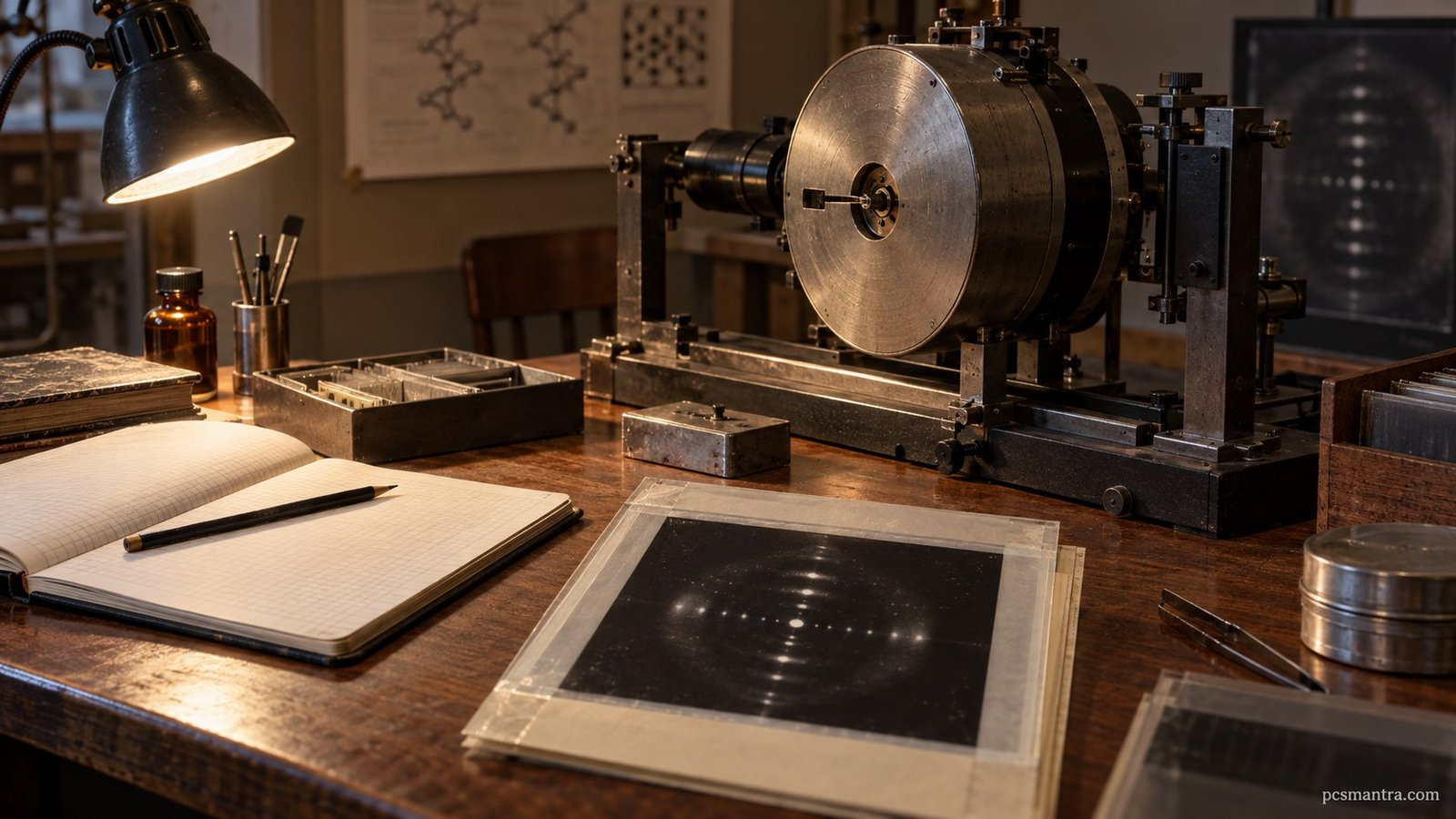
Franklin and her research student Raymond Gosling produced this X-ray diffraction image of DNA’s B form at King’s College London in May 1952. It is not a direct picture of a DNA molecule taken with an ordinary camera. [3]
In X-ray diffraction, X-rays interacting with a specimen produce a pattern. Analysis of its spots, lines and spacing helps researchers infer molecular arrangement. Photograph 51’s cross-like pattern was important evidence for a helical structure, but interpreting the image also required calculations and other evidence. [1] [3]
Why Photograph 49 matters
The study finds that Photograph 49 contained a clear pattern, but part of it was cropped because the film holder was not properly centred. Franklin nevertheless used the visible pattern to calculate important helical parameters of the B form. She then reused the same DNA sample under the same experimental conditions to obtain the better-centred Photograph 51. [1]
The simple story that Franklin obtained the image but failed to understand its importance therefore misses the records’ meaning. The authors argue that her decision to make the clearer image itself demonstrates recognition of its scientific value. This is the study’s historical interpretation, not a reason to reduce an entire discovery to one photograph. [1] [2]
Measurements are not the complete model
The paper discusses Franklin’s notebook calculations involving an axial repeat of about 34 angstroms and spacing of about 3.4 angstroms between base layers. An angstrom is a unit of length equal to 10^-10 m, useful for molecular-scale measurements. [1] [4]
Identifying these parameters was not the same as constructing the complete double-helix model. Watson and Crick’s 1953 model also incorporated complementary base pairs and other conclusions. The study restores attention to Franklin’s analysis without erasing other contributions. [1]
A lesson in scientific evidence
Historian Alistair Sponsel and X-ray crystallographer Brian Sutton wrote the study. Laboratory notebooks, original photographs and equipment are used to test later popular accounts. [1]
Three kinds of scientific work emerge: producing evidence, analysing it and presenting it clearly. A high-quality image may be more than decoration; it can document and communicate calculations already performed. Assessments of scientific credit should take account of these different contributions.
Exam distinctions
Associate Photograph 51 with B-form DNA, X-ray diffraction, Franklin and Gosling, and 1952. The 2026 study concerns the relationship between Photographs 49 and 51. It is not the first discovery of the double helix in 2026. Historical parameters of one DNA form should not be treated as unchanging measurements for every DNA structure under all conditions. [1] [3]
Prelims Practice Questions
Question 1
Consider the following statements about Photograph 51:
Statement 1: It is an X-ray diffraction image of DNA’s B form.
Statement 2: It is associated with Rosalind Franklin and Raymond Gosling.
Statement 3: It is the first direct ordinary-camera photograph of a DNA molecule, taken in 2026.
Which of the statements given above are correct?
Answer and Explanation
Correct answer: (a)
Statement 1 is correct: the image records X-ray diffraction from B-DNA.
Statement 2 is correct: Franklin and Gosling produced it in 1952.
Statement 3 is incorrect: it is not a direct camera photograph made in 2026.
Question 2
What relationship does the 2026 historical study identify between Photographs 49 and 51?
Answer and Explanation
Correct answer: (b)
The study connects calculations made from Photograph 49 with the reuse of the same DNA specimen to obtain a better-centred image.
Question 3
One angstrom equals:
Answer and Explanation
Correct answer: (c)
An angstrom is 10^-10 m. It is useful for expressing molecular-scale lengths.
Frequently Asked Questions (FAQ)
Does 51 in Photograph 51 mean the year 1951?
No. It is a number in a laboratory series of diffraction images, not a year. The study places Photographs 49 and 51 within Franklin and Gosling’s sequence of images.
Does a clearer image always represent a new discovery?
No. Photograph 51 shows how an improved image can provide clearer documentation of analysis already performed.
Why distinguish laboratory notebooks from later memoirs?
Notebooks record dates, experimental arrangements and calculations made during the work. Memoirs are written later from memory and a particular perspective. The 2026 study compares such evidence when testing the historical account.
Sources
- https://link.springer.com/article/10.1007/s10739-026-09866-7
- https://www.kcl.ac.uk/news/rosalind-franklin-deliberately-created-photo-51-after-earlier-photograph-revealed-dnas-structure
- https://www.kcl.ac.uk/the-story-behind-photograph-51
- https://www.nist.gov/pml/triatomic-spectral-database/triatomic-spectral-database-special-units-fundamental-constants-and
Download this article: PDF

PCSMANTRA Editorial Team
Research and Editing
We prepare current affairs analysis, exam updates and study material in Hindi and English for UPSC, State PCS, PCS-J and other competitive examinations. Every article is verified against official sources before publication; sources are listed at the end of each article.
Read our editorial policy