
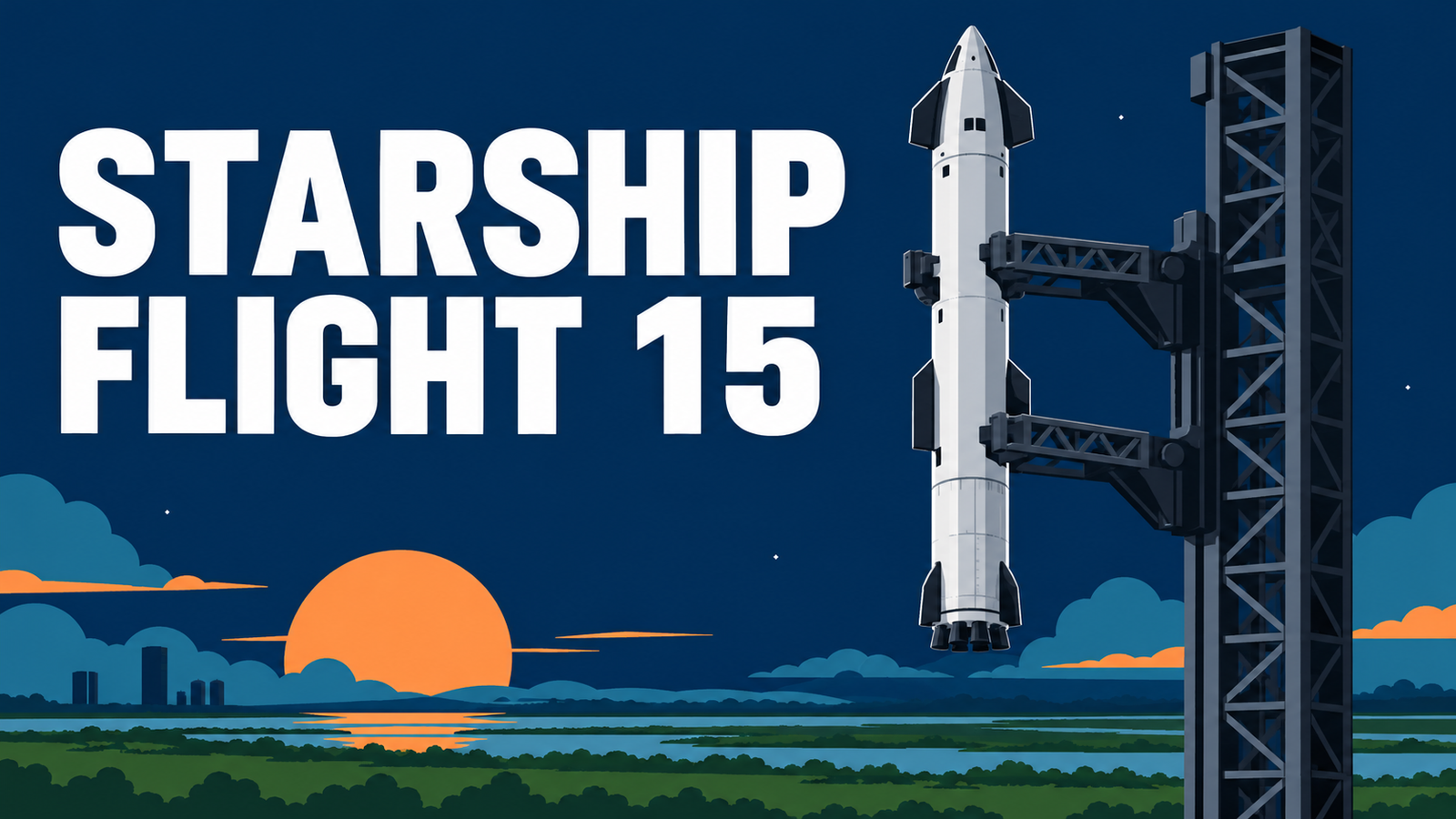
15 November 2026: SpaceX's Starship made history on its 15th test flight - the upper stage (the ship), returning from orbit, was caught midair by the giant mechanical arms ('chopsticks') of the launch tower at Starbase, Texas, about 22 hours after liftoff. It is the first time a Starship returning from space has been 'caught' at its own launch pad. However, the first-stage Super Heavy booster exploded shortly after liftoff, so the 'double catch' (booster + ship) remained unachieved this time.
Flight 15: what happened
- Liftoff: Friday (13 November) from Starbase, Texas; the booster exploded early in flight and its wreckage fell in the Gulf of Mexico, cordoned off by buoys.
- The ship's return: the stainless-steel ship completed its orbit and descended on Saturday precisely into the launch tower's arms - the first successful tower catch of a Starship ship.
- Why it matters: reusability is the soul of the Starship programme; catching the ship was considered its hardest link.
Starship: basic facts
- Structure: a two-stage, fully reusable super-heavy-lift rocket - the Super Heavy booster (first stage) and the Starship ship (second stage); total height about 120 metres, the largest and most powerful rocket ever built.
- Purpose: crewed missions to the Moon and Mars; a variant has been selected as the Human Landing System (HLS) under NASA's Artemis programme.
For the exam
- Questions can be asked on the catch system (the launch tower's mechanical arms), flight number (15th), location (Starbase, Texas), rocket structure (Super Heavy + ship) and the Artemis connection.
Quiz: Test your knowledge
Q1: Which of the following statements about Starship's 15th flight (November 2026) are correct? 1. The upper-stage ship was caught by the launch tower's mechanical arms. 2. The Super Heavy booster was also caught successfully. 3. The flight lifted off from Starbase, Texas. How many are correct?
(a) Only one
(b) Only two
(c) All three
(d) None
Answer and explanation: (b) Statements 1 and 3 are correct. Statement 2 is wrong - the booster exploded shortly after liftoff, so there was no 'double catch'.
Q2: What are the two stages of Starship?
(a) Falcon 9 and Dragon
(b) Super Heavy booster and Starship ship
(c) SLS core stage and Orion
(d) New Glenn and New Shepard
Answer and explanation: (b) The first stage is the Super Heavy booster and the second is the Starship ship; making both fully reusable is the programme's goal.
Mains Practice Question
Reusable rocket technology is changing the cost structure of the space economy. In the light of Starship's latest catch achievement, evaluate the preparedness of India's private space sector. (Answer in 250 words - 15 marks)
Answer outline:
Introduction: The context - the ship's first tower catch on Starship's 15th flight.
Main body: What reusability means - a steep cut in per-launch cost, fast turnaround; a new level of global competition. India's position - the rise of the private sector under IN-SPACe (Skyroot, Agnikul), RLV-TD experiments; challenges - capital, propulsion technology, launch infrastructure, skills.
Conclusion: Policy support, testing facilities and long-term investment are essential not to fall behind in the reusability race.
Frequently Asked Questions (FAQ)
In short: On Starship's 15th flight, the upper-stage ship was caught by the launch tower's arms for the first time after returning from orbit; the booster's explosion meant the double catch remained incomplete.
Question: What is a 'tower catch'?
The launch tower's two giant mechanical arms ('chopsticks') catch the returning stage midair, eliminating the need for landing legs and reducing weight.
Question: What remained unachieved in this flight?
The first-stage Super Heavy booster exploded shortly after liftoff, so the booster catch did not happen; its wreckage fell into the Gulf of Mexico.
Question: What is Starship's ultimate goal?
Fully reusable crewed missions to the Moon and Mars; its variant is NASA's chosen Human Landing System for the Artemis programme.
Sources:
- AP News: Starship returns from orbit, captured by launch pad arms in a first, 14 November 2026
- Aviation Week: Starship Flight 15 ends with first ship tower catch
Download this article: PDF