
Prelims | News context: 2026-11-16
Why in News
The Technology Development Board (TDB) of the Department of Science and Technology (DST) signed an agreement on 16 November 2026 with M/s Neo Seekermetals Pvt. Ltd. (Hyderabad, Telangana) under the RDI Fund. The agreement supports the development and commercialisation of an indigenous technology to extract critical metals by recycling e-waste and lithium-ion battery waste. The total project cost is Rs 20 crore, of which Rs 10 crore will come from the RDI Fund through Optionally Convertible Debt (OCD).
Introduction: TDB and the RDI Fund
Technology Development Board (TDB): A statutory body under the Department of Science and Technology (DST) that finances the commercialisation of technologies developed for the first time in the country - turning laboratory research into market-ready products.
RDI Fund (Research, Development and Innovation Fund): A scheme to finance high-risk, high-impact R&D projects; support comes in several forms, including OCD (debt that can convert into equity under set conditions).
Critical minerals: Minerals such as lithium, cobalt, nickel and rare-earth elements that are essential for electric vehicles, batteries, electronics and clean-energy technologies, and whose supply security has become a strategic issue.
Main Body: project details
- Title: 'Extraction of Critical Metals by Recycling of E-Waste and Lithium-Ion Battery Waste'.
- Finance: Total cost Rs 20 crore; Rs 10 crore from the RDI Fund through OCD.
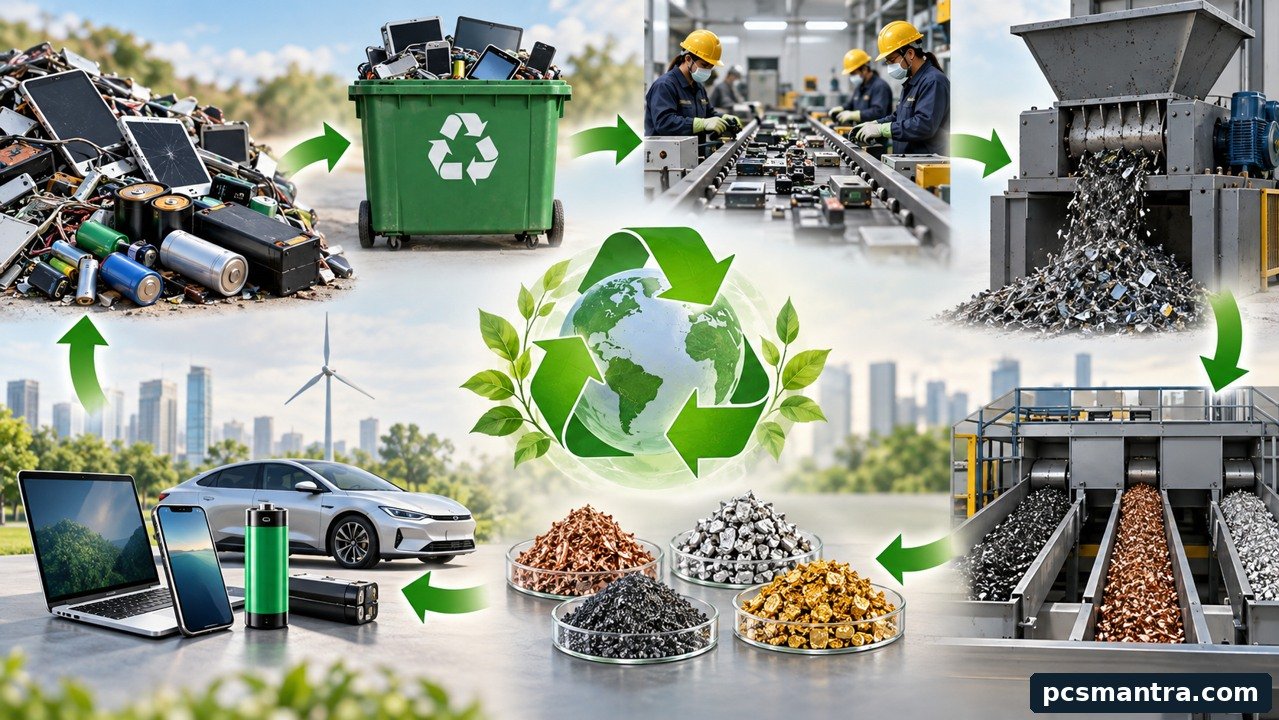
- Technology: The company's integrated and patented recycling process will recover valuable metals and battery materials from both e-waste and battery waste, bringing discarded material back into the productive economy.
- Goal: To advance the technology from TRL-5 to TRL-9 - from validation to commercial-scale deployment.
- Intent: As TDB Secretary Shri Rajesh Kumar Pathak said, an India moving towards clean energy and advanced technologies needs secure, sustainable access to critical minerals; recovery from e-waste is a foundation of the circular economy.
What are TRL levels
Technology Readiness Level (TRL): A 1-to-9 scale measuring a technology's maturity. TRL 1-3 cover concept and laboratory research, TRL 4-6 cover prototypes and validation in a relevant environment (TRL-5 = component validation in a relevant environment), and TRL 7-9 run from demonstration to proven operation in a real system (TRL-9 = technology proven in actual operations).
Exam relevance
For Prelims: TDB's status (under DST), the RDI Fund, OCD, the TRL scale and recovery of critical metals from e-waste are direct question areas.
For Mains: Self-reliance in critical minerals, urban mining and the circular economy - for multi-dimensional GS-III answers.
Way Forward
If the project succeeds, India will gain a stronger domestic supply chain of critical minerals from e-waste and battery waste, import dependence will fall, and waste management will bring environmental gains. Once the technology reaches TRL-9, it can be scaled to other recycling units.
Prelims Practice Questions
Q1. With reference to the TDB-Neo Seekermetals agreement, consider the following statements:
Statement 1: The total project cost is about Rs 20 crore, with about Rs 10 crore supported from the RDI Fund
Statement 2: The project aims to develop the technology from TRL-5 to TRL-9
Statement 3: The TDB is an autonomous component of the Indian Space Research Organisation (ISRO)
Which of the statements given above is/are correct?
Answer and Explanation
Correct answer: (a) 1 and 2 only
Explanation: Statement 1 is correct: the total cost is Rs 20 crore, with Rs 10 crore from the RDI Fund through OCD. Statement 2 is correct: the goal is to move from TRL-5 to TRL-9 (commercialisation). Statement 3 is incorrect: the TDB is a statutory body under the Department of Science and Technology (DST); it is not an autonomous component of ISRO.
Q2. Which stage does TRL-9 represent?
Answer and Explanation
Correct answer: (d) A technology proven in actual operations in a real system
Explanation: TRL-9 is the highest maturity - proven in actual operations; TRL-5 is component validation in a relevant environment.
Mains Practice Question
How is e-waste recycling (urban mining) a strategic option for the supply security of critical minerals? Analyse with reference to the TDB's recent project financing. (GS-III; 250 words)
Answer Outline:
Introduction: Introduce the TDB-Neo Seekermetals agreement (RDI Fund, 16 November 2026); define critical minerals.
Main Body: Recovery of metals like lithium, cobalt and nickel from e-waste/batteries cuts import dependence; the TRL-5 to TRL-9 leap as the commercialisation path; instruments like OCD supporting high-risk innovation; circular economy and waste-management gains; challenges - collection systems, safety standards and scale.
Conclusion: Conclude that urban mining is a shared solution for supply security and environmental safety; public finance accelerates private innovation.
Frequently Asked Questions (FAQ)
Short answer: TDB (DST) signed an agreement with Neo Seekermetals (Hyderabad) under the RDI Fund - Rs 10 crore through OCD within a Rs 20 crore project - to take e-waste and lithium-ion battery critical-metal recovery technology from TRL-5 to TRL-9.
Q: What is the TDB?
The Technology Development Board - a statutory body under the Department of Science and Technology (DST) that finances the commercialisation of indigenous new technologies.
Q: What is OCD?
Optionally Convertible Debt - a loan that can be converted into equity under set conditions.
Q: What does TRL-5 to TRL-9 mean?
The journey on the technology-maturity scale from a component validated in a relevant environment (TRL-5) to a technology proven in actual operations (TRL-9).
Sources
- PIB - TDB-DST Signs Agreement with NeoSeeker Metals under RDI Fund to Advance Indigenous Critical Minerals Recovery Technology (16 November 2026): https://www.pib.gov.in/PressReleasePage.aspx?PRID=2336782&lang=1®=3
Related articles (internal links)
- The San Francisco Declaration: 10 Countries Including India to Secure AI Supply Chains
- The Other Picture of the AI Boom: Rising Opposition to Data Centre Expansion
Download this article: PDF (English)