
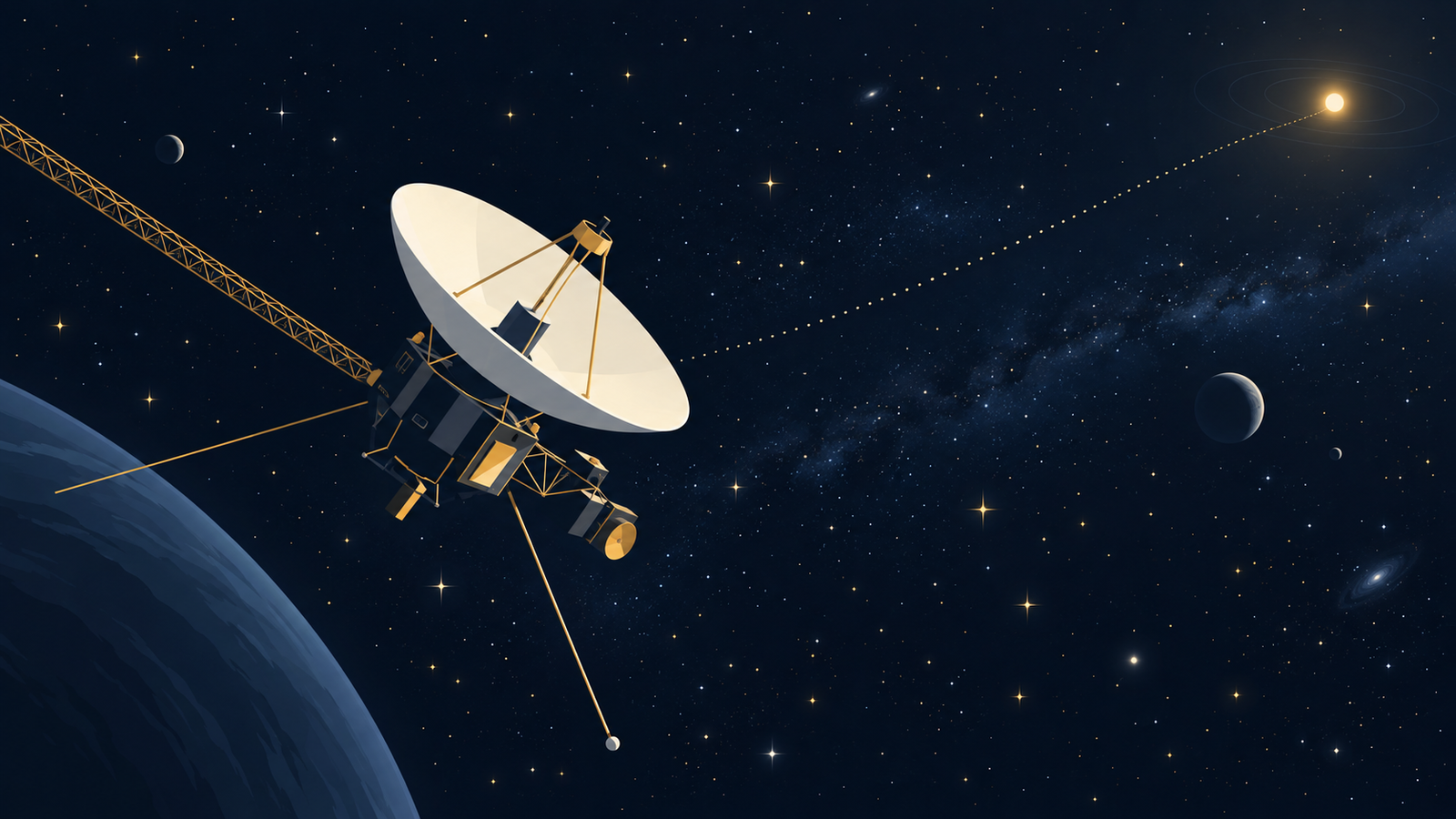
16 November 2026: On Wednesday, 18 November, NASA's Voyager 1 will have travelled one light-day from Earth - more than 16 billion miles (25.9 billion kilometres). Light from Earth now takes 24 hours to reach the spacecraft. It remains the most distant human-made object ever. NASA is marking the milestone with "Shine Bright for Voyager's Light-Day" on 17 November and a JPL panel on 19 November.
What is a light-day?
- Definition: the distance light (~300,000 km/s) covers in 24 hours - about 25.9 billion km.
- Scale: the Earth-Sun distance (1 AU) is just ~8.3 light-minutes; Voyager 1 is roughly 173 times farther.
- Communication: one-way radio time is ~24 hours, so a command-answer round trip takes ~48 hours; only NASA's Deep Space Network (DSN) stays in touch.
Mission facts
- Launch: 1977; the twin probes were designed to exploit a planetary alignment that occurs once every 176 years - the "grand tour" of the outer planets.
- Interstellar space: Voyager 1 crossed the heliosphere in 2012, Voyager 2 in 2018; both still return unique data from beyond the Sun's protective bubble.
- Management: NASA's Jet Propulsion Laboratory (operated by Caltech); funded by the Heliophysics Division; DSN, also JPL-managed, handles communications.
- 50th anniversary (2027): a NASA+ Voyager documentary is planned.
Scientific significance
- Heliosphere: the solar-wind bubble shielding the solar system from interstellar radiation; the Voyagers are its only in-situ sentinels beyond the boundary.
- Interstellar medium: direct measurements of plasma density, magnetic fields and cosmic rays - impossible from Earth.
- Golden Record: each probe carries a copper disc of Earth's sounds and images - a message from human civilisation.
Quiz: Test your knowledge
Q1: Consider: 1. Voyager 1 was launched in 1977 2. It entered interstellar space in 2018 3. In November 2026 it will be one light-day from Earth. Which are correct?
(a) 1 and 2 only
(b) 1 and 3 only
(c) 2 and 3 only
(d) 1, 2 and 3
Answer and explanation: (b) Voyager 1 entered interstellar space in 2012 (Voyager 2 in 2018); on 18 November 2026 it will be ~16 billion miles - one light-day - away.
Q2: Which network communicates with the Voyager probes?
(a) Near Earth Network (NEN)
(b) Deep Space Network (DSN)
(c) TDRSS
(d) ISTRAC
Answer and explanation: (b) The JPL-managed Deep Space Network, with stations at Goldstone, Madrid and Canberra, communicates with the distant probes.
Frequently Asked Questions (FAQ)
In short: On 18 November 2026 Voyager 1 will be one light-day (~16 billion miles / 25.9 billion km) from Earth; launched in 1977 and in interstellar space since 2012, it is the most distant human-made object.
Question: How far is one light-day?
The distance light travels in 24 hours - about 25.9 billion km or 16 billion miles; a radio signal takes ~24 hours one way.
Question: When did Voyager 1 reach interstellar space?
In 2012 it crossed the heliosphere; on 18 November 2026 it becomes one light-day from Earth - the most distant human-made object.
Question: Who manages the Voyager mission?
NASA's Jet Propulsion Laboratory, operated by Caltech; communications via the Deep Space Network and funding from NASA's Heliophysics Division.
Sources:
- https://www.nasa.gov/news-release/nasa-invites-media-public-to-join-voyager-1-one-light-day-activities/ (official: NASA, 10 November 2026)
- https://www.thehindu.com/sci-tech/science/nasas-voyager-1-closes-in-on-a-light-day-in-interstellar-space-for-new-distance-record/article71704036.ece
Download this article: PDF (English)