
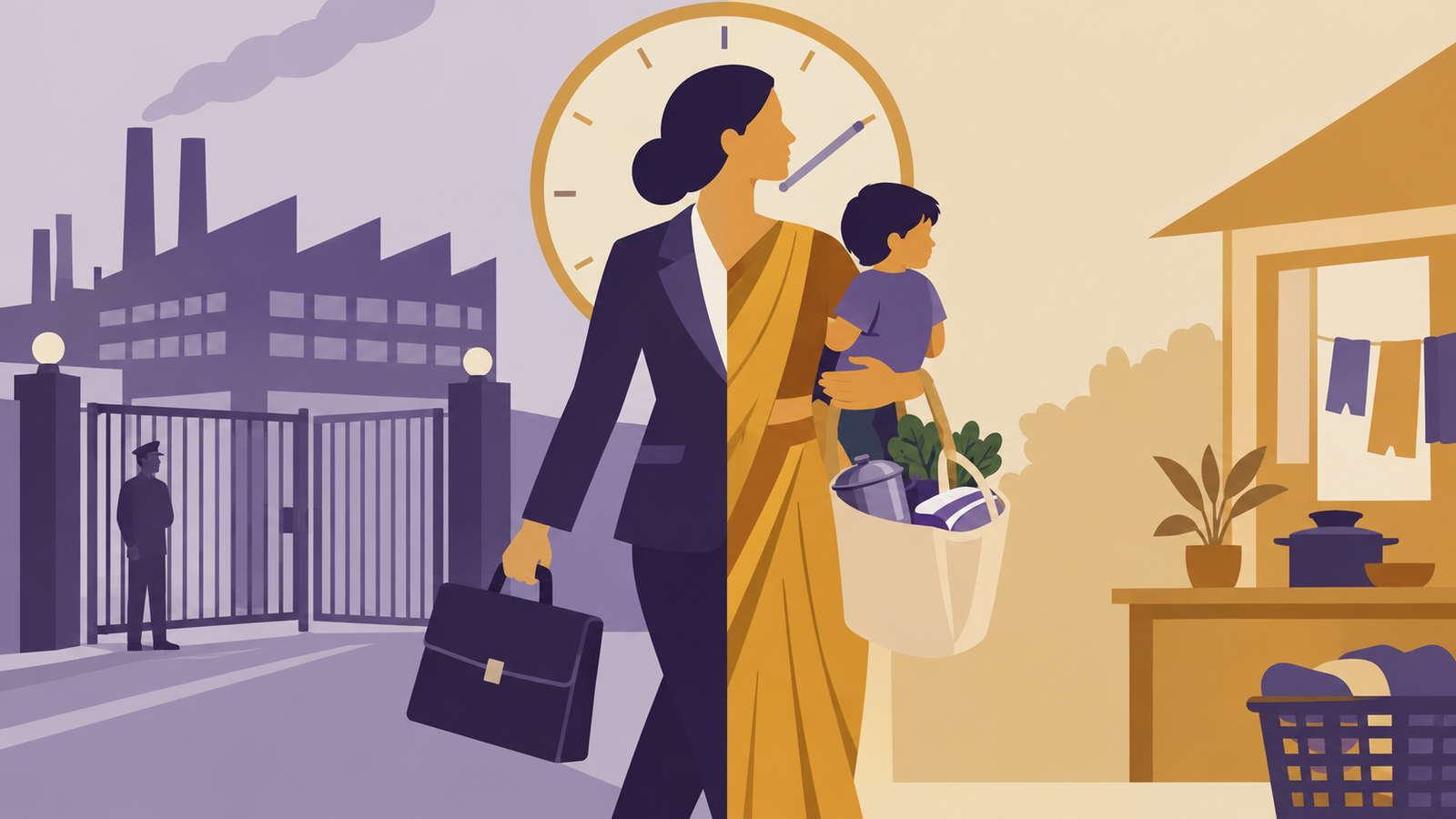
Why in the News
The government is preparing to read the real barrier to women's workforce participation through data. Per the Indian Express (16 November 2026), MoSPI (Ministry of Statistics and Programme Implementation) is proposing changes to two major surveys - PLFS and ASUSE - that will properly measure unpaid domestic and care work for the first time. The World Bank estimates that raising the Female Labour Force Participation Rate (FLFPR) from the current 34.6% (September 2026) to 50% would ease the path to the ~8% growth needed for Viksit Bharat 2047 - but the full data on why women stay out of paid work does not yet exist.
MoSPI's Proposed Changes
- In the PLFS: whether household-produced goods and services (cooking, feeding children, eldercare) are for self-consumption or commercial purposes; whether the person actively sought paid work in the last 30 days; whether they currently wish to work; and the principal reasons for not seeking work - including family and household responsibilities.
- The existing gap: the PLFS already asks reasons, but categories like "childcare/homemaking" are too generic. In 2025, 44.4% of women cited this as their reason for not seeking work; the data does not say whether the unpaid work was by choice or out of social expectation or a sense of duty.
- In the ASUSE: female business owners will be asked about barriers - limited time for the enterprise, restrictions on mobility outside the home, and household and caregiving obligations.
What the Time Use Surveys Say
The government's Time Use Surveys (2019 and 2024) make the asymmetry clear: working-age men (15-59) spent 62 minutes a day on unpaid activities in 2024 (74 in 2019), while women spent 366 minutes (364 in 2019) - nearly six times more. Interestingly, female LFPR rose from about 26.5% to 43.6% over the same period. Unpaid work and rising participation are moving together - so the simple conclusion "care work = quitting work" should not be drawn without better data.
Structural Barriers: The Tamil Nadu Lesson
Unpaid care is only part of the problem; returning to work also requires adequate wages, workplace proximity, safe transport and suitable accommodation. Tamil Nadu accounts for four of every ten directly employed female factory workers in India - the State has adopted elements of the Chinese manufacturing model: dormitories/hostels for women workers near factories or inside industrial campuses. This reduces both commuting distance and safety barriers at once and makes migrant women's employment possible.
The Way Forward
- Expand affordable creches, childcare and accessible eldercare facilities (care infrastructure).
- Improve the measurement and recognition of unpaid work.
- Promote shared distribution of household responsibilities.
- Safe transport, affordable housing and gender-sensitive workplaces.
- Credit, skills, markets and flexible arrangements for women entrepreneurs.
- Region-specific policies from disaggregated PLFS/ASUSE data.
One limit worth noting: the reliability of findings will depend on accurate reporting by respondents - MoSPI officials believe people generally report work accurately, though expectations of government benefits may sometimes influence responses.
Prelims Practice Questions
Q1: Per the Time Use Survey (2024), what was the average daily time spent on unpaid activities (age group 15-59)?
(a) Men 366 minutes, women 62 minutes
(b) Men 62 minutes, women 366 minutes
(c) Men 74 minutes, women 364 minutes
(d) Both about 200 minutes
Answer and Explanation
Answer: (b) In 2024, men spent 62 minutes (74 in 2019) and women 366 minutes (364 in 2019) - women spend nearly six times more time on unpaid work.
Q2: Which two surveys are proposed to be changed by MoSPI?
1. Periodic Labour Force Survey (PLFS)
2. Annual Survey of Unincorporated Sector Enterprises (ASUSE)
3. National Family Health Survey (NFHS)
(a) 1 and 2 only
(b) 2 and 3 only
(c) 1 and 3 only
(d) 1, 2 and 3
Answer and Explanation
Answer: (a) Changes are proposed in the PLFS (questions on unpaid work and the wish to work) and the ASUSE (barriers for women entrepreneurs); the NFHS is a health survey, not part of this.
Mains Practice Question
Question: "The path to raising women's workforce participation runs through better measurement of unpaid care work and the removal of structural barriers." Discuss in the light of MoSPI's proposed survey changes. (250 words)
Outline: Introduction - FLFPR 34.6% and Viksit Bharat 2047; the problem - 44.4% citing "care/homemaking", the TUS six-fold asymmetry; the changes - new PLFS/ASUSE questions; structure - the Tamil Nadu model, care infrastructure; limits - data reliability; conclusion - evidence-based policy for inclusive growth.
Frequently Asked Questions (FAQ)
Short answer: MoSPI is changing its PLFS and ASUSE surveys so that unpaid domestic and care work, the real reasons for not seeking work, and barriers for women entrepreneurs get measured - so that policies to raise women's workforce participation rest on the right data.
Q: How does unpaid care work hold back workforce participation?
The unequal burden of childcare, eldercare and housework (women ~366 minutes/day vs men ~62) restricts women's time and mobility, keeping them out of paid work or even out of job search.
Q: What new questions will the PLFS add?
Whether household production is for self-consumption or commercial use; whether work was sought in the last 30 days; whether the person wishes to work now; and the principal reasons for not seeking work - so that "choice" and "social pressure" can be told apart.
Q: What is the Tamil Nadu model?
Dormitories/hostels for women workers near factories or inside industrial campuses - reducing commuting and safety barriers to enable migrant women's employment; the State accounts for four of every ten directly employed female factory workers in India.
Sources
- Indian Express (Explained, 16 November 2026): Unpaid care work and MoSPI's survey changes - PLFS/ASUSE/TUS figures from this report (MoSPI publishes the underlying surveys separately; no single official document compiles these figures)
- MoSPI (official body): original PLFS and Time Use Survey publications
Download this article: PDF (English)