
Prelims and Mains | News context: 17 November 2026
Why in the news
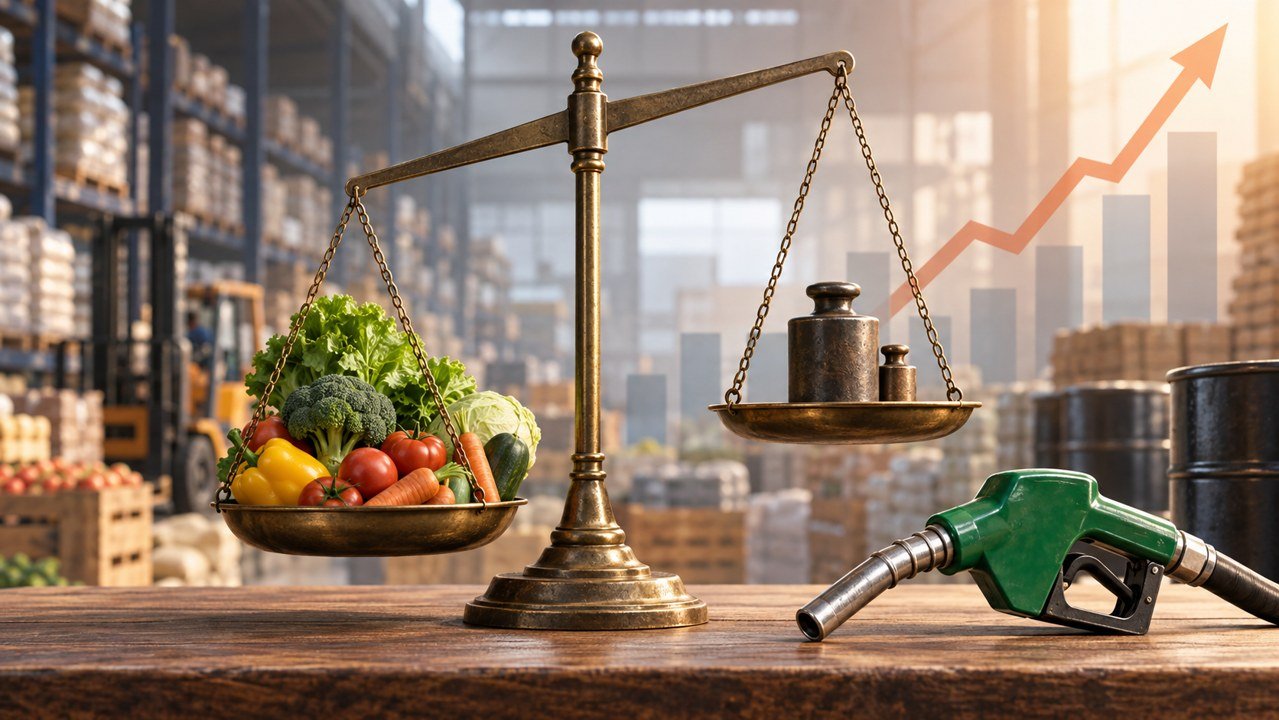
The Ministry of Commerce and Industry released the provisional Wholesale Price Index (WPI) data for October 2026 on 16 November 2026. Wholesale inflation rose to 12.29% (year-on-year) from 11.39% in September 2026 - the second consecutive month of WPI in double digits. This is the highest level in the new series (available since April 2023).
Key figures (base year 2022-23)
All commodities: index 113.3 (112.5 in September); inflation 12.29%
Primary articles: 9.24% (8.67% in September); index 120.6
Fuel and power: 32.84% (25.85% in September); index 115.7 - the biggest driver
Manufactured products: 9.54% (9.76% in September); index 110.2
WPI Food Index: 8.58% (weight 24.99%) - it comprises 'Food Articles' from Primary Articles and 'Manufacture of Food Products' from Manufactured Products
Drivers of inflation: mineral oils (petroleum products), crude petroleum and natural gas, electricity, food articles, basic metals, chemicals, manufacture of food products, non-food articles, textiles, and rubber and plastic products. Inflation in the crude petroleum and natural gas segment stayed above 70% (70.8% in October, 57.3% in September). The final index for August 2026 remained unchanged at 110.8 (inflation 9.92%).
What WPI is and why the new series matters
Introduction: The Wholesale Price Index measures the change in prices of goods at the wholesale level; in India it is released by the Office of the Economic Adviser (eaindustry.nic.in) under the Ministry of Commerce and Industry. The current series has base year 2022-23, with data available from April 2023.
Towards PPI: Along with this release, the ministry also issued the Output Producer Price Index (Output PPI) and a trial Input PPI - the process of moving towards a producer price index, in line with international practice, is continuing.
Retail linkage: CPI data released earlier showed retail inflation in October above the RBI's 6% upper tolerance mark. Wholesale price pressures may pass through to retail prices in the coming months, making the December Monetary Policy Committee (MPC) meeting even more significant.
Way forward
Fuel-driven price pressure will depend on international crude prices and the rupee. If the pass-through of wholesale inflation into retail prices increases, monetary policy will face more pressure; the upcoming data on the WPI-to-PPI transition will also bear watching.
Analysis: causes and challenges
Supply-side causes: Crude oil prices are high amid the West Asia conflict; the fuel chain's effect is spreading to transport, manufacturing and food. Lower sowing/production prospects for rice, maize, oilseeds and pulses (especially tur) could add to food price pressure.
Demand-side causes: Festive-season purchases have added demand-pull pressure, which can make inflation 'sticky'.
Policy dilemma: A rate hike is needed for price stability, but it can dampen lending, investment and consumption, affecting growth. Meanwhile, the Central Government is managing domestic availability with fiscal tools such as fuel export duties (the diesel export duty was raised to ₹14 per litre on 16 November).
Index transition: The CPI is on a new series (base 2024) and the WPI on a new series (base 2022-23); the move from WPI to PPI is also under way - long-run comparative analysis demands caution.
Mains practice question
Question 1. "Inflation in India is currently predominantly supply-driven, yet monetary policy faces difficult choices." Examine this statement in the light of the October 2026 data. (Answer in 250 words - 15 marks)
Answer outline
In the introduction: Introduce the topic with the October 2026 figures - CPI 6.09% and WPI 12.29%; state the RBI's 4±2% target framework.
In the main body: (1) Supply-side causes - crude petroleum at 70.8% (WPI), fuel and power 32.84%, food at 8.94% (CFPI), production concerns for tur and other crops (2) Demand-side signals - festive demand, series-high inflation across groups (3) Monetary options - repo at 5.50% in October, 'calibrated tightening'; the dilemma between a rate hike and growth-investment (4) Complementary fiscal measures - export duties, supply management.
In the conclusion: Give a balanced view - supply-driven inflation will not be contained by rate hikes alone; monetary-fiscal coordination and supply-side correction must move together.
Frequently asked questions
Q1: What was wholesale inflation in October 2026?
Answer: WPI-based wholesale inflation was 12.29% (year-on-year); it was 11.39% in September 2026.
Q2: What is the base year of the current WPI series?
Answer: 2022-23; data for this series is available from April 2023.
Q3: Which group saw the highest inflation?
Answer: Fuel and power at 32.84%; the crude petroleum and natural gas segment reached 70.8%.
Prelims practice questions
Question 1: Consider the following statements with reference to the WPI (base year 2022-23) for October 2026:
Statement 1: Year-on-year inflation for all commodities was 12.29%
Statement 2: Inflation in the fuel and power group was 32.84%
Statement 3: The weight of the WPI Food Index in WPI is 24.99%
Which of the above statements are correct?
Answer and explanation
Correct answer: (d)
All three statements match the official data of the Ministry of Commerce and Industry released on 16 November 2026
Question 2: Consider the following statements:
Statement 1: In India, WPI is released by the Ministry of Commerce and Industry
Statement 2: The base year of the current WPI series is 2011-12
Which of the above statements is/are correct?
Answer and explanation
Correct answer: (a)
Statement 1 is correct - WPI is released by the Ministry of Commerce and Industry (Office of the Economic Adviser)
Statement 2 is incorrect - the base year of the current series is 2022-23
Sources
- PIB, Ministry of Commerce and Industry, provisional WPI data for October 2026 (16 November 2026): www.pib.gov.in
-
DD News: ddnews.gov.in
Related reading
Download this article: PDF (English)