
Published: 23 November 2026
In this article
Why in the news
An official ESA Operations update dated 22 November 2026 confirms BepiColombo’s successful capture into orbit around Mercury. It also reports that the thruster burn was shorter than planned following a software issue. The spacecraft is safe and teams at ESOC are investigating what happened. Orbital capture is therefore confirmed, but this does not establish that every planned step proceeded as intended or that routine science operations have begun.
What is the mission?
BepiColombo is a joint Mercury-exploration mission of the European Space Agency (ESA) and the Japan Aerospace Exploration Agency (JAXA). It launched on an Ariane 5 rocket from French Guiana on 20 October 2018. The mission aims to study Mercury’s interior, surface and magnetic environment together.
Two orbiters, different roles
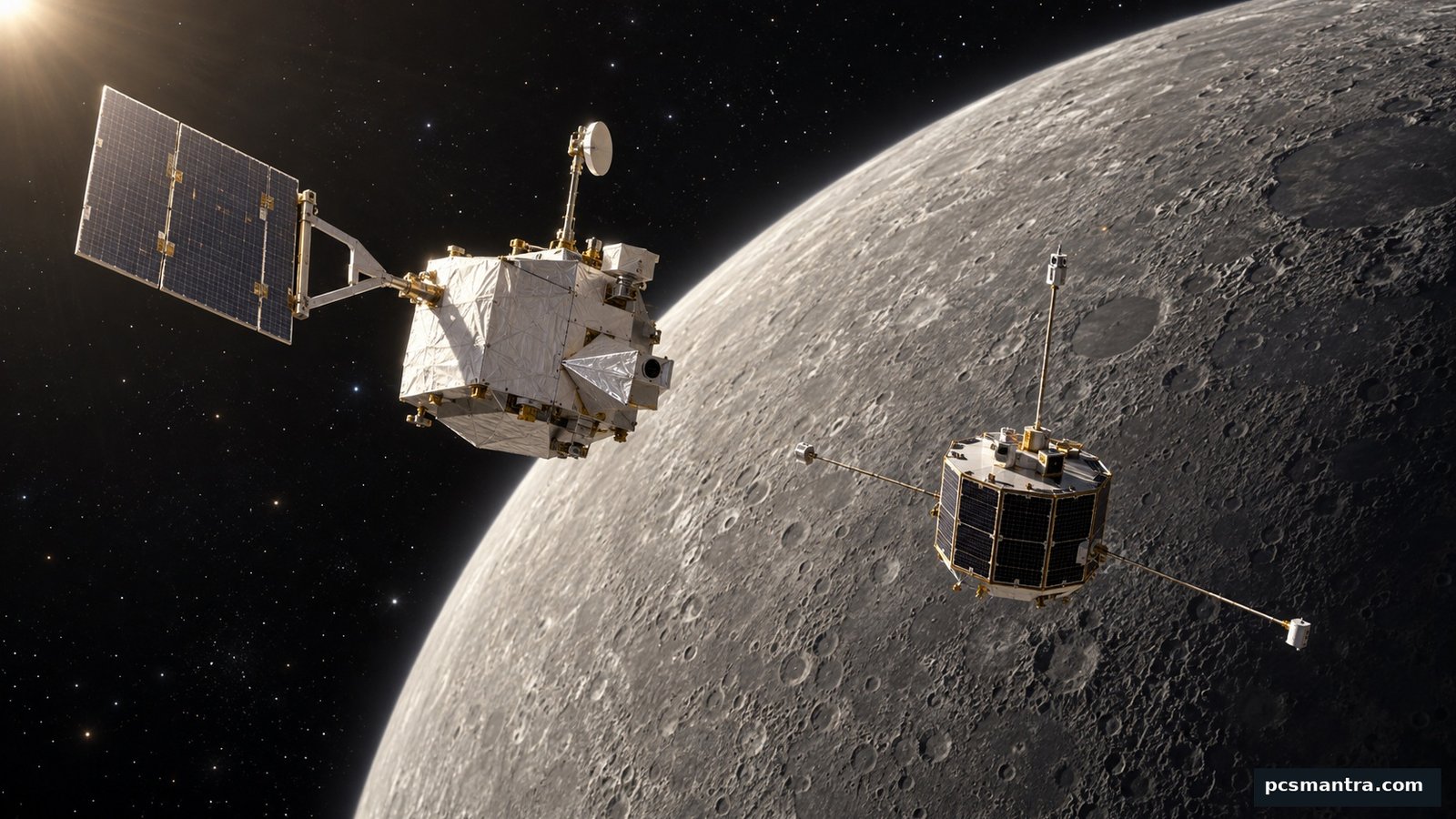
ESA’s Mercury Planetary Orbiter (MPO) and JAXA’s Mio, formerly called the Mercury Magnetospheric Orbiter (MMO), are its two science spacecraft. MPO addresses the planet’s surface and interior; Mio focuses on its magnetic field and magnetosphere. A magnetosphere is the region where a planet’s magnetic field influences the motion of charged particles.
Passing a planet is not orbiting it
During a flyby, a spacecraft passes close to a planet. A gravity assist uses planetary gravity to alter its path and velocity. Orbit insertion requires slowing sufficiently to enter an orbit bound to the planet. The mission’s journey has involved a plan of nine planetary flybys. A close approach or an attractive image is not, by itself, orbit insertion.
Arrival has several stages
The Mercury Transfer Module (MTM) separated successfully on 3 September 2026, an officially confirmed milestone. MPO then had to power and control the combined science spacecraft during the final approach. Orbit insertion, Mio separation, instrument checks and routine science operations are separate stages. The earlier ESA schedule envisaged spacecraft separation in December and science beginning in April 2027. Their current timing and any scientific impact require separate confirmation after the software issue; the old schedule is not evidence of completed operations.
Distinctions for the exam
Mercury is the smallest planet and the closest to the Sun. Studying its magnetic environment alongside its surface can help explain planetary evolution. Travelling towards the Sun is not a simple straight flight: slowing under solar gravity to reach Mercury orbit is difficult. Distinguishing a plan, a test and a confirmed achievement is a basic rule for reading science news.
Prelims practice
Question 1. Consider the following statements about BepiColombo:
Statement 1: It is a joint ESA-JAXA mission to Mercury.
Statement 2: Both Mio and MPO were developed by ESA.
Which of the statements given above is/are correct?
Answer and explanation
Answer: (a).
Statement 1 is correct. Statement 2 is incorrect: MPO is European and Mio is Japanese. Their scientific roles complement each other.
Frequently asked questions
Is a flyby the same as orbit insertion?
No. Passing a planet and entering an orbit bound to it are different.
Are Mio and MMO different spacecraft?
No. Mio is the name of Japan’s Mercury Magnetospheric Orbiter.
Does routine science begin immediately on arrival?
No. Spacecraft separation and instrument commissioning are also required.
Sources
- https://bsky.app/profile/operations.esa.int/post/3n2w6styopc22
- https://www.esa.int/articles/about-us/directorates/science/bepicolombo/latest-updates-bepicolombo-s-arrival-at-mercury
- https://www.esa.int/media/bepicolombo-arrival-at-mercury-timeline
- https://mio.isas.jaxa.jp/en/mission/
Download this article: PDF