
Published: 22 November 2026
In this article
Why in the News
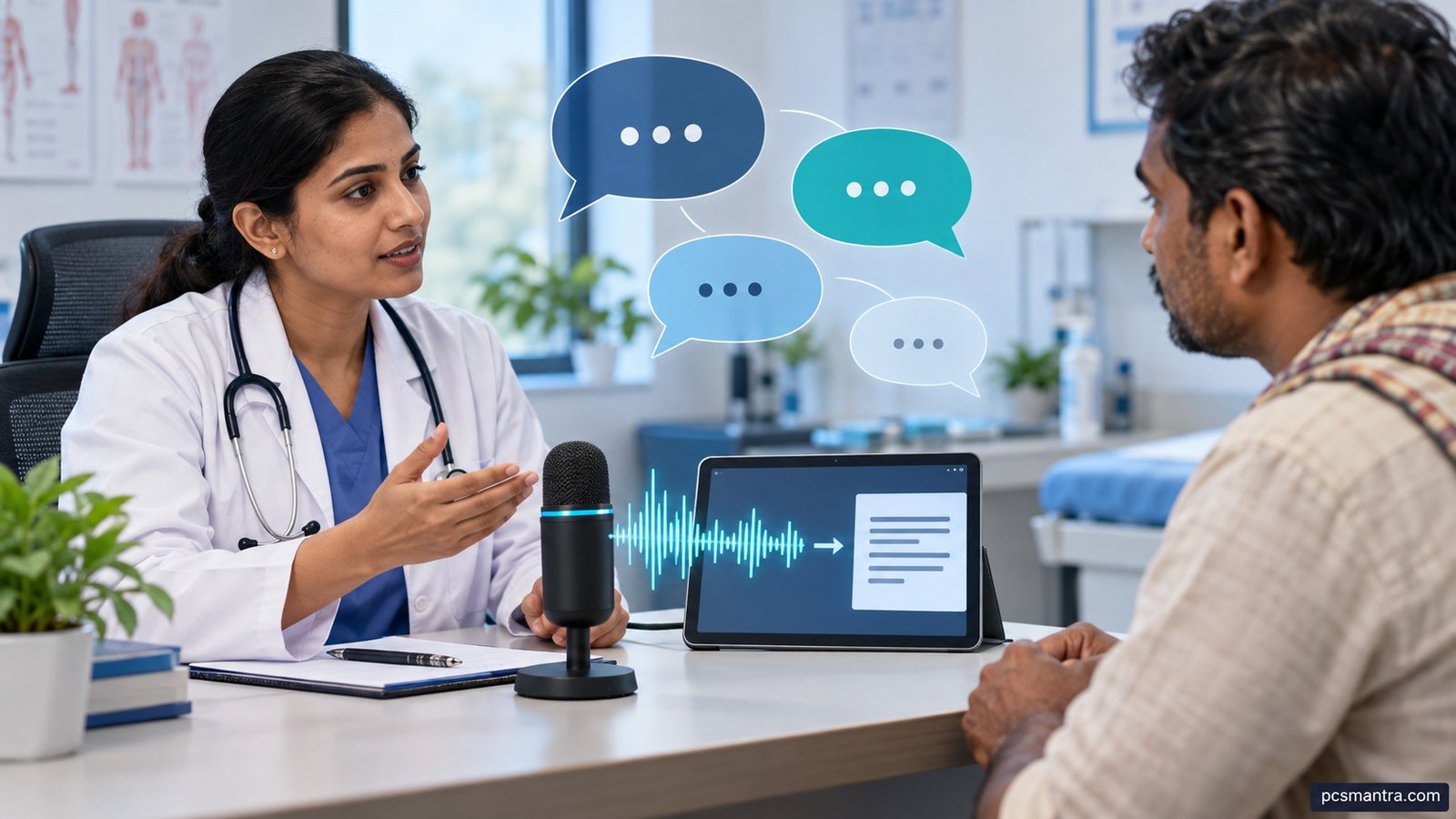
At the Global Digital Health Summit 2026 at Bharat Mandapam in New Delhi, BHASHINI demonstrated multilingual AI applications for healthcare. Examples involving AIIMS, JIPMER and the Directorate General of Medical Services (Army) focused on doctor-patient communication and voice-based clinical documentation. This concerns language assistance within clinical work, not independent treatment decisions by a machine. [1]
What BHASHINI is
The Digital India BHASHINI Division (DIBD) is under the Digital India Corporation and the Ministry of Electronics and Information Technology. It is building a language-technology ecosystem for multilingual digital inclusion. Its capabilities include translation, speech recognition, speech synthesis and transliteration. [1]
Speech recognition converts spoken language into text. Speech synthesis converts text into audio. Transliteration represents a word in another script, whereas translation conveys its meaning in another language. These functions should not be treated as interchangeable.
Applications shown in hospitals
JIPMER: e-BHASHINI was shown integrated with the e-Sushrut Hospital Management Information System. The example supports voice-based recording of case histories, inpatient notes and discharge instructions. [1]
AIIMS: speech technologies were demonstrated for conversations across languages. The official account also mentions speech-to-text integration with AIIMS New Delhi's eHospital prescription module and expansion following a Neurology and Neurosurgery pilot. [1]
Army medical services: the Dhanwantri example converts doctors' spoken clinical notes into typed text. Shrutlekh was also demonstrated for multilingual transcription and translation. These are different institutional use cases, not a uniform achievement across every hospital. [1]
Why language access matters
Patients who can explain their concerns in a familiar language may gain more meaningful access to care. Voice documentation can assist doctors with typing-related work. Accurate recognition of dialects, clinical terms and medicine names remains important. These are potential benefits and evaluation needs; the news does not establish a universal error-free performance rate.
Data Daan was presented as community participation in language-data contribution, and Granthika as a guided platform for collecting and digitising written and oral language resources. Such resources matter for the quality and diversity of language services. [1]
Conditions for safe use
Language assistance should not replace clinical judgement. Doctors should check generated text, medicine names and instructions. Patients need a simple way to correct errors. Limited data collection, secure access and clear consent deserve a place in the design of health-information systems. These are implementation recommendations, not findings that a demonstrated system has failed.
Way forward
Evaluation should ask how accurate and useful communication became, not merely count translations. Local-language and dialect testing, clinical review, error correction and non-digital assistance are important. Success means that patients understand and healthcare professionals can use the service with confidence.
Mains practice questions
Examine the role of initiatives such as BHASHINI in reducing language-based digital exclusion in healthcare. Identify the conditions for safe use. (250 words, 15 marks)
Answer outline
- Introduction:
Connect language barriers with effective access to healthcare. Briefly introduce the healthcare demonstrations involving BHASHINI. - Main body:
Use JIPMER documentation, AIIMS communication/prescriptions and Dhanwantri speech-to-text as examples. Explain potential inclusion and documentation benefits. Discuss clinical-term errors, linguistic diversity, privacy and digital exclusion. Recommend clinical verification, consent, local testing and correction mechanisms. - Conclusion:
Keep multilingual technology as an aid, not a substitute for final clinical judgement. Judge success through understandable and safe care.
Sources
Frequently asked questions
Are speech recognition and translation the same function?
No. Speech recognition converts audio into text; translation conveys meaning in another language.
Does a demonstration establish deployment in every hospital?
No. The account describes institutional examples, not uniform nationwide deployment.
What does Granthika address?
It is a guided platform for collecting and digitising written and oral language resources.
Download this article: PDF