
Disaster management / technology | News context: parliamentary answer on the Cell Broadcast System for disaster alerts | Published: 19 October 2026
Background and Context
Cell broadcast pushes an alert to every phone in a defined geographic cell area at once, without needing phone numbers and without depending on network congestion the way SMS does. It is the standard technology for last-mile disaster warning: a message appears on the handset with a distinct tone.
Why in the News
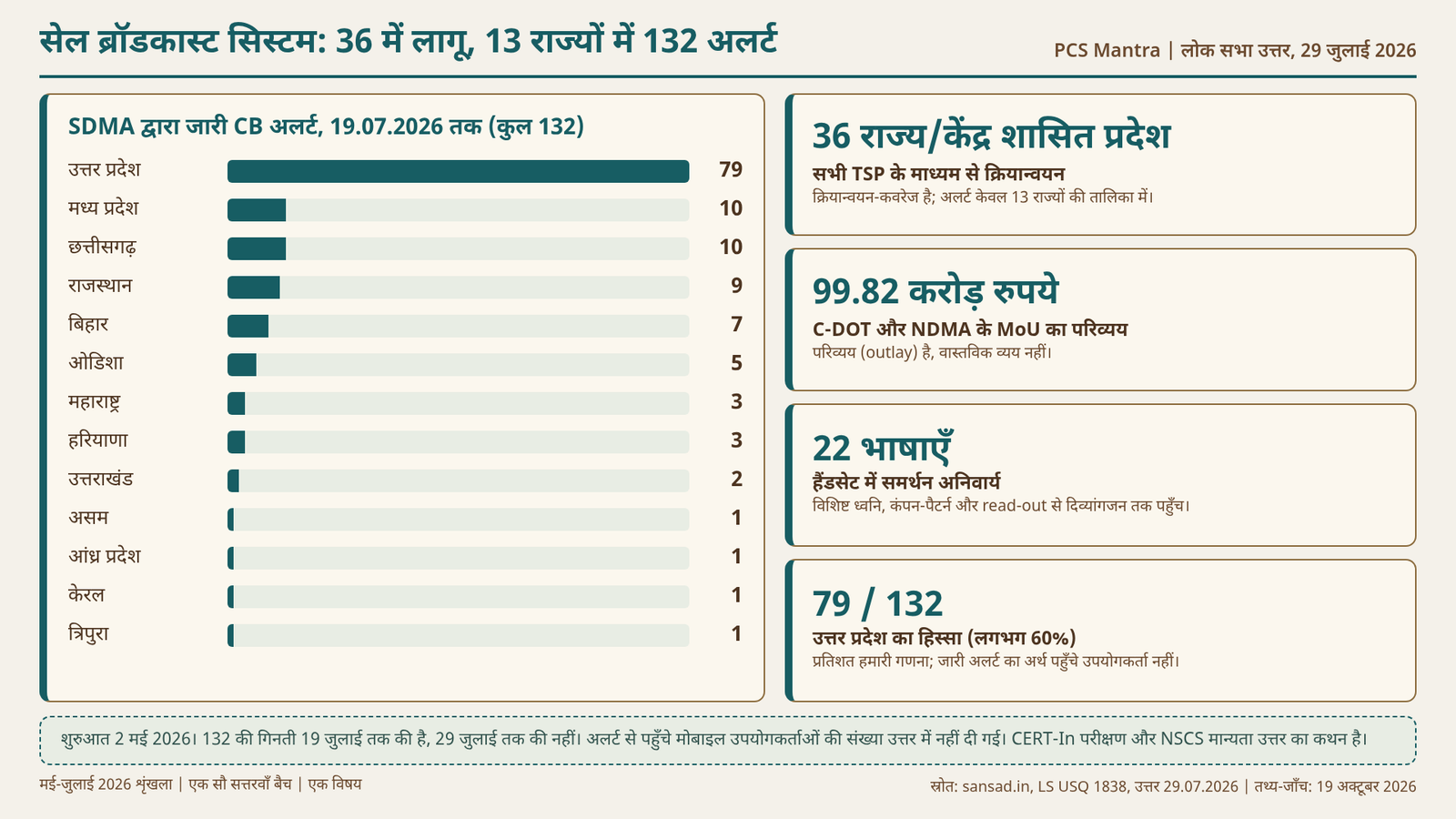
A parliamentary answer described the deployment of the Cell Broadcast System (CBS) for disaster alerts in India, including the number of pre-approved alert message templates and the agencies authorised to send them.
Core Concept: Common Alerting Protocol and Pre-Approved Templates
Alerts follow the Common Alerting Protocol (CAP), so one alert can flow across sirens, TV, radio, apps and cell broadcast. Pre-approved message templates ("lists") let a disaster authority send a standardised alert in seconds without drafting under pressure. The count of approved lists is a measure of preparedness, not of alerts actually sent.
Key Facts and Figures
| Pre-approved lists | 132 pre-approved alert message lists are in place, per the answer (figure as printed in the source). |
|---|---|
| System | Cell Broadcast System for location-targeted disaster alerts integrated with the national early-warning setup; alerts originate from authorised disaster-management agencies and are broadcast through telecom networks to phones in the target area. |
How to Read the Number
Readiness vs use: 132 lists is the library of ready alerts; it does not say how often alerts were sent, to how many phones, or whether they arrived in time. Effectiveness evidence is separate.
Handset dependence: cell broadcast reception depends on the handset supporting and enabling it; coverage claims and actual receipt are different questions.
Challenges and What We Have Not Read
We read the parliamentary answer as reported. Test-alert reports, handset-compatibility data and independent assessments of alert latency we have not read.
The Road Ahead
Watch test alerts and post-disaster reviews; those are the evidence of whether the system works at the last mile.
Distinction of Concepts
(1) Cell broadcast vs SMS; (2) pre-approved template count vs alerts actually sent; (3) system capability vs last-mile receipt; (4) readiness vs effectiveness.
Mains View
GS-III: disaster management, science and technology applications. In answers, note both the technology's strength (congestion-free area targeting) and its dependence on handset support and drills.
UPSC CSE Mains Style: Core Practice Question
Cell broadcast is now part of India's disaster early-warning chain. Discuss its advantages over SMS-based alerting and the conditions on which its last-mile effectiveness depends.
(Answer in 150 words) | 10 marks
Outline of the Answer
Introduction: the CBS deployment and 132 pre-approved lists. Main body: area targeting without numbers; congestion independence; CAP integration; handset and drill dependence; readiness vs effectiveness. Conclusion: templates prepare, tests prove.
Also read: Mission Mausam: 50 Radars and a Plan for 86 New Radars.
Sources
- https://sansad.in/getFile/lsapps/loksabhaquestions/annex/188/AU1838_Wd4AG2.pdf - Lok Sabha unstarred question 1838, answered 29.07.2026 (two pages)
- https://trai.gov.in/sites/default/files/2024-09/CP_03112021.pdf - TRAI consultation paper: SMS and cell broadcast alerts (CAP platform)
- https://www.itu.int/en/ITU-D/Emergency-Telecommunications/Pages/EW4ALL/cell-broadcast.aspx - ITU: Cell broadcast early warning system (CB features)
Download this article: PDF (English)