
Published: 27 November 2026
In this article
Why in the news
Debate on AI-assisted writing and credit keeps raising one legal question: if a work is sold or its copyright is assigned, does the author keep any rights? In India the starting point is Section 57 of the Copyright Act 1957. This note only explains that section for exam use. It does not decide any particular book or dispute.
What Section 57 says
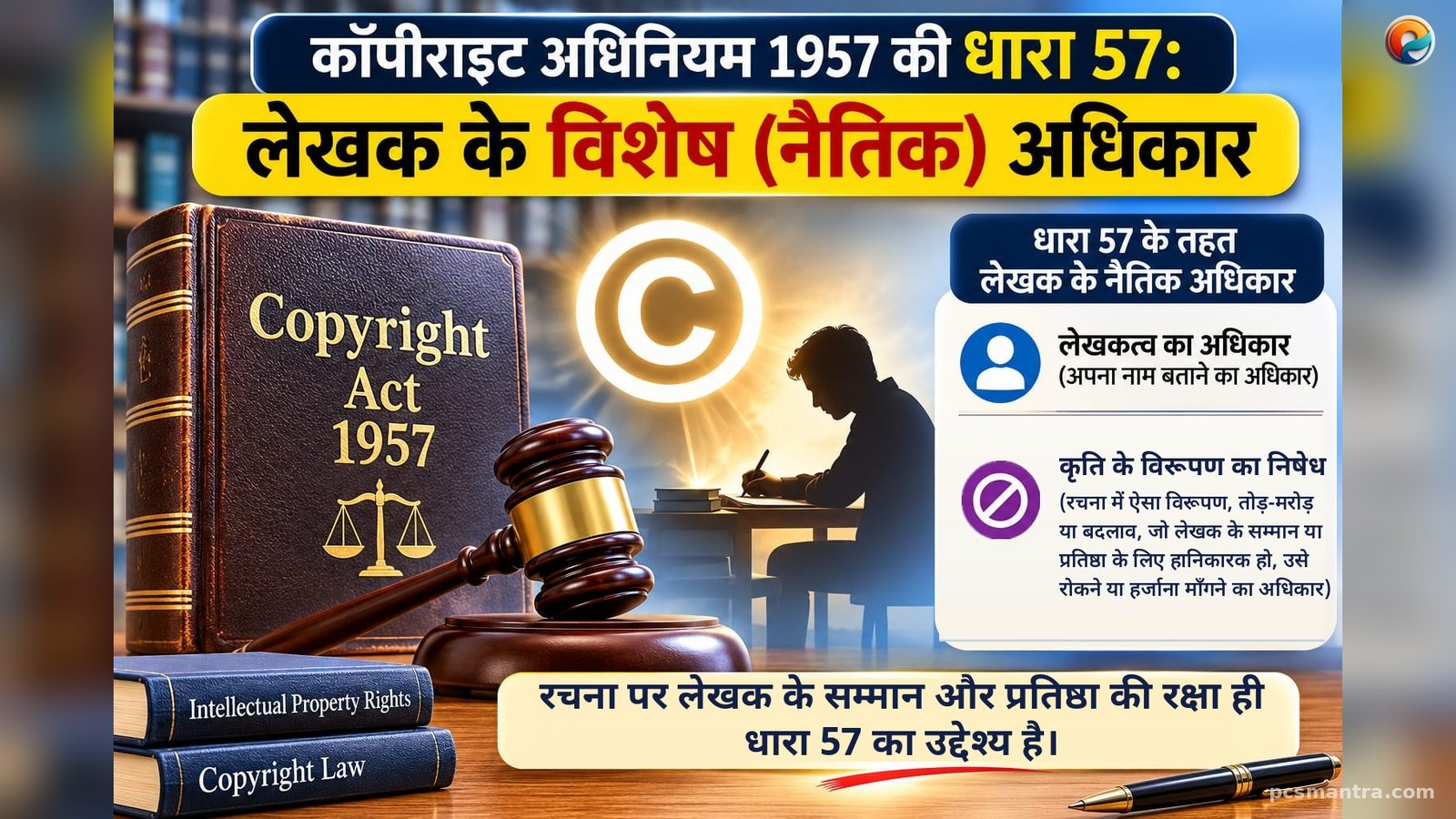
The section is titled "Author's special rights" and is commonly called moral rights. It gives the author two rights:
- Claim authorship: the right to claim authorship of the work (Section 57(1)(a)).
- Protect integrity: the right to restrain, or claim damages for, any distortion, mutilation, modification or other act in relation to the work if it would be prejudicial to the author's honour or reputation (Section 57(1)(b)).
How it differs from economic copyright
The section opens by saying these rights exist "independently of the author's copyright" and even after copyright is assigned, wholly or partially.
- Economic copyright: earning from uses such as publishing, copying or translation. It can be assigned by contract.
- Moral rights: tied to the author's name and the work's reputation. They remain after an assignment.
Legal representatives
Under Section 57(2), the rights in sub-section (1) may be exercised by the author's legal representatives. Be careful: the text does not say that all moral rights end when copyright expires. Do not write that generalisation in an answer. The accurate statement is that the section lets legal representatives exercise the rights as well.
Limits and clarifications
- Computer programme exception: no right to restrain or claim damages for an adaptation of a computer programme covered by Section 52(1)(aa).
- Display explanation: failing to display a work, or displaying it to less than the author's satisfaction, is not an infringement under this section.
- Not every change counts: the integrity right applies only where the act would be prejudicial to honour or reputation.
Link to AI and authorship
For the ethics of disclosing AI help and human accountability, read our note AI and storytelling: assistance, authorship and reader trust. That is a policy discussion. Section 57 applies only to a person who is the "author" in law. Who the author is, and whether an act harms reputation, depends on the facts and on court decisions in a given case.
Quick revision
- Section 57 = author's special rights (Copyright Act 1957, Chapter XII).
- Two rights: claim authorship; restrain or claim damages for prejudicial distortion and similar acts.
- Independent of copyright; survive assignment.
- Legal representatives can exercise them.
- International discussion calls these "moral rights"; the Act's heading is "special rights".
Prelims practice question
Which statement about Section 57 of the Copyright Act 1957 is correct?
Answer and explanation
Answer: (b)
Explanation: Section 57(1) gives both rights independently of copyright and after assignment; Section 57(2) allows legal representatives to exercise them.
Mains practice question
Distinguish an author's moral rights from economic rights in creative works. (250 words)
Answer outline
Introduction: the Copyright Act 1957 and Section 57.
Body: the two rights; independence from economic copyright; survival after assignment; legal representatives; the computer programme exception and display explanation.
Conclusion: balance between commercial use of a work and the author's identity and reputation.
FAQ
Who holds Section 57 rights?
The author of the work. Legal representatives may also exercise the sub-section (1) rights (Section 57(2)).
Do they survive a sale of copyright?
Yes. The section says they exist independently of copyright and after wholly or partial assignment.
Can every edit be challenged?
No. The act must be a distortion, mutilation, modification or other act prejudicial to the author's honour or reputation.
Does this article settle any particular book dispute?
No. It explains the statutory text only. A specific case needs its facts and any court order.
Sources
- Copyright Act 1957, Section 57, IP India (Government of India)
- Copyright Act 1957, Section 57, India Code
- The Copyright Act 1957 (full text), Copyright Office, Government of India
General educational information, not legal advice.
Download this article: PDF