Why in the News
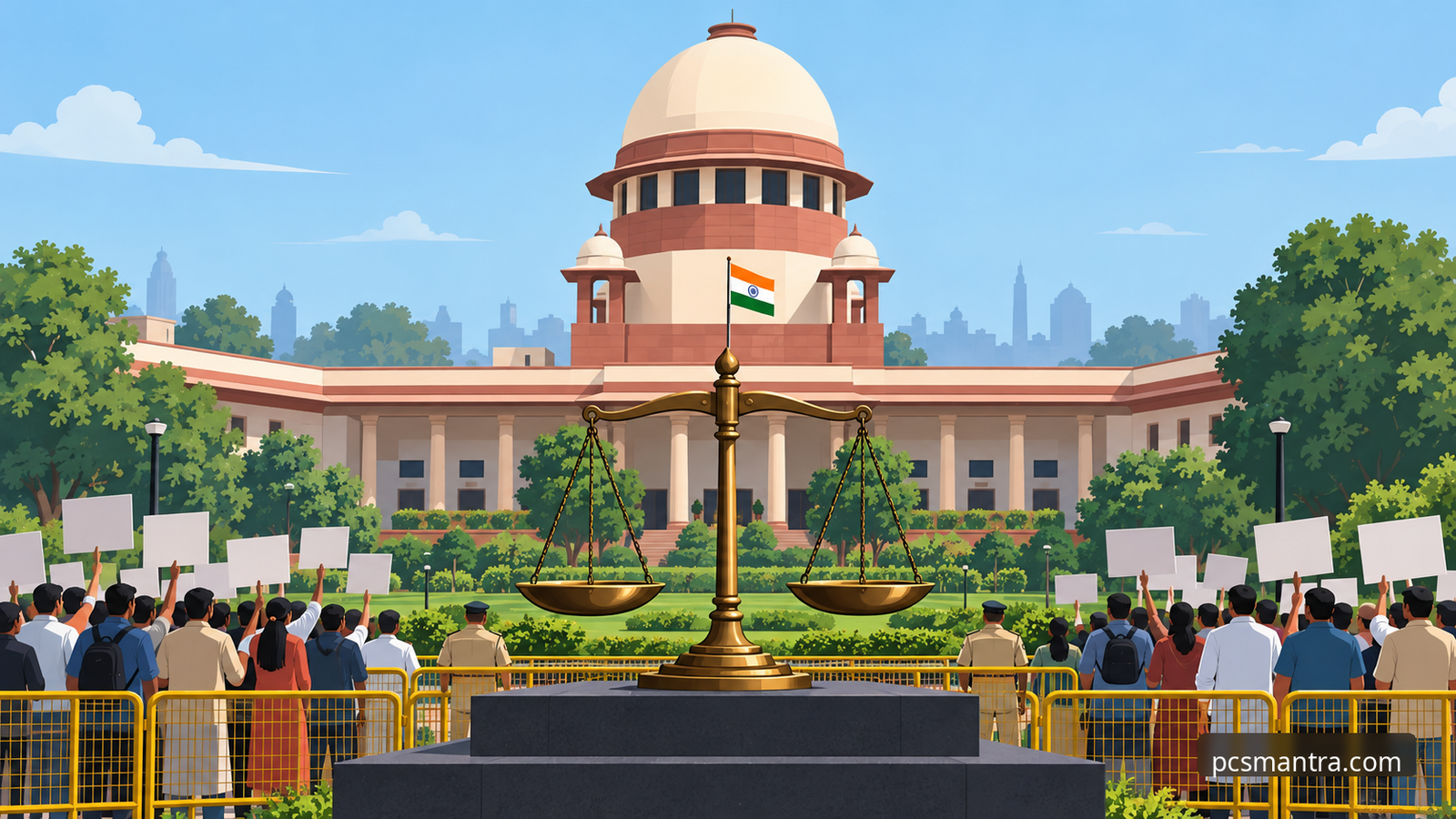
Delhi Police Commissioner Anurag Kumar stated in an affidavit filed in the Supreme Court that seven separate prohibitory orders were issued in the capital's key areas under Section 163 of the BNSS - six on or immediately around 20 August 2026, that is, a month after the violence in the protests against the NEET-UG 2026 paper leak on 20 July; one order imposes restrictions from 26 September to 24 November. The orders were passed for a maximum of 60 days, ex-parte (without hearing objections), on the reasoning that "individual notice could not be served on all concerned". This affidavit came in response to several petitions filed against the arrests of 10-11 October (protests demanding the CEC's resignation) - the petitioners include CPI(M)'s M.A. Baby, Rajya Sabha MP A.A. Rahim, senior advocate Menaka Guruswamy and advocate Shailendra Mani Tripathi; the allegation is that about 7,000 unlawful mass detentions took place and transport, including the Delhi Metro, was shut down.
Scope of the Orders and the Restrictions
The orders cover the sub-divisions of Connaught Place, Tughlaq Road, Parliament Street, Chanakyapuri (Prime Minister's residence, Rashtrapati Bhavan, foreign embassies), Barakhamba Road, Safdarjung Enclave and Defence Colony. The prohibited activities include public meetings, slogan-shouting, speeches, sit-ins and picketing, gatherings of five or more people, and weapons/banners/placards/lathis etc. The police's argument: the sensitivity of the New Delhi district - Jantar Mantar, Parliament, Rashtrapati Bhavan, India Gate - and the events of July 2026 made "swift steps" necessary.
Judicial Oversight: The 9 October Order
Petitioner Shailendra Mani Tripathi (through advocate Chand Qureshi) argued that the 10 October "shutdown" was a clear violation of the Supreme Court's order of 9 October 2026, which had said the administration should not cause hardship to ordinary people through a blanket ban. On this, the apex court directed Delhi Police to place the specific prohibitory orders on record - in response to which this affidavit came.
Section 163 BNSS and the Old Section 144
Section 163 of the Bharatiya Nagarik Suraksha Sanhita (BNSS), 2023 replaces Section 144 of the old CrPC - the power of an executive magistrate/police officer to issue a prohibitory order in an urgent situation. The point of dispute: can a "preventive" power be used in a long-term, pre-planned and ex-parte manner so as to effectively nullify the right of assembly (Article 19(1)(b)) - the Supreme Court's older precedents (the proportionality test) define this very line.
Way Forward
Hearing: In the further hearing on the petitions, the court may review the validity, duration and ex-parte nature of the orders.
Administrative: The issue of public availability of prohibitory orders (publicly available orders) has been raised before as well.
Constitutional: Article 19(1)(a)/(b) versus the "reasonable restrictions" of 19(2)/(3) - the balance between public order and freedom of assembly.
Significance for the Exam
Mains (GS-II): Limits of restrictions on freedom of expression and assembly; preventive power versus suppression; proportionality; judicial oversight.
Prelims: BNSS (2023) Section 163 = old CrPC Section 144; ex-parte orders; maximum duration (60 days); the areas covered.
Mains Practice Question
"Long-term and one-sided use of preventive prohibitory orders can weaken the fundamental right of assembly by giving it a cover of procedural validity." Comment in the context of Delhi's recent 60-day prohibitory orders. (Write the answer in 250 words. 15 marks)
Answer Outline
Introduction: The essence of Delhi Police's seven BNSS-163 prohibitory orders - 60 days, ex-parte, in key areas - and the Supreme Court's scrutiny of them.
Main Body: Rights side: the guarantee of Article 19(1)(a)/(b); the purpose of preventive power is an immediate emergency, not permanent restriction; ex-parte issuance and a 60-day blanket duration take away the opportunity to object; the significance of the 9 October "avoid blanket bans" order. Administration side: the sensitivity of New Delhi (Jantar Mantar, Parliament, Rashtrapati Bhavan), the July 2026 violence, public order as a valid ground under 19(3). Balance: the proportionality test - necessity, least restrictive means, limits of duration and area, public transparency of the orders.
Conclusion: A prohibitory order should be the exception, not the rule - this power stays constitutional only with limits of duration, area and review.
Prelims Practice Questions
Question 1. Consider the following statements with reference to Section 163 of the BNSS, 2023:
Statement-I: It is a prohibitory-order power equivalent to Section 144 of the old CrPC.
Statement-II: The recent orders issued in Delhi were for a maximum duration of 60 days.
Which of the above statements is/are correct?
(a) Both Statement-I and Statement-II are correct
(b) Statement-I is correct, but Statement-II is not correct
(c) Statement-I is not correct, but Statement-II is correct
(d) Neither Statement-I nor Statement-II is correct
Answer and Explanation
Answer: (a) - Section 163 BNSS gives the executive power of prohibitory orders (the old Section 144 CrPC); according to the Delhi Police affidavit, the orders were passed ex-parte for a maximum of 60 days.
Question 2. Which statement is correct with reference to the petitions against the arrests of 10-11 October?
(a) The Supreme Court ordered Delhi Police to immediately cancel all prohibitory orders
(b) The petitioners alleged that the 10 October shutdown violated the Supreme Court's 9 October order, which had said a blanket ban should not cause hardship to ordinary people
(c) The petitions were filed only in the Delhi High Court
(d) The arrests took place during the NEET-UG paper-leak protests
Answer and Explanation
Answer: (b) - The 9 October order emphasised that a blanket ban should not cause hardship to ordinary travellers; the arrests of 10-11 October took place during protests demanding the CEC's resignation - the NEET protests were in July 2026.
Sources
- The Hindu: 60-day prohibitive orders passed ex-parte - Delhi Police in SC (4 November 2026)
- The Hindu: Jantar Mantar is a road, not a site - Delhi Police chief (3 November 2026)
Download This Article: PDF

PCSMANTRA Editorial Team
Research and Editing
We prepare current affairs analysis, exam updates and study material in Hindi and English for UPSC, State PCS, PCS-J and other competitive examinations. Every article is verified against official sources before publication; sources are listed at the end of each article.
Read our editorial policy