
Published: 26 November 2026
In this article
Why in the News
Delhi Environment Minister Manjinder Singh Sirsa said on 25 November 2026 that the government plans a deposit return scheme (DRS) for recyclable waste. PET plastic bottles and packaging of tobacco products such as khaini and gutkha are likely to be among the first categories.[1]
Status: This is a proposal, not a scheme in force. The reports do not say that the deposit amount, collection points or refund process are fixed.
What is a deposit return scheme
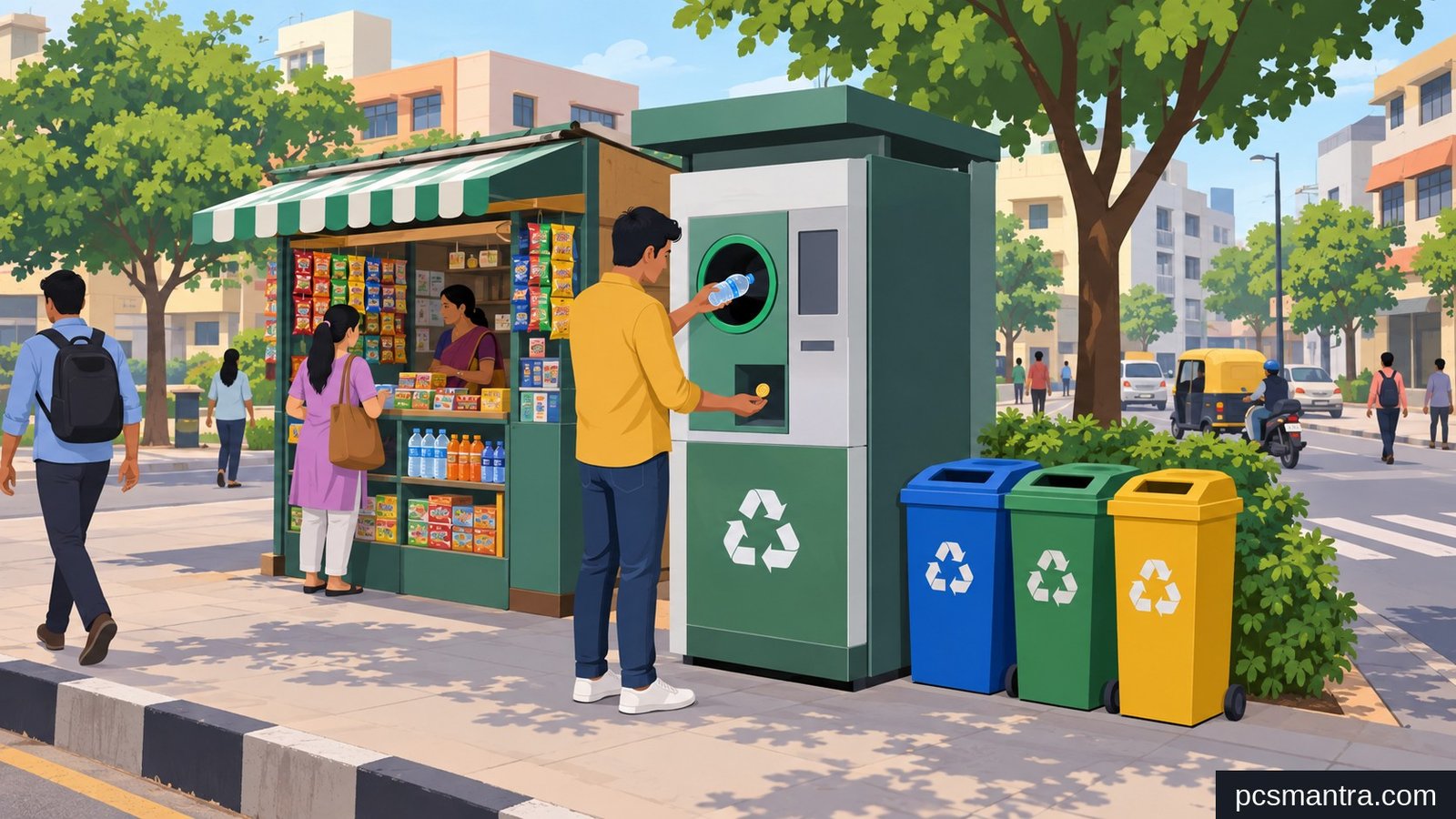
A deposit return scheme is an incentive-based system. The consumer pays a small refundable deposit when buying a specified product. The amount is returned when the empty packaging is brought back to a designated collection point or authorised retailer.[1]
Simple example: a deposit is added to the price of a bottle; returning the bottle gets the same amount back. The bottle is then collected separately and enters the recycling stream instead of the litter stream.
Polluter pays principle: the cost of waste should fall on the party that creates or sells it. A DRS adds producer responsibility to consumer awareness.
Delhi's plan: what is known so far
Process: A meeting chaired by the Minister with senior officials of the environment department discussed the policy framework and implementation strategy. The government is reviewing models from other States, particularly Himachal Pradesh, before tailoring a framework for Delhi. The Minister had earlier asked officials to prepare a detailed proposal within a month.[1]
October report: According to an October report, consumers may pay an extra Re 1 or Rs 2 on a plastic water bottle, and a pilot at tourist destinations is likely. A QR code on bottles could be used to claim refunds. Officials said the deposit amount, collection network and refund mechanism are yet to be finalised.[2] These figures are not final rules: deposit amounts differ in other States.
Scale of waste in Delhi: Citing a Delhi government report, the paper says the capital generates about 1,500 tonnes of plastic waste daily, of which 19 per cent remains unprocessed.[2]
Global claim: Officials said DRS models in more than 40 countries have reported return rates above 90 per cent, and as high as 96 per cent in some.[1] This is an officials' statement and not a guarantee of results in India.
Models in other States
Himachal Pradesh: The State's Department of Environment, Science, Technology and Climate Change notified a DRS in 2025 under Extended Producer Responsibility (EPR). A June 2025 notification set up a high-powered committee chaired by the Chief Secretary to oversee the scheme.[3]
Uttarakhand and Goa: An Uttarakhand official said the scheme began as a pilot in Kedarnath in 2022; the bottle return rate rose from about 20-22 per cent to nearly 90 per cent; the deposit is Rs 10 per bottle. Goa's deposit is reported as Rs 5.[2] These are officials' statements.
Legal background: from EPR to DRS
Under the Plastic Waste Management Rules, 2016, the Ministry of Environment, Forest and Climate Change notified Extended Producer Responsibility (EPR) guidelines on plastic packaging in February 2022.[4] EPR: producers, importers and brand owners share responsibility for collecting and recycling their packaging waste. A DRS ties this responsibility to an economic incentive at the consumer level.
Design questions and challenges
- Deposit level: too low an amount will not motivate returns; too high will raise prices.
- Collection network: the reach of shops, kiosks and reverse-vending machines will decide whether returning is convenient.
- Informal sector: the livelihoods of waste pickers should be linked to the scheme.
- Tobacco packaging: returning and recycling light, multi-layer pouches may be harder than bottles.
- Preventing misuse: QR codes and digital registration will have to check fraud.
Mains Practice Question
"Consumer-level economic incentives can improve the management of plastic packaging waste." Discuss the prospects and challenges in the context of Delhi's proposed deposit return scheme. (Answer in 250 words) | 15 marks
Answer Outline:
Introduction:
In a deposit return scheme the consumer pays a refundable deposit and gets it back on returning empty packaging. It is linked to the polluter pays principle and EPR. Delhi's scheme is still at the proposal stage.
Main body:
- Prospects: Separate collection at source, clean single-type material for recycling, less litter in drains and public places, producer accountability.
- Experience of other States: Lessons from Himachal Pradesh's notified DRS, Uttarakhand's tourist-site pilot and Goa's deposit; return-rate figures are officials' statements.
- Challenges: Fixing the deposit, reach of collection points, practical difficulty with tobacco packaging, fraud, and inclusion of informal waste workers.
- Institutional arrangements: Scheme administrator, producer registration, digital identity (QR) and monitoring.
Conclusion:
With clear rules, a convenient return network and inclusion of workers, a DRS can turn EPR into practice. The final framework has to be awaited.
Prelims Practice Questions
Consider the following statements about a deposit return scheme (DRS):
Statement 1: In a DRS the consumer pays a refundable deposit at purchase and gets it back on returning the empty packaging.
Statement 2: Delhi's DRS has been notified and is in force across the city.
Statement 3: EPR guidelines on plastic packaging were notified under the Plastic Waste Management Rules, 2016.
Which of the statements given above is/are correct?
Answer and explanation
Answer: (c)
Statement 1 is correct: this is the basic working of a DRS.
Statement 2 is incorrect: Delhi's scheme is proposed; no notification or city-wide implementation is known.
Statement 3 is correct: EPR guidelines were notified under the Plastic Waste Management Rules (February 2022).
Sources
- PTI (Moneycontrol), 25 November 2026: Delhi's proposed DRS (secondary source; official notification not recovered)
- The Indian Express, 27 October 2026: Delhi's bottle-return plan
- Government of Himachal Pradesh, Environment Department: notification of the DRS high-powered committee, 25 June 2025
- PIB, 18 February 2022: EPR guidelines on plastic packaging
Frequently Asked Questions (FAQ)
Summary answer: The Delhi Government is considering a deposit return scheme, with PET bottles and tobacco packaging likely among the first categories. It is only a proposal; the deposit amount and framework are not fixed.
How does a deposit return scheme work?
The consumer pays a refundable deposit at purchase. The amount is returned when empty packaging is brought back to a designated collection point or authorised retailer.
Has Delhi's DRS come into force?
No. It is proposed. According to the reports, the deposit amount, collection network and refund process are yet to be finalised.
What is the legal basis of Himachal Pradesh's DRS?
The State environment department notified it in 2025 under Extended Producer Responsibility (EPR).
Download this article: PDF