
Published: 26 November 2026
In this article
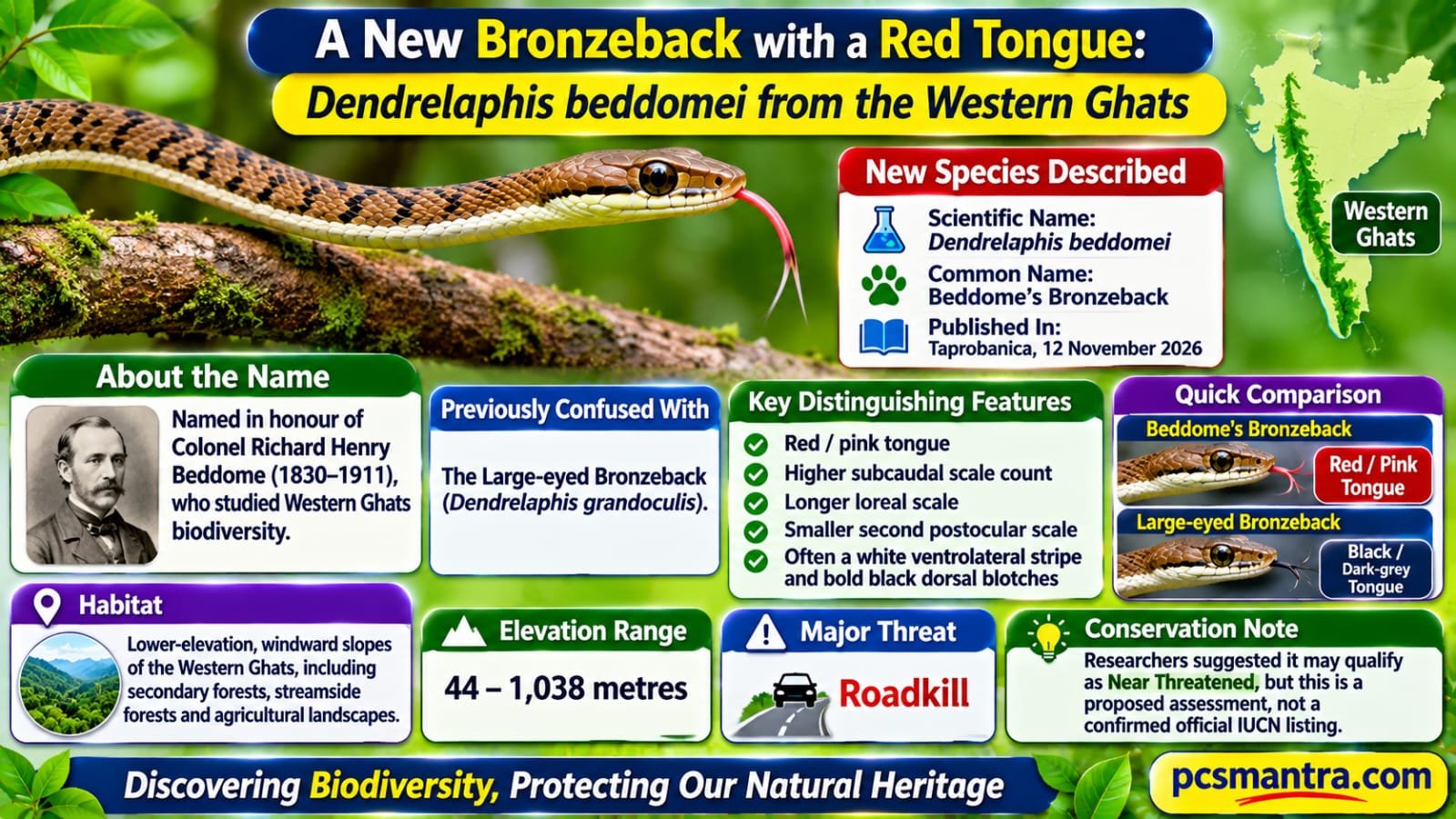
The slender, fast moving tree snakes of the genus Dendrelaphis in the Western Ghats have a new member: Dendrelaphis beddomei. A team of S.R. Ganesh, S.N. Poornaprajna, Ashok Kumar Mallik and Gernot Vogel formally described it in the biodiversity journal Taprobanica on 12 November 2026. The species was not newly evolved; for years it had simply been mistaken for another species.
Why in news
- 12 November 2026: the formal description of Dendrelaphis beddomei appeared in Taprobanica (volume 15, number 2). The paper was submitted on 27 February 2026 and accepted on 23 October 2026.
- Exam link: a new reptile species from the Western Ghats fits the steady Prelims pattern of "recently described species" questions.
What is Dendrelaphis: Dendrelaphis is a genus of slim, long tailed snakes of the family Colubridae. They live mainly on trees and shrubs and move very fast. Many species have a bronze sheen on the back, so they are commonly called bronzebacks. In taxonomy, a newly described species carries the tag sp. nov. (species nova, new species).
A long case of mistaken identity
The new species was long confused with Dendrelaphis grandoculis, a poorly known species endemic to the Western Ghats. The researchers redescribed D. grandoculis from its lectotype (a reference specimen later chosen from the original series) and paralectotypes (the remaining original specimens), together with historical and recent material, and re-diagnosed it sensu stricto (in the narrow, original sense).
The population left over after this separation was described as the new species Dendrelaphis beddomei. The description rests on two type specimens, a few live uncollected individuals and photographs shared through citizen science posts.
Where it lives
Dendrelaphis beddomei mainly inhabits the low elevation windward slopes of the Western Ghats, the slopes that face the incoming monsoon winds. For the exam, the habitat is as important as the name, because a question can ask it directly.
Key identifying features
According to the paper, the features that separate it from D. grandoculis:
| Feature | State in Dendrelaphis beddomei (compared with D. grandoculis) |
|---|---|
| Subcaudals (scales under the tail) | Much higher count |
| Tongue | Red |
| Loreal (scale between eye and nostril) | Longer |
| Second postocular (second scale behind the eye) | Smaller |
| White ventrolateral stripe (stripe along the belly edge) | Frequently present |
| Dorsal blotches | Bold black blotches |
Paper details
| Point | Detail |
|---|---|
| Journal | Taprobanica (journal of Asian biodiversity research), volume 15, number 2, 2026 |
| Authors | S.R. Ganesh, S.N. Poornaprajna, Ashok Kumar Mallik, Gernot Vogel |
| Published | 12 November 2026 (submitted 27 February 2026, accepted 23 October 2026) |
| DOI | 10.47605/tapro.v15i2.436 |
Exam importance
- The new species formula: keep name (Dendrelaphis beddomei), place (low windward slopes of the Western Ghats) and features (red tongue, higher subcaudal count) together.
- Citizen science: photographs shared by ordinary people supported a formal species description, a rising trend in environment questions.
- Western Ghats: a globally recognised biodiversity hotspot with many endemic species; such taxonomic revisions show that even low elevation habitats still hold undocumented diversity.
Sources
Prelims Practice Questions
Question 1: Consider the following statements:
Statement 1: Dendrelaphis beddomei was long mistaken for Dendrelaphis grandoculis
Statement 2: This species is found mainly in the high elevation shola grasslands of the Western Ghats
Which of the statements given above is/are correct?
Answer and Explanation
Answer: (a) 1 only
Statement 1 is correct: the paper notes that this species was long confused with the poorly known endemic Dendrelaphis grandoculis and was separated only after a redescription.
Statement 2 is incorrect: the species mainly inhabits the low elevation windward slopes of the Western Ghats, not high elevation tracts.
Question 2: With reference to Dendrelaphis beddomei, consider the following statements:
Statement 1: It has a red tongue
Statement 2: Its subcaudal count is much higher than that of Dendrelaphis grandoculis
Statement 3: It frequently shows a white ventrolateral stripe and bold black dorsal blotches
Which of the statements given above are correct?
Answer and Explanation
Answer: (d) 1, 2 and 3
Statement 1 is correct: the paper lists a red tongue as one of the features separating this species from Dendrelaphis grandoculis.
Statement 2 is correct: its subcaudal (under tail scale) count is much higher than in Dendrelaphis grandoculis.
Statement 3 is correct: a white ventrolateral stripe is frequently present and bold black dorsal blotches are listed among its identifying features.
Frequently Asked Questions
What is Dendrelaphis beddomei?
It is a newly described snake species from the Western Ghats, belonging to the genus Dendrelaphis (the bronzebacks) in the family Colubridae. Its formal description was published in the journal Taprobanica on 12 November 2026.
Why was this species not identified earlier?
Because it was long mistaken for Dendrelaphis grandoculis, a poorly known endemic species of the Western Ghats. The researchers redescribed grandoculis from its original specimens and then separated the two clearly.
What role did citizen science play in this discovery?
Along with two type specimens and a few live uncollected individuals, photographs shared by ordinary people (citizen science photo posts) were used as supporting evidence in the description.
Download this article: PDF