
Published: 27 November 2026
In this article
Why in the news
According to media reports, the Ministry of Power issued the revised draft Electricity (Rights of Consumers) Amendment Rules, 2026 on 23 November 2026 and has invited comments from States, regulators, distribution companies, industry bodies and consumer groups by 23 December 2026 (neither the issue date nor the comment deadline appears in the Ministry's draft document itself). This is a revised version of the draft first circulated in March 2026. It is not yet a notified rule; the draft proposes that the amendments come into force on 1 April 2027. Only the proviso to Rule 11(4A), the 10 kW default threshold for the storage requirement, is deferred to 1 April 2028.
Introduction
The Electricity (Rights of Consumers) Rules, 2020 were first notified on 31 December 2020 to give electricity consumers a right to reliable service and quality power; they were last amended on 22 February 2024. The Ministry of Power has now drafted wide-ranging amendments under section 176 of the Electricity Act, 2003. According to the Ministry's explanatory note, the backdrop is the deliberations of a Group of Ministers (GoM) on the financial viability of distribution companies (DISCOMs), the sharp fall in battery energy storage costs, and the grid-management challenges created by rising renewable energy.
Main body
Key proposals at a glance
| Proposal | Existing position | Proposed in the draft | Proposed date |
|---|---|---|---|
| Time of Day (ToD) tariff | C&I consumers above 10 kW from 1 April 2024; all others (except agriculture) from 1 April 2025 | Consumers with maximum demand exceeding 10 kW: no later than 1 April 2028; all other non-agricultural consumers: from the date set by the State Commission, no later than 1 April 2029 | 1 April 2028 / 1 April 2029 |
| Review of abnormal bills | No automatic review mechanism | Consumption above 5x or below one-fifth of the average of the preceding six billing cycles triggers review, resolved within 30 days | Within six months of the rules coming into force |
| No disconnection on average-bill payment | - | No disconnection while the consumer pays based on the average of the previous six billing cycles, until the anomaly is resolved | As above |
| Net metering charges | Net metering up to 500 kW where the Commission sets no limit | Commission may levy charges it specifies; no charges up to the capacity threshold the Commission determines | 1 April 2027 |
| Energy Storage System (ESS) | No mandate | Commission may require storage above a threshold it sets; default threshold: installed capacity exceeding 10 kW | 1 April 2027; the 10 kW default-threshold proviso from 1 April 2028 |
| New connection timelines | Metropolitan areas 3 days, other municipal areas 7 days, rural areas 15 days, hilly rural areas 30 days | Municipal corporation areas also brought into the 3-day category; where mains extension or a new substation is needed, supply immediately after the work, within 90 days at most | 1 April 2027 |
| Consumer Grievance Redressal Forum (CGRF) | Multiple levels: sub-division, division, circle, zone, company | Standardised to at least two levels: company level and district/municipality level; maximum four members | 1 April 2027 |
| Demand Response | No definition or framework in the Rules | Definition added; Commission to specify an implementation framework (new Rule 17) | 1 April 2027 |
Time of Day tariff: electricity priced by the hour
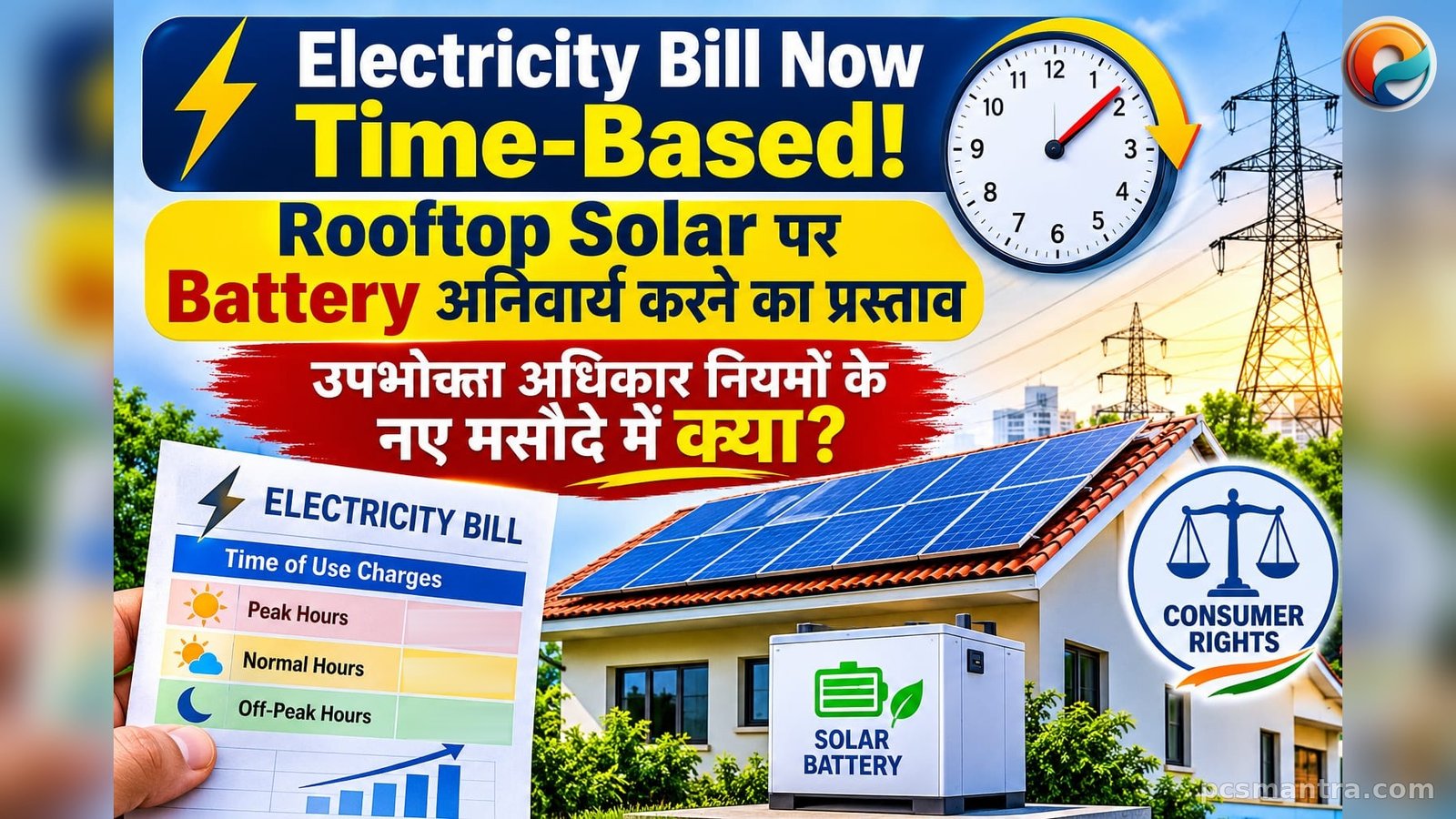
Time of Day (ToD) tariff means different electricity rates for different times of the day, cheaper power when demand is low or solar generation is high, and dearer power during peak hours. Under the draft, ToD tariff will be implemented for consumers with a maximum demand exceeding 10 kW no later than 1 April 2028, and for all other consumers except agricultural consumers from the date specified by the State Commission, but no later than 1 April 2029. ToD applies only to the energy-charge component of the normal tariff. While fixing tariff periods, the Commission must consider the load profile of the licensee and the State, the profile of solar and other renewable generation, the cost of power procurement at different times (including prices discovered on power exchanges), and the capability of the metering infrastructure. The explanatory note links the revised timelines to the pace of smart-meter deployment, expected to be completed nationwide by April 2028. The existing framework prescribes a fixed eight-hour solar period and minimum tariff differentials; the draft gives State Commissions more flexibility to set solar and peak hours based on State-specific conditions.
Automatic review of abnormal bills, and protection from disconnection
A new sub-rule (13) in Rule 6 obliges the distribution licensee to configure its billing system to flag cases where consumption in any billing cycle exceeds five times, or falls below one-fifth of, the average consumption of the preceding six billing cycles (or other limits the State Commission may determine). Such cases must be reviewed at the appropriate level and resolved within 30 days of the bill being generated. The provision takes effect within six months of the rules coming into force, or earlier once the licensee is ready. The key consumer protection: until the issue is resolved, no disconnection can be carried out if the consumer keeps paying electricity charges based on the average consumption of the previous six billing cycles.
Net metering, net-billing and rooftop solar
Net metering is the arrangement under which a rooftop-solar prosumer (producer + consumer) is billed on the difference between electricity drawn from the grid and electricity injected into it. The draft substitutes Rule 11:
- A renewable-energy unit may also be set up on parts of the premises other than the roof. Installed capacity may exceed the sanctioned load, subject to limits the Commission specifies, but injection into the grid is capped at the sanctioned load unless the licensee specifically authorises more. Unauthorised excess injection earns no payment or compensation and can attract a penalty specified by the Commission.
- Net-metering, gross-metering, net-billing and net feed-in arrangements will follow the State Commission's regulations. The Commission may permit net metering subject to charges it specifies; no charges will be levied on installed solar PV capacity up to the threshold the Commission determines. Charges may take into account the imputed cost of energy storage and adjustments for network losses. The explanatory note says the rationale is that net-metered consumers are billed on net consumption and therefore under-contribute to DISCOMs' fixed-cost recovery, raising cross-subsidisation by other consumers.
- For prosumers on net-billing or net feed-in, the Commission may introduce time-of-day tariffs that reward installing storage and using or exporting stored solar energy during peak hours, supporting demand response.
- The Commission may permit gross-metering for prosumers who prefer to sell all their solar power to the licensee, at a generic tariff the Commission decides.
The storage condition: is a battery mandatory for everyone?
No. The proposed sub-rule 11(4A) says that where the installed capacity of a renewable-energy generating system exceeds a threshold specified by the Commission, the Commission may require the prosumer to install an Energy Storage System with storage capacity equivalent to at least twenty per cent of the system's total daily energy generation (or another proportion the Commission specifies). If the Commission does not specify a threshold, the requirement applies to systems with installed capacity exceeding ten kilowatts (10 kW).
Three points must be kept clear:
1. The condition rests on the State Commission's discretion, the Commission "may" require storage; this is not a universal mandate.
2. The twenty per cent is measured on daily energy generation (kWh), not on installed kW capacity.
3. Under the notification text, only this sub-rule's proviso, the 10 kW default threshold, commences on 1 April 2028; the main sub-rule, which lets the Commission require storage above its own specified threshold, takes effect with the rest on 1 April 2027. The explanatory note says the deferral is meant to allow adequate time for regulatory and investment arrangements.
The Ministry's note says Battery Energy Storage System (BESS) costs have fallen substantially over the past two years, making storage with rooftop systems economically viable; stored daytime solar power can be used in the evening, easing grid stress.
New connections: tighter timelines
Under the substituted Rule 4(11), once an application is complete in all respects, a new or modified connection must be provided within 3 days in metropolitan and municipal corporation areas, 7 days in other municipal areas and 15 days in rural areas. In rural areas of hilly States and UTs (Arunachal Pradesh, Himachal Pradesh, Manipur, Meghalaya, Mizoram, Nagaland, Sikkim, Tripura, Uttarakhand, Jammu & Kashmir and Ladakh), the limit is 30 days. Where supply needs an extension of distribution mains or a new substation, electricity must be supplied immediately after that work, within a maximum of 90 days. The explanatory note points out that several large cities are not formally notified as "metropolitan areas" and so face longer timelines today; bringing municipal corporation areas into the 3-day bucket directly benefits them.
Consumer Grievance Redressal Forums: two levels and online tracking
CGRF structures currently vary across States (sub-division, division, circle, zone, company). The draft standardises them to at least two levels, company level and district/municipality level, with a chairperson and not more than three members, including consumer representatives. A grievance will normally be decided within 30 days and in any case within 45 days; a consumer dissatisfied with the district/municipality forum's decision may approach the company-level forum within 90 days before going to the Ombudsman. Licensees must enable online submission, virtual hearings and tracking through a web portal and mobile app, and every grievance's status must be available online.
Demand Response: a new definition and a new Rule 17
Demand Response means managing electricity demand on the grid by encouraging consumers to shift usage to periods of high supply or low demand, using price signals or financial incentives. The draft adds this definition to Rule 2 and inserts a new Rule 17 under which the State Commission will specify an implementation framework, eligibility criteria for demand-response providers, consumer incentives, software and communication protocols, and measurement, verification and financial-settlement procedures. This can cut costly peak power procurement and help integrate variable renewable energy.
Status of the draft: these are not rules yet
The document is a proposal. According to media reports, the Ministry has invited stakeholder comments until 23 December 2026; the draft was issued on 23 November 2026, neither date appears in the Ministry's draft document. Final rules will follow after comments are considered and the notification is published in the Gazette; only then will they be binding. The proposed commencement date is 1 April 2027, and only the proviso to Rule 11(4A) (the 10 kW default storage threshold) commences on 1 April 2028. The principal Rules date from 2020 and were last amended in February 2024; the present text is a revised draft that follows the first draft circulated in March 2026.
Exam relevance
- Prelims: the Rules' name, section 176 of the Electricity Act 2003, the 2020 principal Rules, the proposed ToD dates (2028/2029), the 20%-of-daily-generation storage formula with the 10 kW default threshold, and the 5x/one-fifth billing-anomaly trigger are all factual question material.
- Mains: links to GS-II (governance, regulatory frameworks, citizen-centric services) and GS-III (energy security, renewable integration, DISCOM reform).
Conclusion
The draft attempts to combine consumer interests (billing correction, disconnection protection, faster connections, a stronger grievance system) with grid needs (ToD tariffs, storage, demand response, lower cross-subsidisation). Its final shape will be decided after the consultation; until then it should be read as a proposed change, not a notified one.
Way forward
After comments close on 23 December 2026, according to media reports, the Ministry will notify the final rules. The real impact will then depend on how State Commissions set ToD periods, net-metering charge thresholds and the storage threshold, that is, on State-level regulations.
Mains practice questions
Question 1. Review the major changes proposed in the draft Electricity (Rights of Consumers) Amendment Rules, 2026. How do these proposals balance consumer protection with grid stability? (250 words) (15 marks)
Answer outline:
Introduction:
- Purpose of the 2020 Rules and the revised draft (issued 23 November 2026, according to media reports); the GoM backdrop.
Main body:
- Consumer-interest proposals: automatic billing-anomaly review (5x/one-fifth, 30 days), disconnection protection on average-bill payment, connection timelines (3/7/15/30/90 days), two-level standardised CGRF with 30/45-day disposal.
- Grid-management proposals: ToD tariffs (2028/2029), Commission discretion on net-metering charges, ESS (minimum 20% of daily generation; main sub-rule from 2027, 10 kW default threshold from 2028), demand-response framework.
- The balance: reducing cross-subsidy versus protecting small consumers through charge thresholds; flexibility for State Commissions.
Conclusion:
- A step in the right direction; the real test lies in State-level implementation and the pace of smart metering.
Question 2. "Integrating energy storage with the expansion of rooftop solar has become essential for India's power sector." Discuss this statement with reference to the draft Electricity (Rights of Consumers) Amendment Rules, 2026. (250 words) (15 marks)
Answer outline:
Introduction:
- Rising renewable share and the grid-flexibility challenge; falling BESS costs.
Main body:
- The draft's proposal: Commission-discretion ESS (minimum 20% of daily generation; main sub-rule from 2027, 10 kW default threshold from 2028).
- Benefits: peak shifting, grid stability, lower balancing costs for DISCOMs, energy independence for consumers.
- Challenges: cost, burden on small consumers, uneven State regulation, clarity on capacity thresholds.
- Complementary incentives: net-billing and ToD tariffs rewarding storage.
Conclusion:
- A conditional, phased approach is pragmatic; clear State regulations and cost support are essential.
Frequently asked questions (FAQ)
1. Have the Electricity (Rights of Consumers) Amendment Rules, 2026 come into force?
No. According to media reports this is a draft issued on 23 November 2026, and the Ministry is accepting comments until 23 December 2026 (these dates do not appear in the draft document itself). The amendments will apply only after the final notification; the proposed commencement date is 1 April 2027.
2. Will every rooftop-solar consumer now have to install a battery?
No. The draft gives the State Commission discretion to require storage for systems above a capacity threshold it sets; if no threshold is set, the requirement applies to systems above 10 kW of installed capacity. Storage capacity must equal at least 20% of daily energy generation. This is not a universal mandate.
3. When will Time of Day tariffs apply?
Under the draft, for consumers with maximum demand exceeding 10 kW, no later than 1 April 2028; for all other non-agricultural consumers, from the date the State Commission sets, but no later than 1 April 2029.
4. What happens if my bill is abnormally high?
The draft proposes that cases where consumption exceeds five times, or falls below one-fifth of, the average of the previous six billing cycles be reviewed automatically and resolved within 30 days; meanwhile, a consumer who keeps paying the average-based bill cannot be disconnected.
5. How quickly must a new electricity connection be given?
The draft proposes: metropolitan and municipal corporation areas 3 days, other municipal areas 7 days, rural areas 15 days, hilly rural areas 30 days; where mains extension or a new substation is needed, within 90 days at most.
6. What is Demand Response?
Shifting electricity use to periods of high supply or low demand in response to price signals or financial incentives; it balances the grid and reduces the need for costly peak power.
Sources
- Ministry of Power, Government of India, Draft Electricity (Rights of Consumers) Amendment Rules, 2026 with Explanatory Note
- Ministry of Power, "Seeking comments on Draft Electricity (Rights of Consumers) Amendment Rules, 2026" (12 March 2026, first draft), notices list
- SolarQuarter (24 November 2026)
- Elekore Energy (25 November 2026)
Download this article: PDF