
In this article
Why in the News
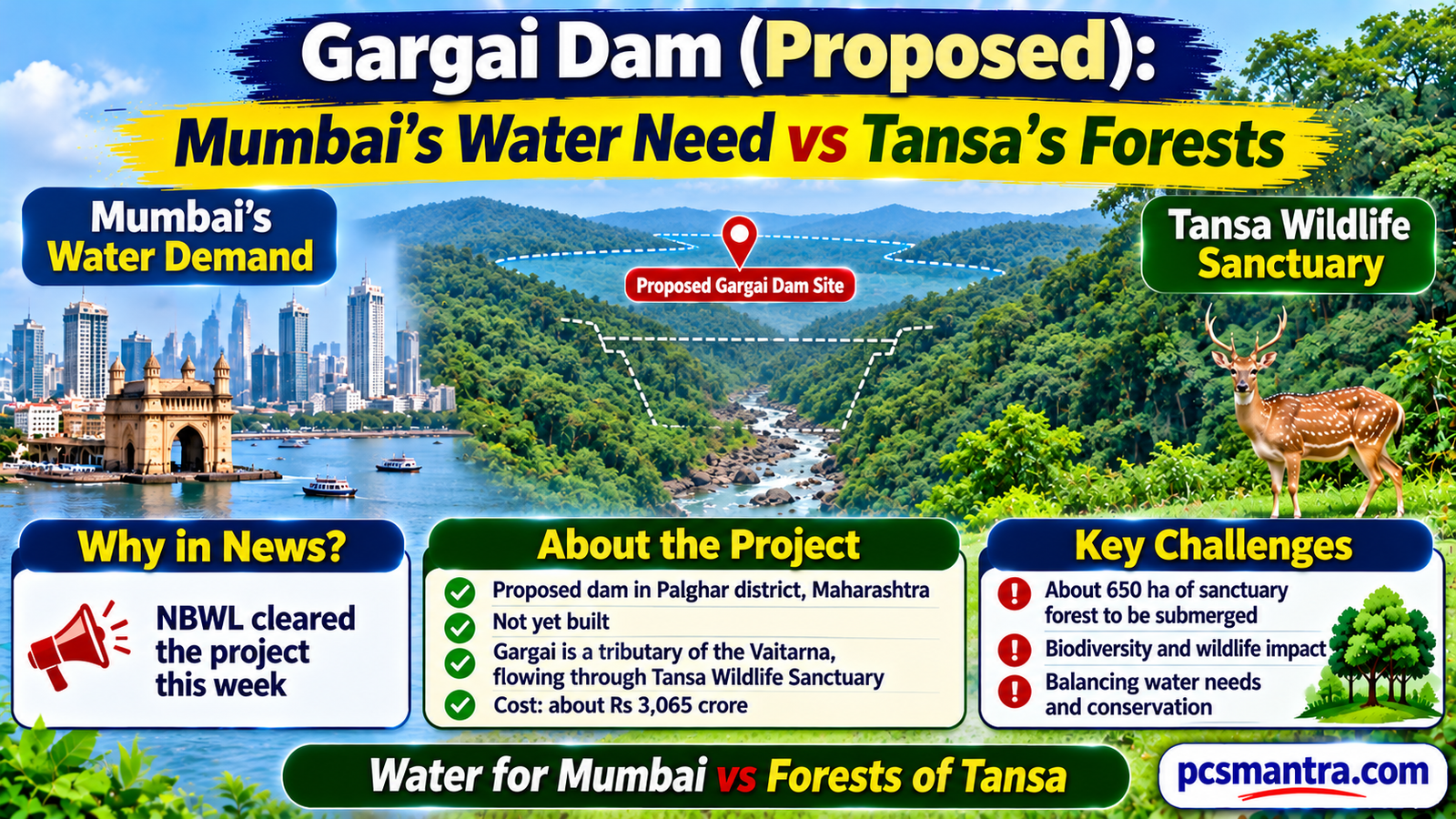
To raise water supply for Mumbai, the Brihanmumbai Municipal Corporation (BMC) has proposed a Rs 3,065 crore dam on the Gargai river in Palghar district. News accounts say the National Board for Wildlife (NBWL) cleared the project this week, subject to certain commitments by the BMC. It is the first time the BMC has planned wildlife management and the relocation of tribal villages. [1]
Source limit: the NBWL meeting minutes and the exact approved conditions could not be checked. The details below rest on a news report.
The Water Need
Mumbai draws about 4,100 MLD from seven lakes against a demand of about 4,600 MLD. MLD means million litres a day. A 10% water cut is currently in force. The BMC expects demand to reach 6,424 MLD by 2041. The Gargai dam is projected to add 450 MLD. Other projects to close the gap include a seawater desalination plant at Manori, which will start at 200 MLD and can expand to 400 MLD. [1]
The BMC is the only civic body that has built, owned and operated several dams: Tulsi, Vihar, Tansa, Modak Sagar and Middle Vaitarna (completed in 2014). Gargai would be its sixth. [1]
Impact on the Forest
The dam is expected to submerge about 650 hectares of forest land of the Tansa Wildlife Sanctuary. The sanctuary spreads across Thane and Palghar districts and covers about 335 square kilometres. Six tribal villages lie near the project site, home to 619 tribal people according to a 2019 survey. [1]
The BMC's Mitigation Plan
- Introducing herbivores: In the northern stretch of the sanctuary, which has dense cover but few herbivores, spotted deer and antelope will be introduced. The hope is that leopards will follow and the food chain will return.
- Resettlement: People of the six villages will be rehabilitated in Wada town, 21 km away. One member of each family is offered a job with the civic body.
- Forest compensation: Converting more than 500 hectares of non-forest land into forest and transplanting over three lakh trees in the project area.
- Road and habitat: Diverting State Highway 34, which passes through the forest, and developing part of the submerged Khodade village as a breeding habitat for reptiles such as pythons, cobras and monitor lizards.
- Funds and execution: A corpus of Rs 250 crore (about 8% of project cost) is earmarked for the plan, drawn up with experts of the Wildlife Institute of India (WII). The forest department will carry it out, as the civic body lacks wildlife expertise. [1]
The Legal Route for Approval in a Sanctuary
Under Section 29 of the Wild Life (Protection) Act, 1972, the state government must consult the State Board for Wild Life before permitting any activity in a sanctuary. Following the Supreme Court's directions of 9 May 2002, all such proposals also need the recommendation of the Standing Committee of the National Board for Wildlife. In practice the clearance comes as a recommendation of the Standing Committee of the NBWL. For national parks the corresponding consultation is in Section 35(6). [2]
NBWL clearance is one stage, not the whole chain of approvals. Other permissions, such as those for forest land use and tree felling, go through separate processes. An earlier report from April 2025 mentioned a state wildlife board approval and some more approvals pending, while the current report speaks of a national board clearance. The latest approval status of the project must be confirmed from official records. [3]
Will the Plan Work
The most uncertain link in the plan is the assumption that introducing herbivores will bring leopards. According to the report, the forest department released spotted deer in the area in 2015, but most were hunted by local tribals. That is why the plan seeks to relocate the villages and end human interference there. The social side of resettlement will also draw questions. It is a useful exam example of balancing environment and water security. [1]
Prelims Practice Questions
Question 1
Consider the following statements:
Statement 1: Under Section 29 of the Wild Life (Protection) Act, 1972, the state government must consult the State Board for Wild Life before permitting an activity in a sanctuary.
Statement 2: Following the Supreme Court's directions of 9 May 2002, proposals for such activities in sanctuaries also need the recommendation of the Standing Committee of the National Board for Wildlife.
Statement 3: Section 35(6) of the Wild Life (Protection) Act, 1972 deals with consultation for activities in wildlife sanctuaries.
Which of the statements given above are correct?
Answer and Explanation
Correct answer: (b)
Statement 1 is correct: Section 29 provides for consultation with the State Board for Wild Life before an activity in a sanctuary.
Statement 2 is correct: after the 9 May 2002 directions, the Standing Committee's recommendation is also needed.
Statement 3 is incorrect: Section 35(6) concerns national parks, not sanctuaries.
Question 2
Consider the following statements:
Statement 1: The BMC's proposed plan for the Gargai dam includes introducing herbivores such as deer and antelope in the northern part of the Tansa sanctuary.
Statement 2: The plan proposes rehabilitating tribal villages near the project site in Wada town.
Statement 3: The plan proposes bringing leopards from outside and releasing them in the northern part of the sanctuary.
Statement 4: The plan proposes diverting State Highway 34 that passes through the forest.
How many of the statements given above are correct?
Answer and Explanation
Correct answer: (c)
Statements 1, 2 and 4 are correct: these are measures in the BMC's proposed plan.
Statement 3 is incorrect: the plan introduces herbivores in the hope that leopards will move there on their own; it does not propose releasing leopards.
Question 3
In which districts does the Tansa Wildlife Sanctuary, recently in the news, spread?
Answer and Explanation
Correct answer: (d)
According to the report, the Tansa Wildlife Sanctuary (about 335 square kilometres) spreads across Thane and Palghar districts.
Sources
- The Indian Express: report on the Gargai dam wildlife plan, 26 November 2026 (NBWL minutes could not be checked)
- Environment Ministry: guidelines for NBWL Standing Committee recommendations for activities in protected areas
- The Indian Express: earlier report on the state wildlife board nod and pending approvals, April 2025
Frequently Asked Questions (FAQ)
What is the cost and purpose of the Gargai dam project?
According to a news report the cost is Rs 3,065 crore and the aim is to add 450 MLD to Mumbai's water supply.
How much of the Tansa sanctuary will the dam submerge?
About 650 hectares of forest land belonging to the Tansa Wildlife Sanctuary.
Is the NBWL clearance the final approval?
No. It is one stage. Other permissions such as forest land use and tree felling are separate; the latest status must be checked in official records.
Download this article: PDF