
Published: 27 November 2026

In this article
Why in the news
A release dated 26 November 2026 reports a new study of polar gamma-ray observations of the solar event of 11 November 2025.
Introduction
Powerful eruptions on the Sun, such as solar flares and coronal mass ejections (CMEs), accelerate extremely high-energy particles, mainly protons, into interplanetary space. When these particles enter Earth's atmosphere, they collide with atmospheric atoms and generate cascades of secondary particles of hadronic, mesonic and electromagnetic types. When this secondary cascade is strong enough to be recorded by instruments on the ground, the event is called a Ground-Level Enhancement (GLE). GLEs are the rarest and most extreme form of solar energetic particle (SEP) events, with only a few occurring in each solar cycle. They have traditionally been identified through neutron monitor networks, which record sudden increases in secondary neutron counts during SEP events.
What was the event?
On 11 November 2025, active region AR 4274 produced an intense X5.1-class solar flare which, as measured by the GOES-18 satellite, began at 09:49 UT, peaked at 10:04 UT and ended at 10:17 UT. It was accompanied by a very fast CME travelling at 1772 km per second and a strong SEP event. The event was designated GLE #77. Note the timeline: the event occurred in November 2025, the research paper was published on 19 November 2026, and the PIB release came on 26 November 2026.
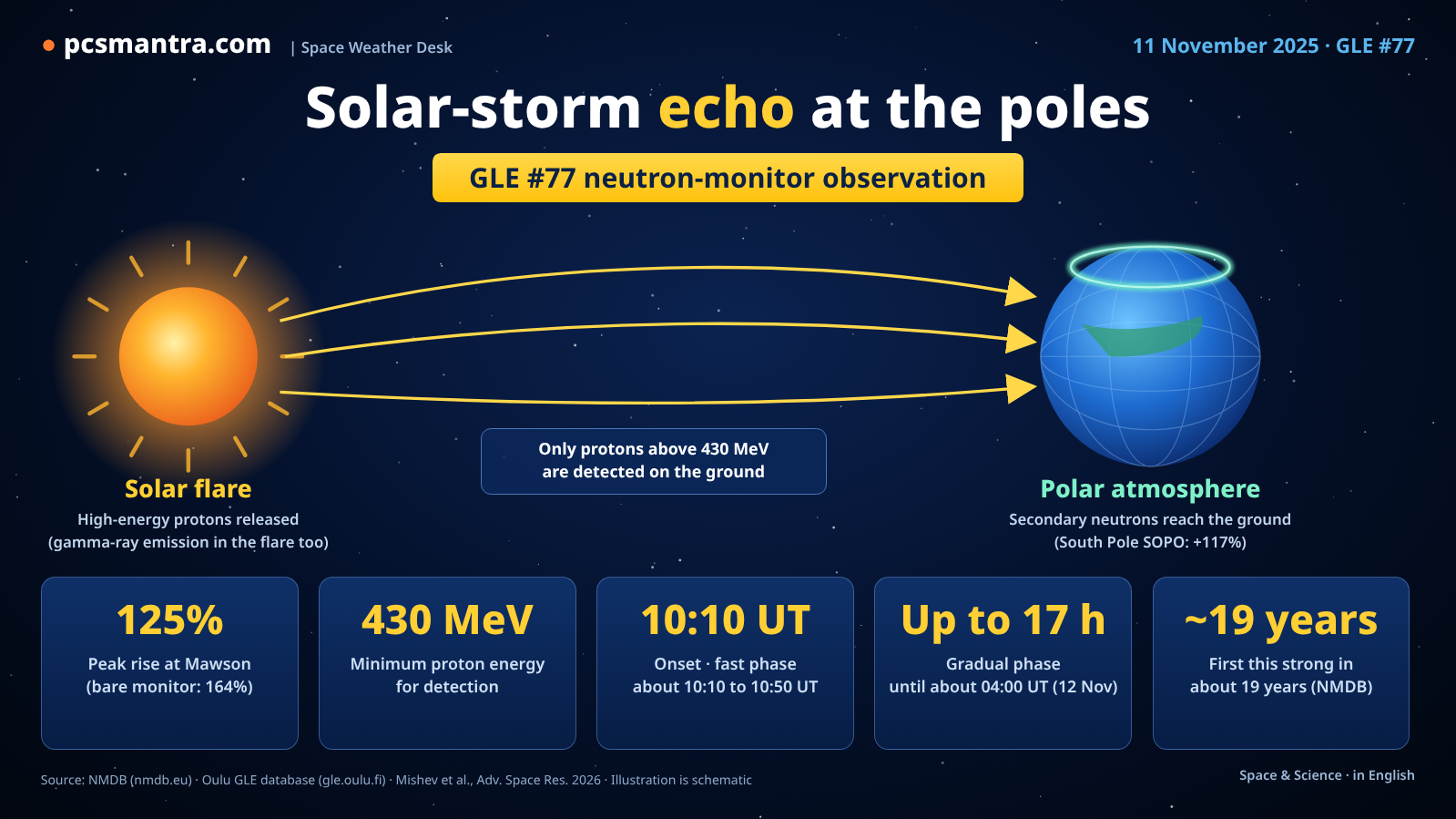
In this infographic, 10:10 UT is the GLE onset recorded by neutron monitors, not the start or peak of the solar flare. The flare times given above are separate.
India's role: IIG's polar detectors
The Indian Institute of Geomagnetism (IIG), Mumbai, an autonomous institute of the Department of Science and Technology (DST), installed NaI(Tl) scintillation detectors at two Indian polar stations under its research programme on cosmic-ray and space-weather phenomena through ground-based observations at polar latitudes:
- Maitri (Antarctica): geographic coordinates 70.46 degrees S, 11.43 degrees E; geomagnetic cutoff rigidity about 0.3 GV.
- Ny-Alesund (Arctic): geographic coordinates 78.92 degrees N, 11.91 degrees E; cutoff rigidity about 0.01 GV. India's Arctic station Himadri is located here.
These detectors use a thallium-doped sodium iodide crystal (10.16 x 10.16 x 40.46 cm) coupled to a photomultiplier tube, recording gamma-ray spectra in roughly the 200 keV to 10 MeV range at one-minute intervals.
How was the signal confirmed?
The team systematically separated the GLE-related enhancement from other possible sources. Energies below 3 MeV are dominated by natural terrestrial radioactivity, so gamma rays above 3 MeV were interpreted primarily as secondary atmospheric gamma rays from SEP-induced air showers. Background terrestrial radioactivity, lightning-related terrestrial gamma-ray flashes (TGFs), thunderstorm ground enhancements (TGEs), gamma-ray bursts (GRBs) and direct solar-flare photons were each ruled out. The gamma-ray count rates were then compared with the traditional neutron monitor network and GOES particle-flux data, and the results were found to be consistent.
Two poles, two distinct responses
The two stations recorded distinct temporal signatures. Maitri in Antarctica showed a prompt response, while Ny-Alesund in the Arctic showed a gradual rise. The prompt peak coincided with the SEP flux peak at energies above 150 MeV, and the gradual peak coincided with the SEP peak in the 12 to 99 MeV range. The gamma-ray GLE amplitude at Antarctica was about an order of magnitude stronger than at the Arctic. This shows that high-energy solar particles enter and interact with Earth's atmosphere differently at different geographic locations and under different geomagnetic conditions.
Why does this matter?
This is the first ground-based gamma-ray detection of a GLE observed simultaneously from both polar regions. Gamma-ray detectors are relatively compact and cost-effective compared to conventional neutron monitor installations. A wider network of such detectors at strategically selected locations could complement existing monitoring systems, expand the geographic coverage of ground-based observations and deepen understanding of the Sun-Earth connection. Importantly, this method complements neutron monitors rather than replacing them: even in this study, the reliability of the gamma-ray data was established by matching it with neutron monitor and GOES data. Moreover, NaI(Tl) detectors cannot fully separate gamma rays from other secondary particles, so a small contribution from other particles cannot be ruled out.
Conclusion
The detection of GLE #77 is a notable step for Indian polar research and Indian space-weather science. It establishes that cost-effective gamma-ray detectors at polar latitudes can meaningfully support traditional networks in monitoring extreme solar events. As such detectors join international networks in larger numbers, both the geographic spread of ground-based monitoring and the assessment of extreme space-weather impacts will grow stronger.
Prelims practice question
Question 1. With reference to Ground-Level Enhancement (GLE), consider the following statements:
I. A GLE is a rare and extreme manifestation of a solar energetic particle (SEP) event, in which very high-energy particles accelerated by solar eruptions enter Earth's atmosphere and generate secondary particles that ground-based instruments can record.
II. GLE #77 was observed for the first time simultaneously from both polar regions, the Antarctic and the Arctic, by gamma-ray detectors of the Indian Institute of Geomagnetism.
III. Gamma-ray-based detection has the capability to completely replace neutron monitor networks.
Which of the statements given above are correct?
Answer and explanation
Answer: (a) I and II only
Statement I is correct: a GLE is the ground-level detection of secondary particle cascades produced when high-energy protons from solar eruptions (flares, CMEs) enter the atmosphere.
Statement II is correct: IIG's NaI(Tl) detectors at Maitri and Ny-Alesund recorded the first gamma-ray observation of GLE #77 (11 November 2025) from both poles.
Statement III is incorrect: the method complements neutron monitors, it does not replace them; confirmation in this study itself came through matching with neutron monitor data.
Mains practice question
Question 1. "Gamma-ray-based detection of Ground-Level Enhancements is a complement to, not a substitute for, neutron monitor networks." Examine this statement and assess the role of India's polar stations in space-weather monitoring. (150 words) (10 marks)
Answer Outline
In the introduction:
Define a GLE and cite GLE #77 of 11 November 2025: the first dual-polar gamma-ray detection from IIG's Maitri and Ny-Alesund detectors.
In the main body:
Grounds for "complement": consistency with neutron monitor and GOES data; compact and cost-effective, so wider networks feasible; limits of NaI(Tl) (no full separation from other secondaries) and a single-event sample. Role of Indian polar stations: strategic location of Maitri and Himadri (Ny-Alesund), study of particle-atmosphere interaction under differing geomagnetic conditions, contribution to Sun-Earth connection research.
In the conclusion:
Sharing real-time data with international networks could tie this capability into warning systems; its scientific value remains strongest as a complement to neutron monitors.
Frequently asked questions (FAQ)
Question 1: How is a GLE different from an ordinary solar energetic particle (SEP) event?
A GLE is the rarest and most extreme manifestation of an SEP event, representing the highest-energy end of its spectrum. Relativistic particles, mainly protons, produce atmospheric secondary cascades strong enough to be detected by ground-based instruments. Only a few such events occur in each solar cycle.
Question 2: How does a gamma-ray detector differ from a neutron monitor?
Neutron monitors count secondary neutrons from atmospheric particle cascades, whereas a NaI(Tl) detector records gamma rays from the same cascades in roughly the 200 keV to 10 MeV range. Gamma-ray detectors are relatively compact and cost-effective, so they can complement neutron monitors rather than replace them.
Question 3: Why did the two polar stations show different responses to the event?
Maitri recorded a prompt response and Ny-Alesund a gradual one. The two locations differ in geomagnetic conditions, cutoff rigidity (about 0.3 GV and 0.01 GV respectively) and particle arrival directions, which may help explain these contrasting responses. The gamma-ray GLE amplitude at Antarctica was about ten times stronger than at the Arctic.
Short answer: Ground-Level Enhancement (GLE) #77 is a rare and extreme solar event of 11 November 2025, recorded for the first time simultaneously from both polar regions by the Indian Institute of Geomagnetism's NaI(Tl) gamma-ray detectors at Maitri (Antarctica) and Ny-Alesund (Arctic).
Sources
[1] Press release, Ministry of Earth Sciences / PIB, 26 November 2026 (PRID 2341985): https://www.pib.gov.in/PressReleseDetailm.aspx?PRID=2341985&lang=2®=48
[2] Thakur, Vichare, Gopalswamy and Chelliah, "First Detection of a Gamma-Ray Ground-level Enhancement on 2025 November 11 from the Antarctic and Arctic Stations", The Astrophysical Journal Letters, published 19 November 2026: https://doi.org/10.3847/2041-8213/aeaee7
Download this article: PDF