
Why in the News?
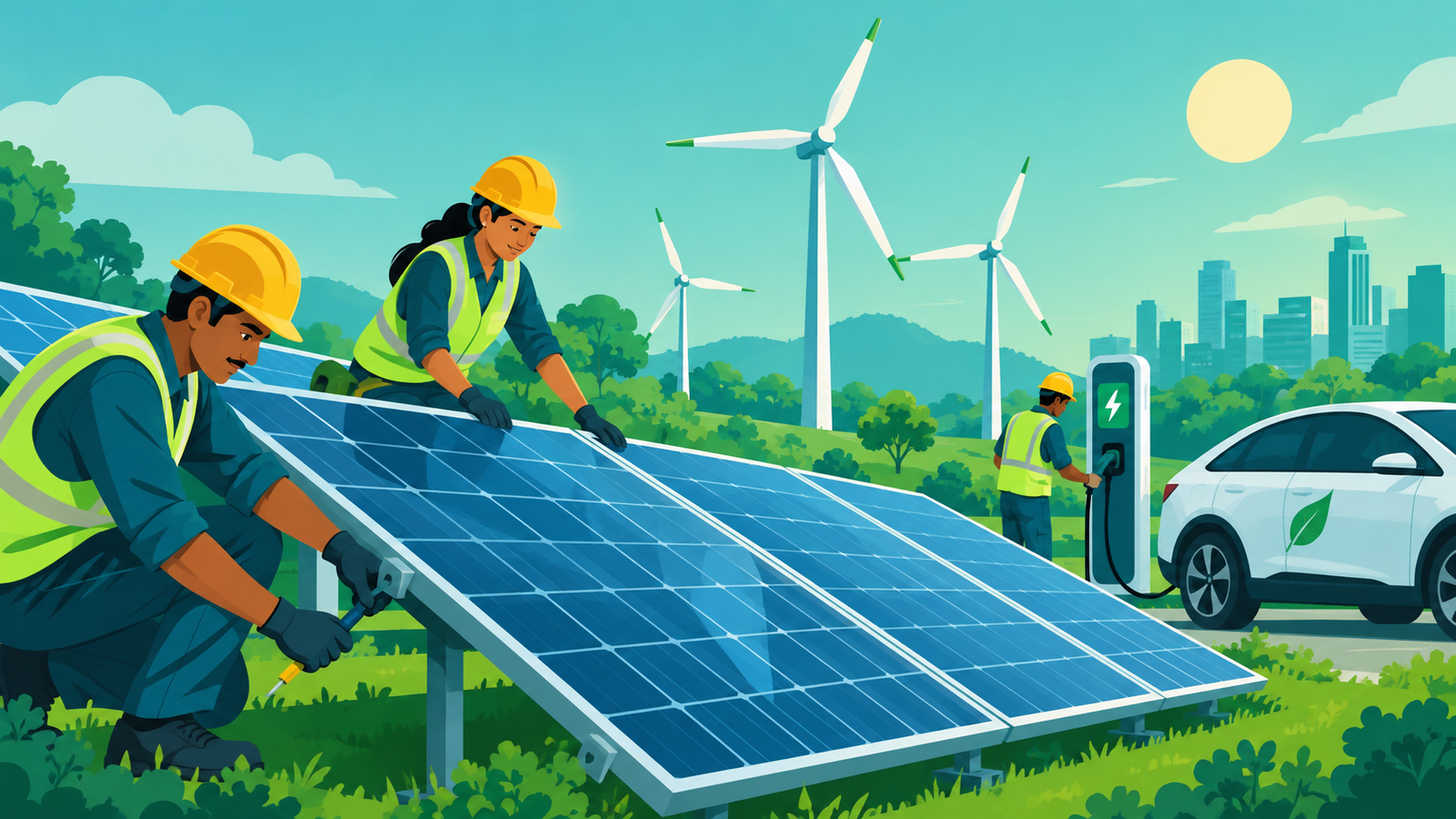
The expansion of clean energy, electric vehicles, recycling and ecological restoration could create new employment opportunities in India. A research assessment estimates potential for about 9.6 million to 13 million jobs by 2035. This is neither a count of jobs already created nor a government guarantee of recruitment. Its scope and assumptions matter more than memorising the largest number.
What Is a Green Job?
Green employment: Work that contributes to protecting or restoring the environment, using resources more efficiently, or reducing pollution and emissions. Examples include solar-plant maintenance, EV repair, safe recycling and forest restoration.
Job quality: Environmentally useful work is not automatically safe or well paid. Sorting waste without protective equipment may help recover materials while exposing workers to harm. Green policy therefore needs labour protection and social security.
Reading the Employment Potential
The research examines four broad areas: green energy, electric mobility, the circular economy and nature-based solutions. A circular economy keeps products and materials in use through repair, reuse and recycling. Nature-based solutions include activities such as forest and mangrove restoration.
| Scope | Estimate for 2035 | Important qualification |
|---|---|---|
| Renewables, green hydrogen, EV manufacturing/charging, formal recycling and nature-based activities | About 9.6 million | Model-based potential |
| The above plus largely informal EV servicing and municipal-waste recovery | About 13 million | Including informal livelihoods expands the scope |
| Nature-based solutions | About 4.15 million full-time-equivalent opportunities | Restoration scale-up potential, not that many new hires each year |
Full-time-equivalent employment: Total working hours expressed in units equal to a full-time job. Two part-time roles can together represent one full-time-equivalent job. It is therefore not always the same as the number of individual workers.
The estimates depend on investment, government targets and labour requirements per unit of activity. Actual employment may differ if investment and targets are not realised.
What Happens to Existing Jobs?
Skill transferability: Some knowledge used in an existing occupation can also be useful in a new technology. Electricians, machine operators and maintenance technicians may enter new sectors after additional training.
Among assessed source-to-destination role mappings from thermal power to renewables and green hydrogen, the research finds about 71% with high or medium transferability. This does not mean that 71% of workers have already found new jobs, or that every worker can change occupations after a very short course.
Location mismatch: A coal-dependent district and a solar project in another state may belong to different labour markets. Housing, travel, language and family responsibilities can make a move difficult.
Timing mismatch: An old job may disappear before a new one becomes available. Training alone is insufficient without support during the income gap.
A Just Industrial Transition
A just transition seeks to prevent workers and communities from bearing an unfair share of the costs of cleaner production. Policy must ask where new work will emerge, who can access it, how good it will be and who supports people during lost-income periods.
- District planning: Map local industries, skills and livelihood dependence rather than relying only on national totals.
- Employer-linked training: Connect courses with actual roles, equipment and apprenticeships. Measure jobs and wages as well as certificates.
- Recognition of existing skills: Experienced workers should not have to restart their education from zero; bridge training should be used where appropriate.
- Informal-worker inclusion: Repair workers, waste pickers and subcontracted workers need protective equipment, recognition and social protection.
- Women's participation: Safe transport, suitable facilities and training compatible with care responsibilities can widen access.
- Local economies: Small businesses and local revenue linked to coal can also be affected. A list of direct employees alone is insufficient.
Risks Alongside Opportunities
Clean technologies also require minerals, land, water and energy. Battery and solar-equipment production can form part of a green value chain while still requiring responsible management of raw materials and waste. Likewise, counting more jobs is not enough if they remain unsafe or poorly paid.
The Way Forward
The objective should be an industrial transition that reduces emissions, raises productivity and improves workers' income and security. Converting employment potential into real opportunity requires skills, investment, labour protection and local development to move together.
Prelims practice questions
Consider the following statements:
1. Full-time-equivalent employment may measure working hours rather than simply count distinct individuals.
2. Finding that skills can transfer between roles is equivalent to workers actually obtaining new jobs.
3. A just transition may include social protection and livelihood support for affected workers.
How many of the statements given above are correct?
(a) Only one
(b) Only two
(c) All three
(d) None
Answer and explanation
Answer: (b)
Statement 1 is correct: Hours in part-time work can be combined into full-time-equivalent units. Statement 2 is incorrect: Skill compatibility does not automatically remove barriers relating to vacancies, location, selection and wages. Statement 3 is correct: Fair distribution of transition costs is important to a just transition.
Mains practice question
Growth in green employment does not automatically ensure a just industrial transition. Discuss in the Indian context and suggest measures for a worker-centred transition. (250 words, 15 marks)
Answer outline:
In the introduction: Distinguish the environmental purpose of green jobs from the distributional concerns of a just transition.
In the body: Explain location, timing and skill mismatches; formal and informal work; safety and wages; women's participation; and local economic dependence. Distinguish 2035 employment potential from guaranteed recruitment. Suggest district plans, recognition of prior skills, employer-linked training, income protection and job-quality indicators.
In the conclusion: Make emissions reduction and worker protection parts of the same industrial policy.
Frequently Asked Questions (FAQ)
Summary answer: The expansion of clean energy, electric vehicles, recycling and ecological restoration could create new employment opportunities in India.
Question: Are 13 million green jobs by 2035 guaranteed?
No. The figure represents employment potential under the study's sectoral coverage and assumptions, not guaranteed recruitment or a count of current jobs.
Question: Why do the estimates differ between 9.6 million and 13 million?
The larger estimate also includes largely informal livelihoods in EV servicing and municipal-waste recovery.
Question: What does full-time-equivalent employment measure?
It expresses working hours in units equivalent to full-time jobs. It need not equal the number of distinct individuals.
Question: Does skill transferability mean a worker has obtained a new job?
No. Vacancies, location, selection and wages matter alongside compatible skills.
Sources
- [Press] [India's Green Jobs Moment: Pathways to Build a Future-Ready Workforce](https://iforest.global/wp-content/uploads/2026/10/National-report_Green-Jobs.pdf)
- [Press] [After poverty decline, green jobs can power India's next growth story](https://indianexpress.com/article/opinion/columns/after-poverty-decline-green-jobs-can-power-indias-next-growth-story-10960506/)
Download This Article: PDF