
Published: 26 November 2026
In this article
Why in news
On 25 November 2026 the Union Cabinet approved the continuation of the Department of Posts' Estates Management Scheme. The Central Sector Scheme will run through the 16th Finance Commission cycle, FY 2026-27 to 2030-31, with a total outlay stated at Rs 1,491 crore. [1]
What the scheme is
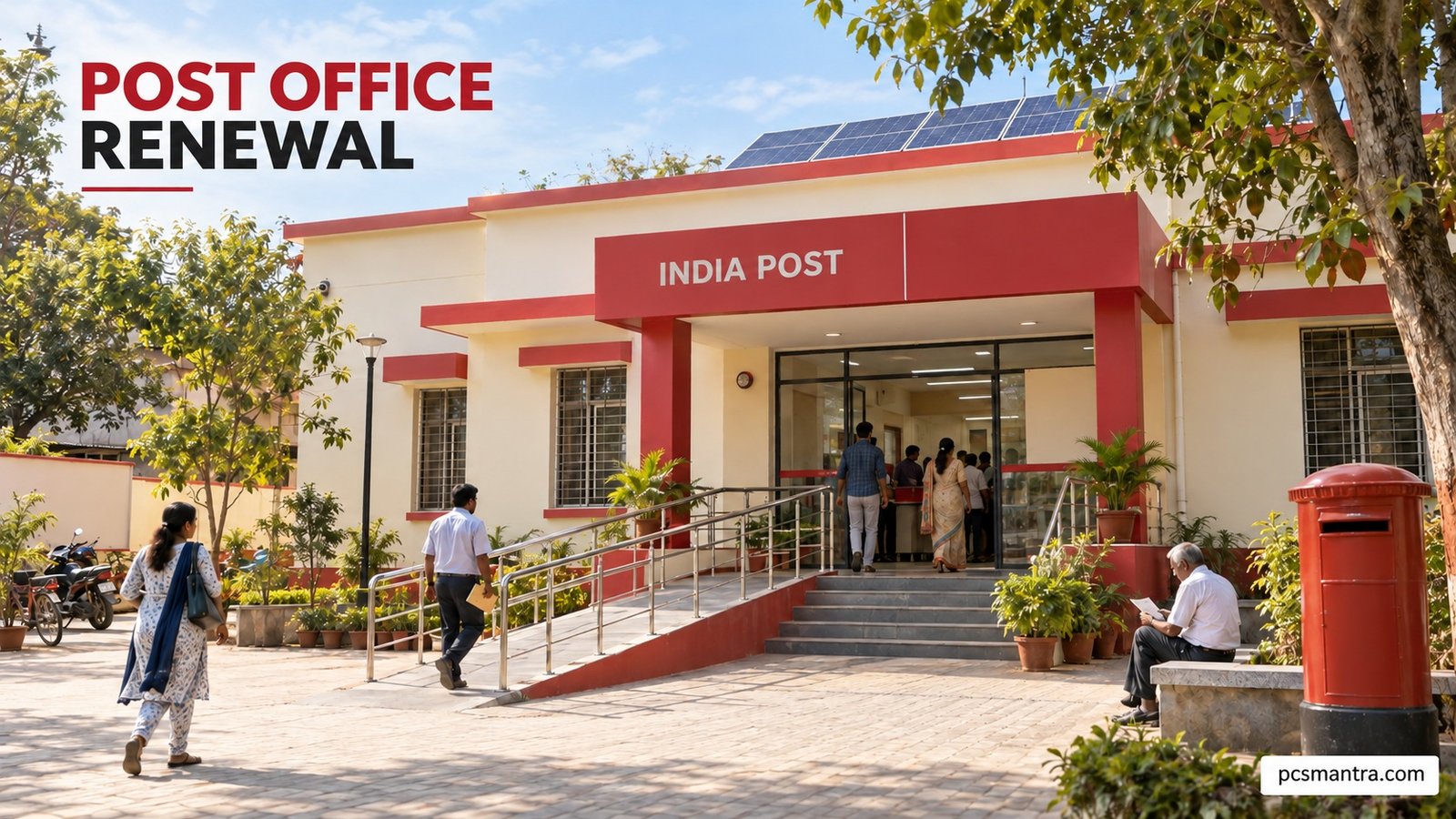
Objective: according to the official release, the scheme modernises the Department of Posts' estates infrastructure comprehensively. It covers construction, re-construction, renovation and uniform branding of post offices and residential colonies, and the preservation of the country's heritage postal buildings.
What it links to: the release ties the scheme to first-mile delivery, financial inclusion and citizen-centric service, and describes it as aligned with Digital India, Atmanirbhar Bharat and Viksit Bharat.
The scale of the postal network
The release says India has 1.65 lakh post offices, of which 1,49,385 are in rural areas, about 90 per cent. These offices do more than handle mail and parcels. They provide the Post Office Savings Bank (POSB), India Post Payments Bank (IPPB), Postal Life Insurance (PLI), Aadhaar services, Post Office Passport Seva Kendras and support for rural artisans through Dakghar Niryat Kendras (DNKs).
That is why buildings matter here beyond bricks and mortar. In a remote village, a safe, accessible and recognisable post office is the first point of contact for these services.
The components at a glance
The release lists the components as follows (amounts in Rs crore):
| Component | What it does | Amount |
|---|---|---|
| New construction | 190 departmental postal buildings on vacant departmental plots, to replace rented premises and remove rent liabilities | 280 |
| Re-construction | Demolishing and rebuilding 50 dilapidated departmental structures | 108 |
| Renovation and branding | Upgrading and uniformly branding 2,550 departmental sub-post offices | 318 |
| Rented post office upgrades | Upgrading and uniformly branding 2,500 post offices in rented premises | 37.50 |
| Heritage preservation | Restoring and preserving 20 landmark heritage postal buildings | 180 |
| Colony renovation | Revamping 150 high-demand postal residential colonies | 357.50 |
| Allied and inclusive activities | Solar power, rainwater harvesting, ramps and Braille signage (under Sugamya Bharat Abhiyan), ladies' toilets and feeding rooms | 100 |
| Integrated Technology Centre | Permanent premises in Bengaluru for the Centre for Excellence in Postal Technology (CEPT), to support advanced postal technology services and the indigenous open-source tech stack | 100 |
Note: the release states a total outlay of Rs 1,491 crore, but the eight components above add up to Rs 1,481 crore. The release does not explain the Rs 10 crore difference. For the exam, write the official total as Rs 1,491 crore and read the component-wise amounts as given in the release.
Related concepts
Central Sector Scheme: a scheme fully funded by the Union government and implemented by a central department. Here it is a Department of Posts (Ministry of Communications) scheme.
Finance Commission cycle: each Finance Commission's recommendations cover a fixed period, usually five years, and schemes are continued against that cycle. Here the cycle is 2026-27 to 2030-31.
First-mile delivery: access at the starting point of a service or parcel network, that is, the location closest to the consumer.
Sugamya Bharat Abhiyan: the national Accessible India Campaign to make public buildings, transport and information accessible to persons with disabilities. The ramps and Braille signage mentioned here follow this approach.
Another approval the same day: the Cabinet also approved the continuation of a separate Department of Posts scheme, the Postal Operations Scheme, on the same day. The two are different: the Estates Management Scheme concerns buildings and physical infrastructure.
Analysis for the exam
From rented to owned: the 190 new buildings are meant to replace rented premises and cut rent liabilities. The gain will materialise only if buildings are completed on time and to quality.
Inclusion: ramps, Braille signage, ladies' toilets and feeding rooms take the scheme beyond construction. They make post offices more accessible to persons with disabilities and to women.
Heritage and environment: preserving 20 heritage buildings and adding solar power and rainwater harvesting links heritage with sustainability.
Limits: the release gives no performance indicators, such as how much rent will fall or how many offices will be completed by when. The Rs 10 crore gap between the total and the sum of components is also unexplained. The real effect of the scheme can be judged only when implementation data arrives.
Way forward
Success will depend on construction and renovation finishing on schedule, the new buildings being maintained, and the accessibility features actually being used. Building upgrades should also be read against the quality of postal services, such as access to banking and insurance and waiting times at rural post offices. Outcome-based public reporting would strengthen accountability.
Prelims practice question
Question 1. Consider the following statements regarding the Department of Posts' Estates Management Scheme:
Statement 1: It is a Central Sector Scheme continued in the 16th Finance Commission cycle, from FY 2026-27 to 2030-31.
Statement 2: It provides for 190 new postal buildings on vacant departmental plots, to replace rented premises.
Statement 3: It provides for permanent premises of the Centre for Excellence in Postal Technology (CEPT) in Hyderabad.
Which of the statements given above are correct?
Answer and explanation
Answer: (a).
Statement 1 is correct: the scheme is a Central Sector Scheme running from 2026-27 to 2030-31. Statement 2 is correct: 190 new buildings are to come up on vacant departmental plots. Statement 3 is incorrect: the permanent CEPT premises are proposed in Bengaluru, not Hyderabad.
Question 2. Which component of the Estates Management Scheme has the largest allocation?
Answer and explanation
Answer: (c).
Per the release, renovation of postal residential colonies gets Rs 357.50 crore, the largest among the components. Renovation and branding gets Rs 318 crore, new construction Rs 280 crore and heritage preservation Rs 180 crore.
Mains practice question
Question 1. "The Department of Posts' Estates Management Scheme is not merely a building programme, it is a means of service delivery and inclusion." Discuss. (250 words, 15 marks)
Answer outline
Introduction: A brief introduction to the approval, duration and outlay; mention the scale of the postal network.
Body: The shift from rented to owned buildings; rebuilding dilapidated structures; uniform branding; accessibility and women-friendly facilities; heritage preservation; solar power and rainwater harvesting; the permanent CEPT premises; limits, such as the absence of performance indicators and implementation challenges.
Conclusion: A balanced conclusion: buildings are the base of service, but the real test is the quality and reach of services in rural areas.
Sources
- https://www.pib.gov.in/PressReleseDetailm.aspx?PRID=2341181&lang=2®=48 (PIB, Cabinet approves continuation of Estates Management Scheme for Department of Posts, 25 November 2026)
Frequently asked questions
Until when has the Estates Management Scheme been continued?
On 25 November 2026 the Union Cabinet approved its continuation in the 16th Finance Commission cycle, that is, FY 2026-27 to 2030-31.
What is the total outlay?
The release states Rs 1,491 crore over five years. The component-wise figures in the release add up to Rs 1,481 crore, and the release does not explain the difference.
How many new buildings will be built?
The scheme provides for 190 new postal buildings on vacant departmental plots, along with the re-construction of 50 dilapidated buildings.
How is it different from the Postal Operations Scheme?
The Estates Management Scheme focuses on physical infrastructure such as buildings and residential colonies, while the Postal Operations Scheme is a separate Department of Posts scheme approved by the Cabinet the same day.
Download this article: PDF