
Why in the News
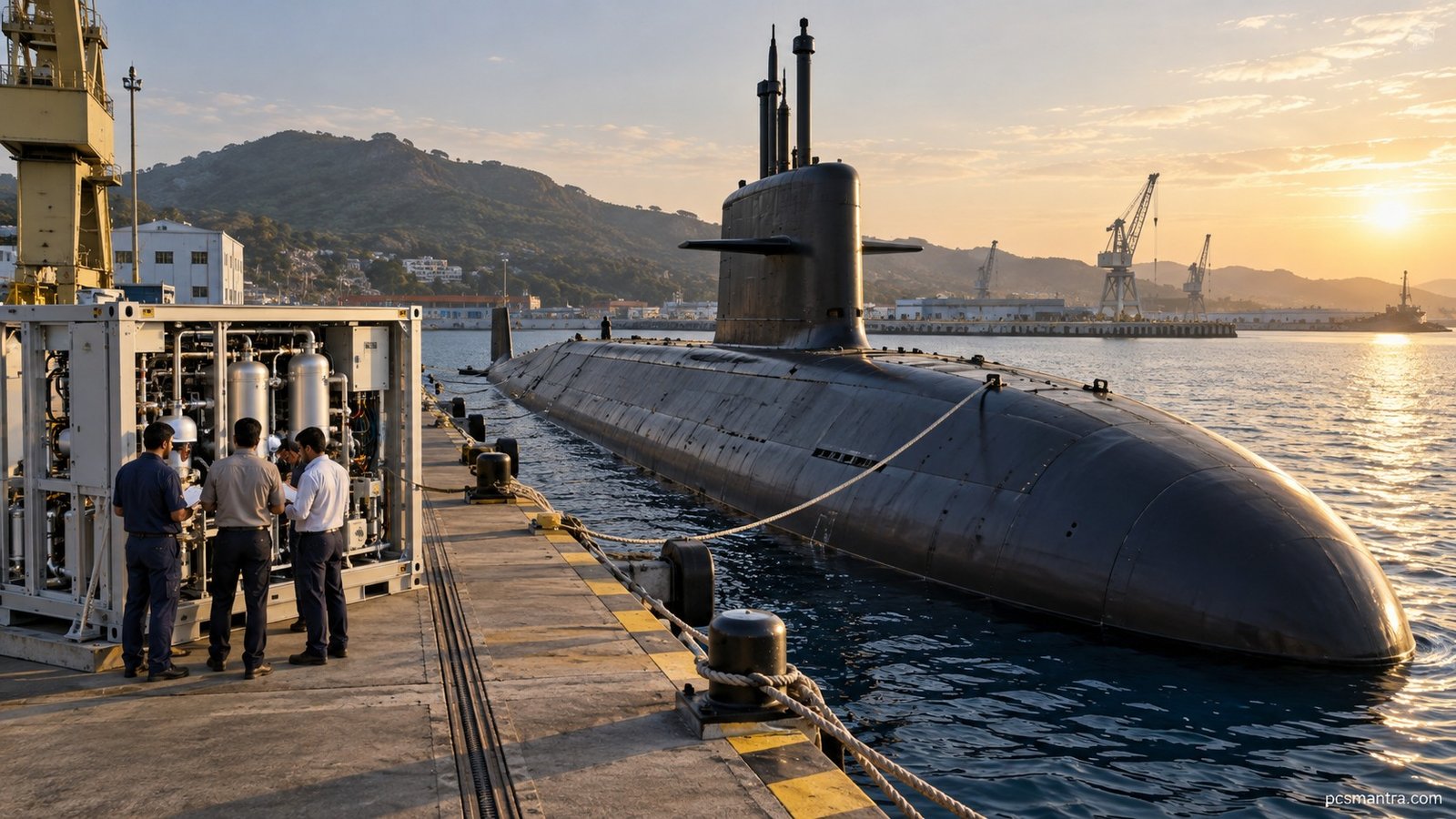
On 24 October 2026 the Ministry of Defence announced the inauguration of the 'Setting to Work Phase-2' (STW-2) activity of the indigenous Air Independent Propulsion (AIP) system's Energy Module, developed by DRDO's Naval Materials Research Laboratory (NMRL), at Larsen & Toubro's A.M. Naik Heavy Engineering Complex in Hazira, Gujarat. The module will next be energised for power production, tested under the Indian Navy's protocols, and then handed to Mazagon Dock Shipbuilders Limited (MDL) for integration on a Kalvari-class submarine in early 2027. The event details are in the companion explainer; this article examines the milestone through the lens of defence indigenisation and naval self-reliance.
Introduction
A conventional diesel-electric submarine must periodically surface or raise a snorkel mast to run its diesel engines and recharge batteries, which is when it is most vulnerable to detection. Air Independent Propulsion lets such a submarine generate power underwater without atmospheric oxygen, lifting submerged endurance from days to weeks, as the Ministry of Defence's Annual Report 2025-26 describes it. AIP therefore acts as a force multiplier for conventional submarines, and building it indigenously matters as much as having it.
Key Dimensions
1. The programme chain, and why it signals maturity. The indigenous AIP has moved through identifiable stages: a land-based prototype tested by DRDO in March 2021; a June 2023 contract with L&T for two AIP system modules for the Kalvari class; a December 2024 contract worth around Rs 1,990 crore with MDL for construction of the AIP plug and its integration; and now the STW-2 phase at Hazira, ahead of handover to MDL for integration on a Kalvari-class submarine in early 2027. The chain links a DRDO laboratory (NMRL), a private-sector heavy-engineering firm (L&T), the Navy as the testing and validating user, and a public-sector shipyard (MDL) - the institutional model Indian defence indigenisation aims for.
2. Why a retrofit matters. The six Kalvari-class submarines were built by MDL under Project-75 with technology transfer from France's Naval Group (INS Kalvari commissioned December 2017, followed by Khanderi, Karanj, Vela, Vagir, and Vaghsheer in January 2025), but without AIP. Adding the capability through refits - inserting a new hull section, the plug, carrying the energy module - upgrades the existing fleet rather than waiting for a future class. The December 2024 plug contract was projected to generate nearly three lakh man-days of employment.
3. Fit with the wider indigenisation record. Defence production reached an all-time high of Rs 1.54 lakh crore in FY 2024-25, up from Rs 46,429 crore in 2014-15, and defence exports hit a record Rs 23,622 crore in FY 2024-25, reaching around 80 countries; the private sector now contributes nearly 23 per cent of production. The AIP programme is one strand of this shift from licensed assembly to designed-and-built-in-India systems, and it explicitly invokes the Aatmanirbhar Bharat goal in the Ministry's own releases.
4. The fleet-level context. India's conventional underwater arm is being renewed on more than one track. Alongside the AIP retrofit, press reporting (Business Today, October 2026) describes Project-75(I) - six advanced submarines to be built in India with Germany's Thyssenkrupp Marine Systems at an estimated investment above Rs 80,000 crore - as submitted for final approval, with a proposal for three additional Kalvari-line boats also under consideration. A proven indigenous AIP would give India its own propulsion option across these choices.
Challenges
- No disclosed performance figures. The Ministry's release gives no power output or endurance numbers, so the system's real gain can be assessed only after Navy trials.
- Safety engineering. The Defence Secretary stressed maintaining the exacting safety culture that hydrogen and fuel-cell systems demand; defence reporting describes the design as generating hydrogen on demand rather than storing it, precisely to manage this risk.
- Retrofit complexity and timelines. Integration means cutting into an operational boat's pressure hull during a refit window; press reporting also notes the programme's earlier target dates have slipped, making the early-2027 integration goal the test to watch.
The Way Forward
Meeting the 2027 integration timeline, completing the Navy's protocol trials without diluting safety standards, standardising AIP as a fit on future conventional submarines, and carrying the DRDO-industry-Navy model into other underwater technologies would convert this milestone into durable capability - and, in time, into an exportable one.
Mains Practice Question
"Indigenous Air Independent Propulsion marks a shift from buying capability to building it." Examine the significance of the DRDO AIP programme for India's naval self-reliance, noting the challenges that remain. (250 words, 15 marks)
Answer outline
- Introduction: why conventional submarines need AIP (snorkelling vulnerability; endurance from days to weeks).
- Body: programme stages (2021 land prototype, 2023 L&T modules, 2024 MDL plug contract, 2026 STW-2, 2027 integration target); DRDO-L&T-Navy-MDL model; fit with record defence production (Rs 1.54 lakh crore) and exports (Rs 23,622 crore) in FY 2024-25; fleet context (six Kalvari boats; reported Project-75(I)).
- Challenges: undisclosed performance figures, hydrogen/fuel-cell safety, retrofit complexity, past timeline slippage.
- Conclusion: 2027 integration as the proof point; AIP as a template for self-reliance.
Sources
DRDO press release, 30 December 2024: AIP plug contract details -
Naval Group press release, 16 January 2025: INS Vaghsheer commissioning
six Kalvari-class boats and their commissioning dates -
PIB: record defence production of Rs 1.54 lakh crore and exports of Rs 23,622 crore in FY 2024-25
The Eastern Strategist: description of the retrofit plug and hydrogen-on-demand design
MoD Annual Report 2025-26 on AIP endurance (secondary reporting used only where attributed) -
