
In this article
Why in the News
On 25 November 2026 IN-SPACe made public a report titled "Supply Chain Landscape of Satellite Manufacturing in India". IN-SPACe is an autonomous body under the Department of Space that both regulates and promotes private space activity. According to the report, India's satellite supply chain depends heavily on imports for critical components. [1][2]
Source limit: the full text of the report could not be checked while this article was prepared. The points below come from news accounts of the report, so treat them as a summary and not as the report's exact wording.
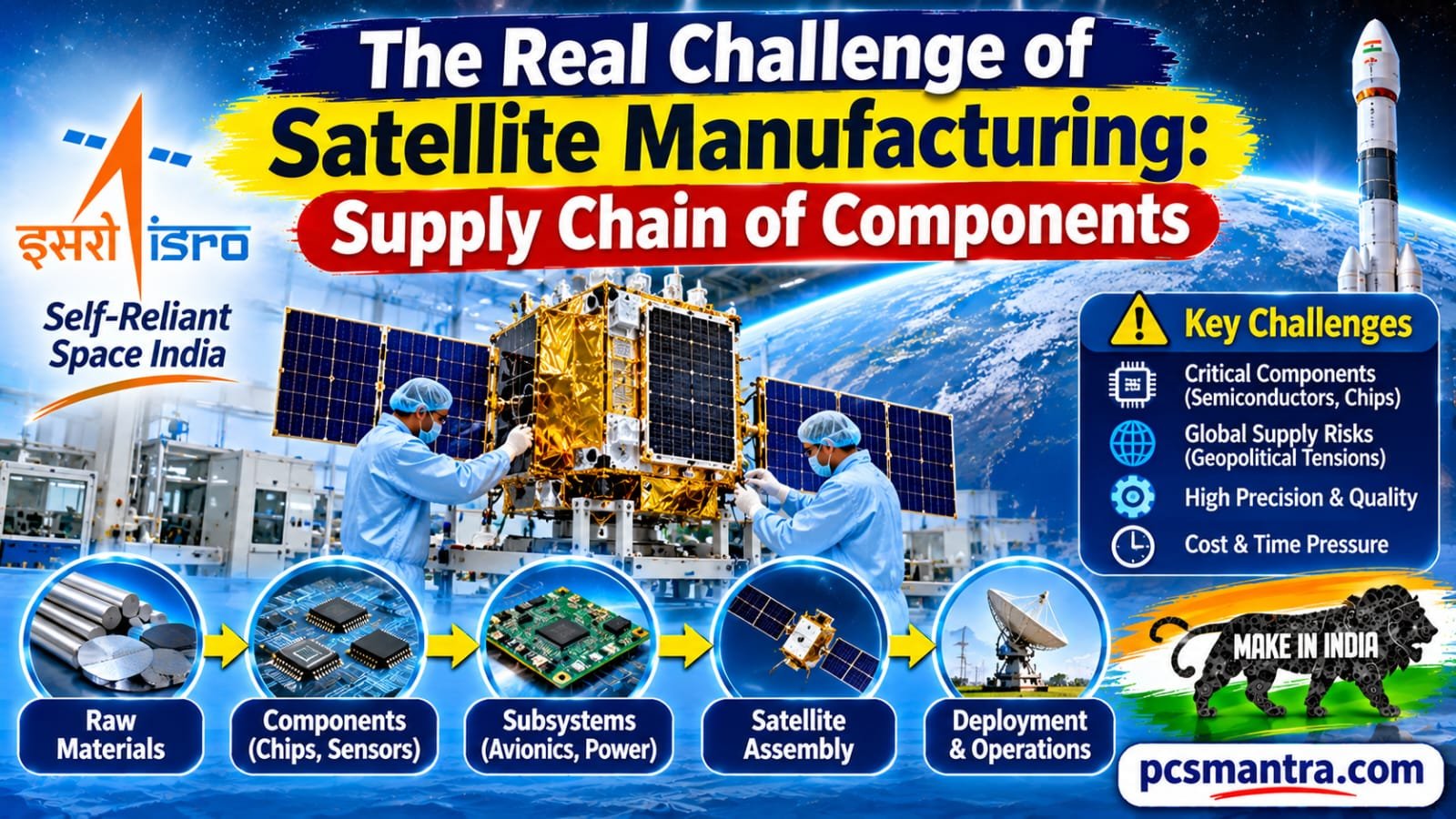
A supply chain is the full link from raw material and parts to a finished satellite. Wherever one critical part comes from abroad, delay, price and restriction risks reach the satellite builder.
What the Report Does
It is a descriptive map, not a statistical survey. The report splits satellite manufacturing into major subsystems and identifies components, materials and equipment for each. A subsystem is a part of the satellite that does a separate job, such as the structure, propulsion or power. The report then lists 53 Indian and 162 foreign suppliers of these products. The foreign list includes firms from the United States, Germany, Japan, France and the Netherlands. [1]
What "60 Per Cent" Really Means
According to news accounts of the report, about 60% of a satellite's cost is attributed to electronic, electrical and electromechanical (EEE) components and specialised materials, and many of these are imported. This is a share of cost. Reading it as 60% of imports, or as the imported share of parts, would be wrong. News accounts describe it only as a share of cost and give no measured import share. [1]
| Figure | What it measures | Wrong reading |
|---|---|---|
| About 60% | Share of satellite cost in EEE parts and specialised materials | 60% of imports |
| 53 and 162 | Indian and foreign suppliers listed in the report | Market share |
Weak Links in the Domestic Supply Chain
- Domestic role: The private sector's contribution is described as mostly "structural assemblies" and "propulsion components", largely supplied by established public sector firms and older private firms.
- Testing and certification: Facilities are limited. Certification is formal proof that a part will survive space conditions. Its absence weakens acceptance in global markets.
- Project-based manufacturing: Many firms produce project by project, which discourages long-term investment in automation and production capacity.
- Procurement delays: Critical components often take 12-16 months to arrive. Projects slip and market openings are lost. [1][3]
- Skills and research: There is a shortage of trained people in systems engineering, quality assurance and testing, and private research and technology transfer are limited.
Opportunity and the Demand Question
The report concludes that with policy interventions, strategic investment and international collaboration India could become, within a decade, a trusted global supplier of space-grade components, satellite platforms and turnkey solutions. At present the private sector mostly plays the assembler. The possibility of becoming an exporter is stated in the report; it is not an achievement. [1]
Minister of State (Independent Charge) for Science and Technology Jitendra Singh said this week that India's space economy is worth nearly 9 billion dollars and could reach 40-45 billion dollars in under a decade, with the private sector growing from a few start-ups to 400-500 companies. These are projections. IN-SPACe chairman Pawan Goenka said at a conclave that the bigger need is creating demand, then bringing in enough money and having workable procedures at every level. [1]
Way Forward
- Component-level priority: From the full list, pick the parts whose domestic substitute can be built fastest and cheapest.
- Shared testing and certification facilities: Small firms cannot build costly test labs alone.
- Demand assurance: Long-term procurement orders give private investment stability.
- Skills and research: Training in satellite systems, quality and testing, along with industry-institute partnerships.
Mains Practice Questions
Question 1. Despite growing private participation in India's satellite manufacturing, import dependence for critical components persists. Discuss the reasons and suggest measures to strengthen the domestic supply chain. (250 words, 15 marks)
Answer outline
Introduction:
State the import dependence and the limited private role in satellite manufacturing.
Body:
EEE components and specialised materials form a large share of satellite cost; few domestic suppliers.
Limited testing and certification, project-based manufacturing, 12-16 month procurement delays, gaps in skills and research.
Measures: component priorities, shared test facilities, demand assurance, training.
Conclusion:
Self-reliance means a trusted and diversified supply, not making everything at home.
Question 2. Explain the role of testing and certification facilities in satellite manufacturing. (150 words, 10 marks)
Answer outline
Introduction:
State why reliability of space-grade components matters.
Body:
Certification proves a part can survive space conditions.
Limited facilities affect cost, time and global acceptance.
Conclusion:
Shared and reliable facilities are a precondition for export capability.
Sources
- The Hindu: news account of the IN-SPACe report, 25 November 2026 (the report itself could not be checked)
- The Economic Times: second news account confirming the release, 26 November 2026
- World Economic Forum briefing paper, February 2025: procurement time of 12-16 months
Frequently Asked Questions (FAQ)
What is IN-SPACe?
IN-SPACe is an autonomous body under the Department of Space. It both regulates and promotes private space activity.
What does 60% mean in the report?
It is the share of satellite cost in EEE components and specialised materials, as described in news accounts. They do not give an import share.
How many suppliers does the report list?
As described in news accounts, 53 Indian and 162 foreign suppliers. The report is a descriptive map, not a statistical survey.
Download this article: PDF