
Published: 26 November 2026
In this article
Why in the News
The Karnataka Cabinet has approved a policy for the prevention, treatment, rehabilitation and social reintegration of burn survivors. The policy is named the "Karnataka Policy for Prevention, Treatment, Rehabilitation and Social Reintegration of Burn Survivors-2025", announced in the 2025-26 Budget.[1] A report published on 26 November 2026 describes Karnataka as the first State in the country to bring such a policy; this is the report's claim and has not been checked against an independent official list.[2]
This is an approval stage. According to the Principal Secretary (Health), the next step is implementation. The proposed 15-bed wards and the Centre of Excellence are therefore not yet operating facilities.
Reports of the Cabinet meeting appeared on 20 November 2026 ([1][3]); the detailed account is in the 26 November report.
What the policy proposes
District level: 15-bed burns care wards in district hospitals and government medical college hospitals. Each unit would have 10 general beds, 3 high-dependency unit (HDU) beds and 2 intensive care unit (ICU) beds, with operation theatres for burns procedures, isolation facilities and physiotherapy.[2]
Apex institution: The Mahabodhi Burns Care Centre at Bangalore Medical College and Research Institute (BMCRI) is to be upgraded as a Centre of Excellence. It would provide training, research and technical support to district units. The report also mentions hydrotherapy, prosthetics, radiology and laser facilities, treatment protocols, telemedicine and a State Burns Registry.[2]
Hub-and-spoke model: The Centre of Excellence (hub) would be linked to district units (spokes) through standard guidelines and referral protocols across primary, taluk, district and tertiary levels.[2] Hub-and-spoke: a network in which a large central institution handles complex cases while routine care happens locally.
Cost: The one-time cost of the 15-bed wards is estimated at Rs 100.95 crore. Rs 4.5 crore is earmarked for upgrading the Centre of Excellence, with recurring expenditure of Rs 1.2 crore a year.[2] A news-agency report mentions about Rs 100 crore for the wards.[3] Note: reports differ on the number of centres of excellence. One report describes a single centre (the Mahabodhi centre at BMCRI), while a news-agency report mentions two.
Beyond treatment: rehabilitation and reintegration
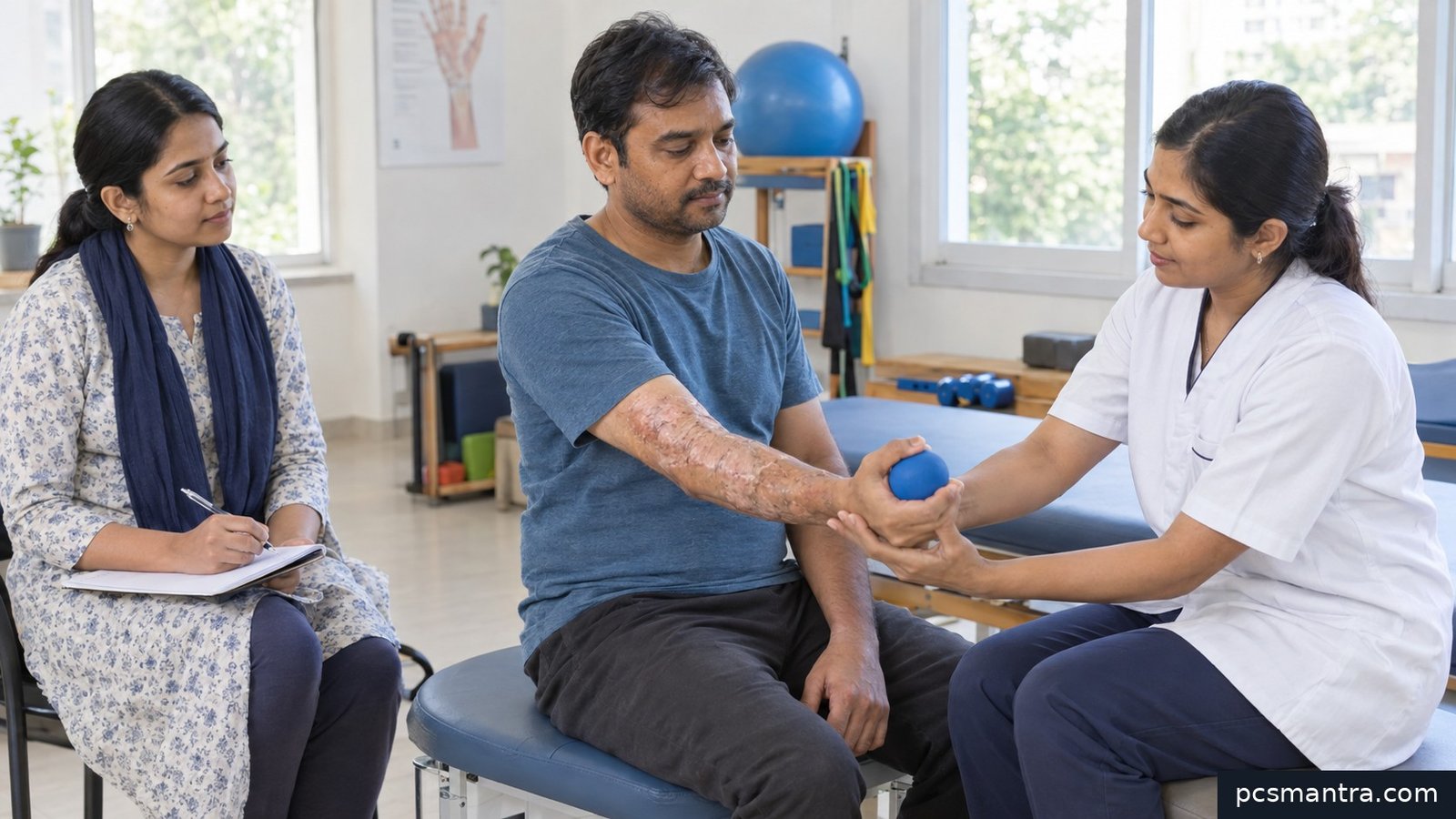
According to the report, the policy links the whole chain from emergency response, transport and stabilisation to treatment, referral and long-term rehabilitation. Standard protocols for wound management, intensive care and surgery are proposed. Where clinically appropriate, physiotherapy and rehabilitation are to start from the first day of treatment.[2]
Burns also leave psychological and social damage. The policy envisages counselling, reconstructive surgery, social security, and support for returning to family, education, employment and community. Livelihood support and vocational rehabilitation are also described.[2]
The numbers and the gap
Karnataka records an estimated 2.5 lakh to 3 lakh burns cases a year, according to the Cabinet note. The report says specialised care, including intensive care and rehabilitation, is concentrated in Bengaluru and Mysuru. The district units are meant to reduce this regional gap.[2]
What already exists at the Centre
Health and hospitals are State List subjects in the Seventh Schedule of the Constitution, so States can frame their own policies. The Centre's National Programme for Prevention and Management of Burn Injuries (NPPMBI) became a full programme in the 12th Five Year Plan. According to the National Health Mission website, the Cabinet Committee on Economic Affairs (CCEA) approved it on 6 February 2014 for 67 State Government medical colleges and 19 district hospitals.[4] A November 2026 PIB release says 47 burn units and 196 trauma care facilities have been sanctioned under the National Programme for Prevention and Management of Trauma and Burn Injuries (NPPMT&BI).[5]
The novelty of the Karnataka policy therefore lies in a State-level integrated framework: treatment, referral, registry and rehabilitation in one policy. It cannot be said that the State had no burns facility earlier.
Points of debate
Women's rights activist Donna Fernandes (co-founder of Aweksha) welcomed the policy but named two gaps. First, disfigurement is not recognised as a disability, which could leave survivors outside disability benefits. Second, burns involving women are not always kitchen accidents; they can be linked to domestic violence or dowry harassment.[2] She asked for compensation and health benefits on a par with acid-attack survivors.[2] The Schedule to the Rights of Persons with Disabilities Act, 2016 lists "acid attack victims" as a specified disability.[6]
Tests of success: Building beds is not enough. Trained surgeons, nurses, physiotherapists and psychologists, steady supplies of dressings and drugs, speed of ambulance referral and regular registry data will be the real test.
Mains Practice Question
Care of burns patients is not only a question of adding hospital beds. In the context of Karnataka's burn-survivor policy, examine the conditions for success of a State-level burns care system. (Answer in 250 words) | 15 marks
Answer Outline:
Introduction:
Burns are both a sudden emergency and a long rehabilitation issue. Karnataka has approved a policy covering prevention to social reintegration, aiming at district facilities and a State Centre of Excellence.
Main body:
- Structure: 15-bed wards (10 general, 3 HDU, 2 ICU) and hub-and-spoke referral can reduce dependence on Bengaluru and Mysuru.
- Human resources: Beds are useless without trained burn surgeons, nurses, physiotherapists and counsellors; the training role of the Centre of Excellence matters here.
- Rehabilitation: Physiotherapy from day one, reconstructive surgery, counselling and livelihood support help survivors return to society.
- Data and accountability: A State registry can show causes, regions and outcomes, which can shape prevention policy.
- Inclusion: Recognition of disfigurement and of burns linked to domestic violence, and the question of disability benefits, remain open.
- Finance: Regular provision for one-time and recurring costs is needed; the gap between announcement and a working service will be decided by implementation.
Conclusion:
Time-bound implementation, trained manpower and inclusive rehabilitation together can turn this policy from an announcement into real relief.
Prelims Practice Questions
Consider the following statements about the care of burns patients:
Statement 1: Public health and hospitals are State List subjects in the Seventh Schedule of the Constitution.
Statement 2: Approval of Karnataka's burn-survivor policy means all proposed district burn wards are already functioning.
Statement 3: Each proposed 15-bed unit is planned to have 10 general, 3 HDU and 2 ICU beds.
Which of the statements given above are correct?
Answer and explanation
Answer: (b)
Statement 1 is correct: hospitals and public health are in the State List, so States can frame their own policies.
Statement 2 is incorrect: Cabinet approval is a policy stage. Implementation is still to come, so the wards cannot be treated as functioning.
Statement 3 is correct: the reported unit structure is 10 + 3 + 2 = 15 beds.
Sources
- The Post, 19-20 November 2026: Cabinet meeting summary, full policy name
- The Hindu, 26 November 2026: Karnataka burn-survivor policy
- PTI (Deccan Chronicle), 20 November 2026: Karnataka Cabinet decisions
- National Health Mission: National Programme for Prevention and Management of Burn Injuries (NPPMBI)
- PIB, 22 November 2026: AIIMS Bhubaneswar, third burn care training centre (sanctioned NPPMT&BI units)
- Rights of Persons with Disabilities Act, 2016 (Schedule)
Frequently Asked Questions (FAQ)
Summary answer: The Karnataka Cabinet has approved a policy for burn-survivor care and rehabilitation, with 15-bed wards in district hospitals and an upgraded Centre of Excellence at BMCRI. These are proposed facilities, not services already running.
What does the Karnataka burns care policy propose?
15-bed burns wards (10 general, 3 HDU, 2 ICU) in district and government medical college hospitals, an upgrade of the Mahabodhi Burns Care Centre at BMCRI, a State Burns Registry and a referral network. It also provides for counselling, reconstructive surgery and livelihood support.
Are all the proposed burns wards functioning?
No. The policy has Cabinet approval. The Principal Secretary (Health) says the next stage is implementation.
What criticism has been raised?
Activist Donna Fernandes said the policy does not treat disfigurement as a disability and does not separately recognise violence-linked burns among women. This is her view, not the policy text.
Download this article: PDF