
Published: 22 November 2026
27–28 November update: contempt notices and Receivers
What happened on 24 November: Despite the 20 November order, the lamp was not lit at the Deepathoon on 24 November; after a resolution by the temple trustees it was lit at the customary Deepa Mandapam. The District Collector's preliminary report said the trustees had refused to authorise a lamp-lighting team; the court called this "crocodile tears".
The 27 November order: The bench of Justices Aravind Kumar and Vipul M. Pancholi prima facie held that non-compliance with the 20 November order was "flagrant and wilful disobedience" born of a "pre-meditated conspiracy" between the State and the temple trustees. It suspended the temple's Board of Trustees and appointed two former High Court judges, Justice S. Vaidyanathan, former Chief Justice of the Meghalaya High Court, and Justice V. Parthiban, former judge of the Madras High Court, as Receivers.
Key directions:
-
The Karthigai Deepam will be lit again on 28 November 2026, this time at the stone pillar (Deepathoon), as originally ordered on 20 November. The Receivers will conduct the ceremony in consultation with the temple Stanikars.
-
The interim order creates no future equities for any party; its scope is limited to the contempt petitions. The main matter, the religious-rights dispute, will be heard in the second week of January 2027.
-
The 27 November order also allowed the public to light lamps on the hill on 28 November (this is distinct from the restricted group at the pillar ceremony described below); central forces will provide security. A 50-metre cordon will ring the dargah, but worshippers' access and rights will not be affected.
-
Show-cause notices went to the Tamil Nadu Chief Secretary, the DGP, the Madurai District Collector and Police Commissioner, the HR&CE Commissioner and Deputy Commissioner, and the temple's chairperson, Executive Officer and trustees; all must appear personally on 15 December 2026.
-
The Chief Secretary must file a personal affidavit within 10 days explaining the "apparent disregard" of the State's constitutional duty under Article 144 to carry out a Supreme Court order, with details of communications (emails, call records) between the State and district administration.
Status as of 1:48 p.m. on 28 November: The Receivers had reached the temple. The latest report expected lighting around 5 p.m., with only 20–25 people selected by the Receivers allowed to witness it. This records preparations at that time, not a completed ceremony.
Limits of the order: This order is not a final decision. Custom, ownership and any permanent right to light the lamp at the pillar remain open in the main hearing; both the 20 November and 27 November orders are interim.
Update sources
In this article
Why in news
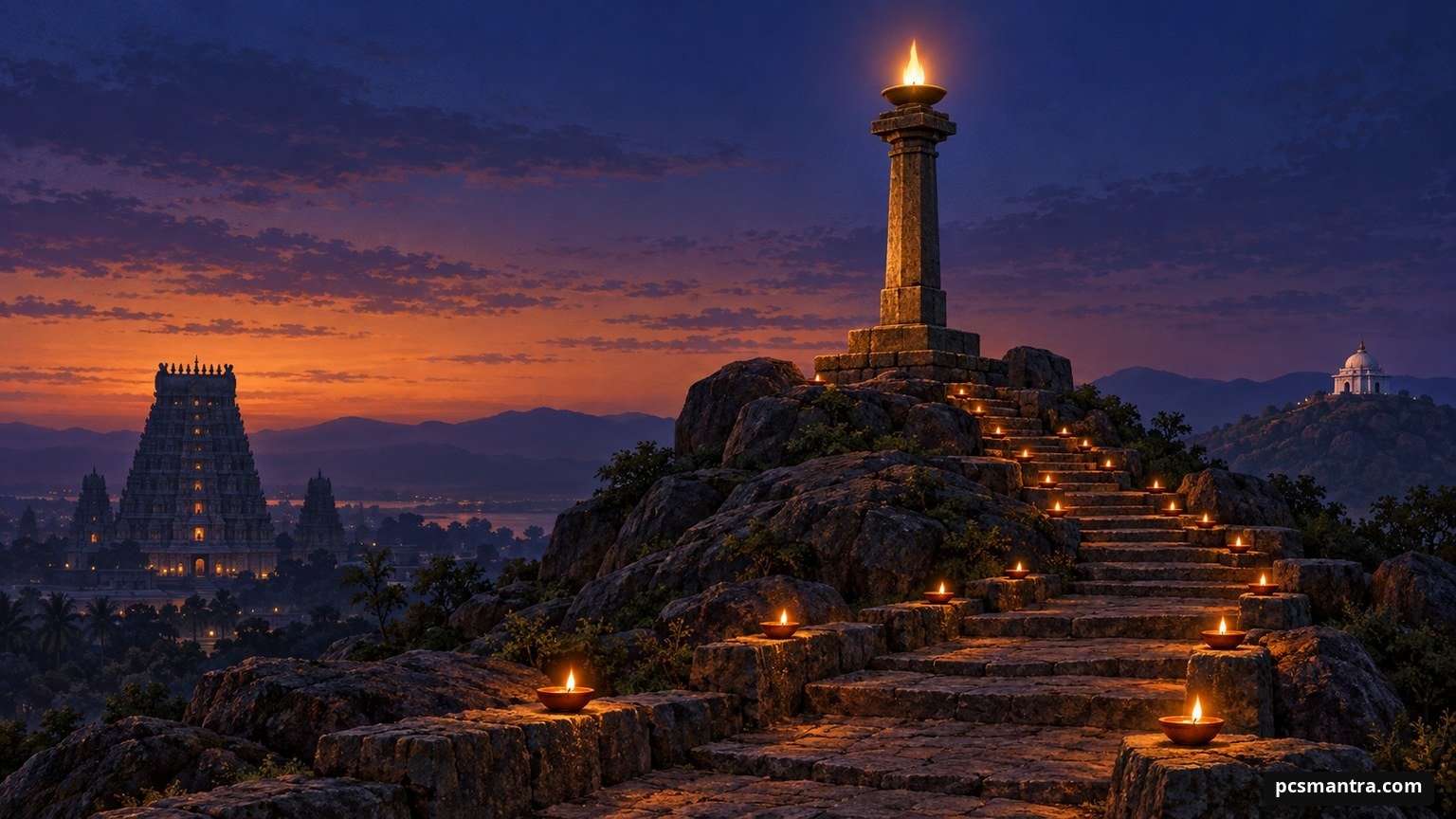
On 20 November 2026, a Supreme Court bench of Justices Aravind Kumar and Vipul M. Pancholi made a limited interim arrangement for lighting the Karthigai Deepam at the Deepathoon, a stone pillar on Thirupparankundram hill near Madurai in Tamil Nadu, on 24 November 2026. Paragraph 12 of the signed order stays the findings in paragraphs 1-141 of the Madras High Court Division Bench judgment dated 6 January 2026, insofar as challenged in these proceedings, until further orders and subject to the Supreme Court's directions. It does not set aside the entire High Court judgment. The one-time permission does not establish any claimed custom or religious right. [1]
Background: the Karthigai Deepam tradition
Karthigai Deepam is a lamp festival of Tamil Nadu, observed in the Tamil month of Karthigai, around November-December. Lamps are lit in homes and temples. Thirupparankundram hill near Madurai is associated with the Subramanya Swamy temple and the Sikandar Dargah. The demand to light the lamp at the Deepathoon is disputed; the Supreme Court has not established a customary right at that pillar. [1][2][4]
How the dispute escalated
The High Court judgment describes the customary Deepa Mandapam near Uchipillaiyar Temple on the hill. Some petitioners sought lighting at the Deepathoon. After the single judge's directions, the High Court Division Bench gave its judgment on 6 January 2026. The Tamil Nadu authorities challenged it before the Supreme Court. In a separate, earlier High Court contempt-enforcement stage, the 4 December 2025 order records directions for CISF protection. That earlier arrangement must not be confused with the CRPF provision in the Supreme Court's 20 November 2026 order. [1][2][3]
The Supreme Court's order
The Supreme Court permits the 24 November 2026 ceremony as a temporary, one-time arrangement, without recognising or enforcing any asserted customary, religious or proprietary right. Its safeguards include: [1]
- Only a Devasthanam-authorised team will light the lamp. The Madurai District Collector will settle the team's size and composition in consultation with the temple Executive Officer, the Archaeological Survey of India (ASI) and the Commissioner of Police, Madurai.
- The Collector is the nodal officer. The Police Commissioner must provide police protection and regulate access. The Union's competent authority is to examine and facilitate CRPF deployment if required and sought by the State, taking operational feasibility into account, to supplement local police for the limited ceremony.
- No general public may accompany the team. No procession, public congregation, demonstration, slogan-raising or activity unrelated to the ceremonial lighting is permitted at the site. Access is limited to the authorised persons and officials needed for supervision and security.
- The administration will settle timing, route and duration with public safety, fire prevention, archaeological protection and peace in view. The team must leave immediately after the ceremony without leaving temporary articles or installations.
- ASI will prescribe preservation conditions. No excavation, construction, structural alteration, permanent installation or damage to a monument, religious structure or property is permitted.
- Existing customary observances will continue undisturbed. Lawful religious activities, access and enjoyment of the Dargah and other institutions must not be interfered with. No additional right of entry, occupation or control over any part of the hill is created.
The Court leaves title, possession, custom, religious entitlement, temple administration and access open for adjudication. This ceremony cannot be used as evidence of an established custom or as an independent basis for permission in later years. Articles 25 and 26 and essential religious practice remain issues for consideration, not rights established by this interim order. The Collector must submit a compliance report within three days after the festival. The matters were directed to be listed in the second week of January 2027; that is not a promise of a final judgment then. [1]
22 November: review petition reported
LiveLaw and The Hindu reported on 22 November 2026 that Tamil Nadu's Hindu Religious and Charitable Endowments (HR&CE) Department had sought review of the interim order. This filing is attributed to those reports; the official review petition has not been independently retrieved for this article. A reported filing is not a court decision staying or reversing the 20 November order. The order's limited permission and the challenge to it should be kept distinct. [5][6]
Exam relevance
For Prelims: Karthigai Deepam is a Tamil Nadu festival; Thirupparankundram is in Madurai (Tamil Nadu); remember the concepts of interim order and stay. For Mains: write on religious freedom versus public order, the limits of judicial intervention, and the "essential religious practice" test under Articles 25-26.
Prelims practice question
Consider the following statements:
Statement 1: Karthigai Deepam is a lamp festival celebrated in Tamil Nadu.
Statement 2: Thirupparankundram hill is located in Kerala.
Statement 3: The Supreme Court permitted the lamp to be lit at the Deepathoon on 24 November as a one-time measure.
Which of the statements given above are correct?
Answer and explanation
Answer: (a)
Statement 1 is correct: Karthigai Deepam is Tamil Nadu's major lamp festival, celebrated in the month of Karthigai.
Statement 2 is incorrect: Thirupparankundram hill is near Madurai in Tamil Nadu, not in Kerala.
Statement 3 is correct: paragraph 13 of the signed 20 November 2026 order permits a limited, one-time ceremony at the Deepathoon on 24 November 2026. The stay concerns challenged High Court findings in paragraphs 1-141, not a final resolution of the dispute.
Sources
- Supreme Court: signed order, 20 November 2026
- Madras High Court: 6 January 2026 judgment, court-text mirror
- Madras High Court: 4 December 2025 order, court-text mirror
- Tamil Nadu Tourism: Karthigai Deepam, festival background only
- LiveLaw: review petition reported, 22 November 2026
- The Hindu: review petition reported, 22 November 2026
Frequently asked questions
What is Karthigai Deepam?
A major lamp festival of Tamil Nadu celebrated in the month of Karthigai; lamps are lit in temples and homes.
What is the Thirupparankundram dispute?
A dispute between the temple administration and petitioners over lighting the Karthigai Deepam at the Deepathoon (stone lamp pillar) on Thirupparankundram hill near Madurai.
What did the Supreme Court order?
The signed 20 November 2026 order stays the challenged findings in paragraphs 1-141 of the High Court judgment until further orders, subject to its directions, and permits a limited, one-time ceremony on 24 November 2026. It does not decide custom, ownership or a permanent right to light the lamp.
Download this article: PDF (English)