
Why in the news
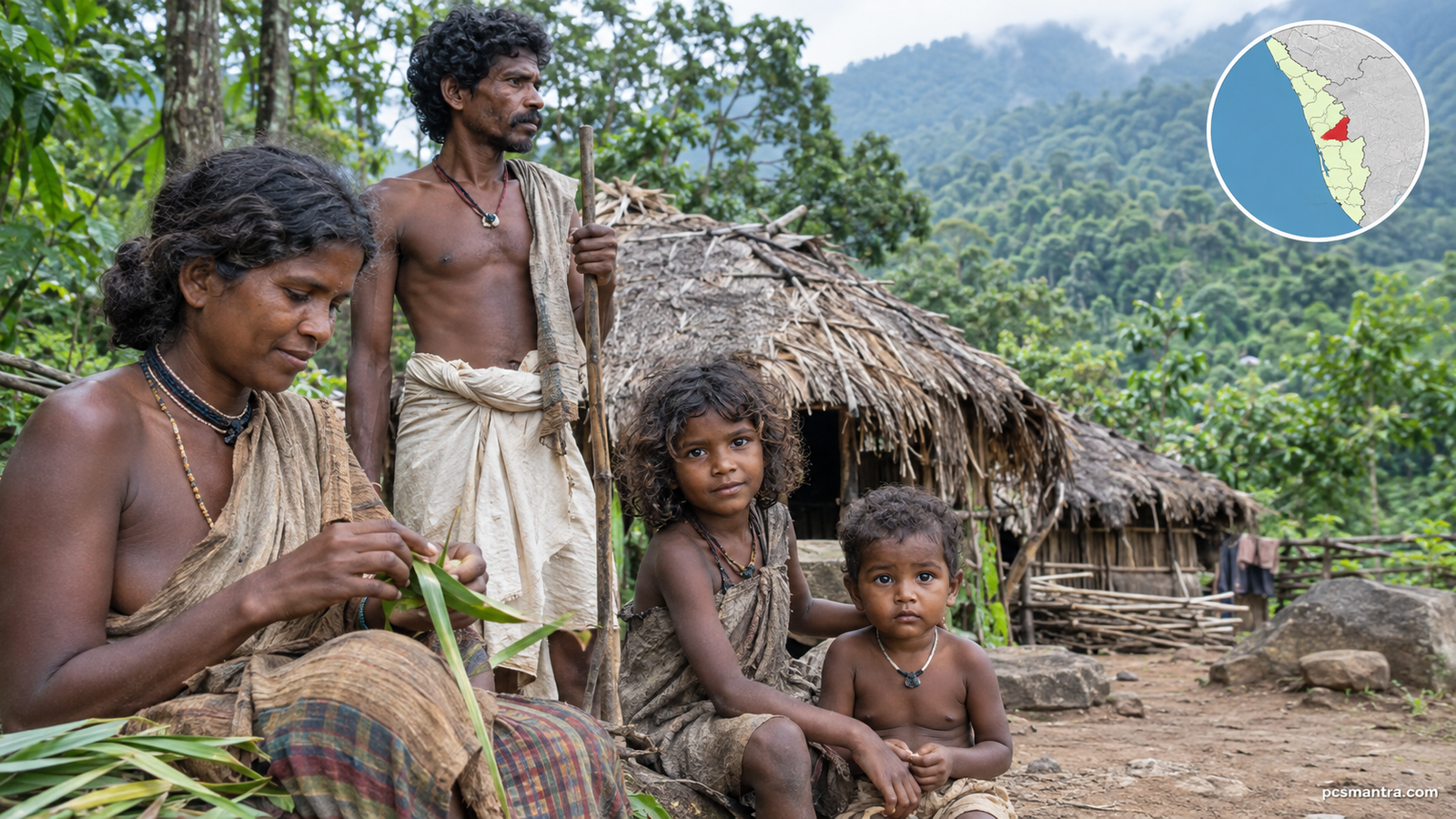
November 13, 2026: With the census exercise under way in the country, the future of a small Adivasi tribe of Kerala - the Kurumbas - and of their language has come into discussion. As of 2024, the community numbers only 2,719 people. The Kurumba language has no script of its own - it is entirely oral. Since the census does not record separately the languages spoken by fewer than 10,000 people, Kurumba statistically merges into the 'others' category, raising questions about its very survival.
The Kurumba community: an introduction
Habitat: The Kurumba community lives in the hilly forest tracts of Attappady in Kerala's Palakkad district.
Status: The Ministry of Tribal Affairs, Government of India, has classified the Kurumbas as a Particularly Vulnerable Tribal Group (PVTG) - the category meant for tribes with the weakest economic, social and educational indicators in the country. Kerala has five PVTGs in all, of which the Kurumbas are one.
Livelihood: The community is tied to forest resources, collective traditions and oral knowledge; the Kurumba language is at the centre of its cultural identity and rituals.
Features of the Kurumba language
- Oral tradition: The language has no script; knowledge, songs, stories and medicinal understanding travel mouth to mouth across generations.
- Everyday use: Even today Kurumba remains the primary language of communication within the community.
- Outside pressure: Outsiders do not speak the language, so community members must learn Malayalam or other languages for education, jobs and daily dealings - this process of language shift is the greatest danger to small languages.
- Language family: Kurumba is regarded as belonging to the Dravidian family; certain other tribal speech varieties of the Nilgiris are also called 'Kurumba', but they are considered distinct from the Kurumba of Kerala.
The census rule and 'invisible' languages
Indian census practice does not list separately languages or mother tongues with fewer than 10,000 speakers - they are merged into an 'others' category. In Census 2011, 121 languages were listed on the strength of having 10,000 or more speakers, including the 22 scheduled languages of the Eighth Schedule. The result: dozens of languages spoken by thousands of people lose their identity in official statistics - Kurumba is one of them.
Preservation efforts
- SPPEL: The Scheme for Protection and Preservation of Endangered Languages, run by the Central Institute of Indian Languages (CIIL), Mysuru, documents languages spoken by fewer than 10,000 people - preparing grammars, dictionaries and audio archives.
- PM-JANMAN: Launched in 2023 for PVTG communities, the scheme focuses on housing, roads, health and education; language preservation is not a direct component, and expanded facilities may even quicken language shift by increasing outside contact - a duality that is a matter of policy debate.
- UNESCO listings: Many Indian languages are counted endangered worldwide; scriptless languages are the most vulnerable, because as speakers decline, the store of knowledge fades with them.
Key facts at a glance
- Community: Kurumba - Kerala, Palakkad district, Attappady
- Status: PVTG (one of Kerala's five PVTGs)
- Population: 2,719 (as of 2024)
- Language: Kurumba - oral, without a script; the community's primary language
- Census rule: Languages with fewer than 10,000 speakers are not recorded separately
- Related institution/scheme: CIIL (SPPEL), Ministry of Tribal Affairs, PM-JANMAN
Prelims practice questions
Question 1. With reference to the Kurumba community, consider the following statements: Statement 1: The community lives in the Attappady region of Kerala's Palakkad district Statement 2: It has been declared a Particularly Vulnerable Tribal Group (PVTG) by the Government of India Statement 3: The Kurumba language is written in the Devanagari script How many of the above statements are correct?
(a) Only one
(b) Only two
(c) All three
(d) None
Answer and explanation
Answer: (b)
Statement 1: The Kurumba community lives in the hilly forest tracts of Attappady in Palakkad district of Kerala, so this statement is correct. Statement 2: The Ministry of Tribal Affairs has classified the Kurumbas as a PVTG; they are one of Kerala's five PVTGs, so this statement is correct. Statement 3: Kurumba is an oral language with no script of its own, so this statement is not correct.
Question 2. With reference to the classification of languages in the Indian census, consider the following statements:
1. Languages with fewer than 10,000 speakers are generally not listed separately
2. Census 2011 listed 121 languages with 10,000 or more speakers
Which one of the following is correct in respect of the above statements?
(a) Statement 1 is correct, but Statement 2 is not correct
(b) Statement 1 is not correct, but Statement 2 is correct
(c) Both Statement 1 and Statement 2 are correct
(d) Neither Statement 1 nor Statement 2 is correct
Answer and explanation
Answer: (c)
Statement 1: Under census practice, languages with fewer than 10,000 speakers are merged into the 'others' category, so this statement is correct. Statement 2: In Census 2011, 121 languages were listed with 10,000 or more speakers, so this statement is also correct.
Question 3. The Scheme for Protection and Preservation of Endangered Languages (SPPEL), which documents endangered languages, is run by which institution?
Which one of the above is correct?
(a) Sahitya Akademi
(b) Central Institute of Indian Languages (CIIL), Mysuru
(c) Visva-Bharati, Santiniketan
(d) Linguistic Survey of India, New Delhi
Answer and explanation
Answer: (b)
SPPEL is run by the Central Institute of Indian Languages (CIIL), Mysuru, and prepares grammars, dictionaries and audio records of languages with fewer than 10,000 speakers. The other options are not the operating institution of this scheme.
Mains practice question
With the example of the Kurumba language, explain why oral (scriptless) tribal languages drift towards extinction and why documentation alone cannot save them. (250 words, 15 marks)
Answer outline:
In the introduction: The Kurumba example - 2,719 members, an oral language, 'others' in the census.
In the body: Causes of decline - without a script the knowledge store lives only with its speakers; shift to Malayalam for education and jobs; policy neglect caused by the 10,000-speaker census threshold. Limits of documentation - efforts like SPPEL create archives but do not restore daily use; a language lives only when the new generation speaks it at home and in the market. Remedies - mother-tongue early education, community-led audio-visual archiving, language indicators in PVTG schemes, use of the mother tongue in local services.
In the conclusion: A language is not merely communication but a knowledge system and an identity.
Frequently Asked Questions (FAQ)
Summary answer: November 13, 2026: With the census exercise under way in the country, the future of a small Adivasi tribe of Kerala - the Kurumbas - and of their language has come into discussion.
Question: Where does the Kurumba community live and what is its population?
In the hilly forest tracts of Attappady in Kerala's Palakkad district; the population is 2,719 as of 2024.
Question: What does PVTG mean?
Particularly Vulnerable Tribal Group - the category of tribes weakest in economic, social and educational indicators; the Kurumbas are one of Kerala's five PVTGs.
Question: Why do small languages fall into the census 'others' category?
Languages with fewer than 10,000 speakers are not recorded separately; in Census 2011, 121 languages with 10,000 or more speakers were listed.
Sources
- [Press] https://www.thehindu.com/news/national/kerala/kurumba-a-language-and-community-fighting-for-visibility/article71695235.ece
- [Press] https://static.pib.gov.in/WriteReadData/specificdocs/documents/2023/nov/doc20231129275301.pdf
Download This Article: PDF