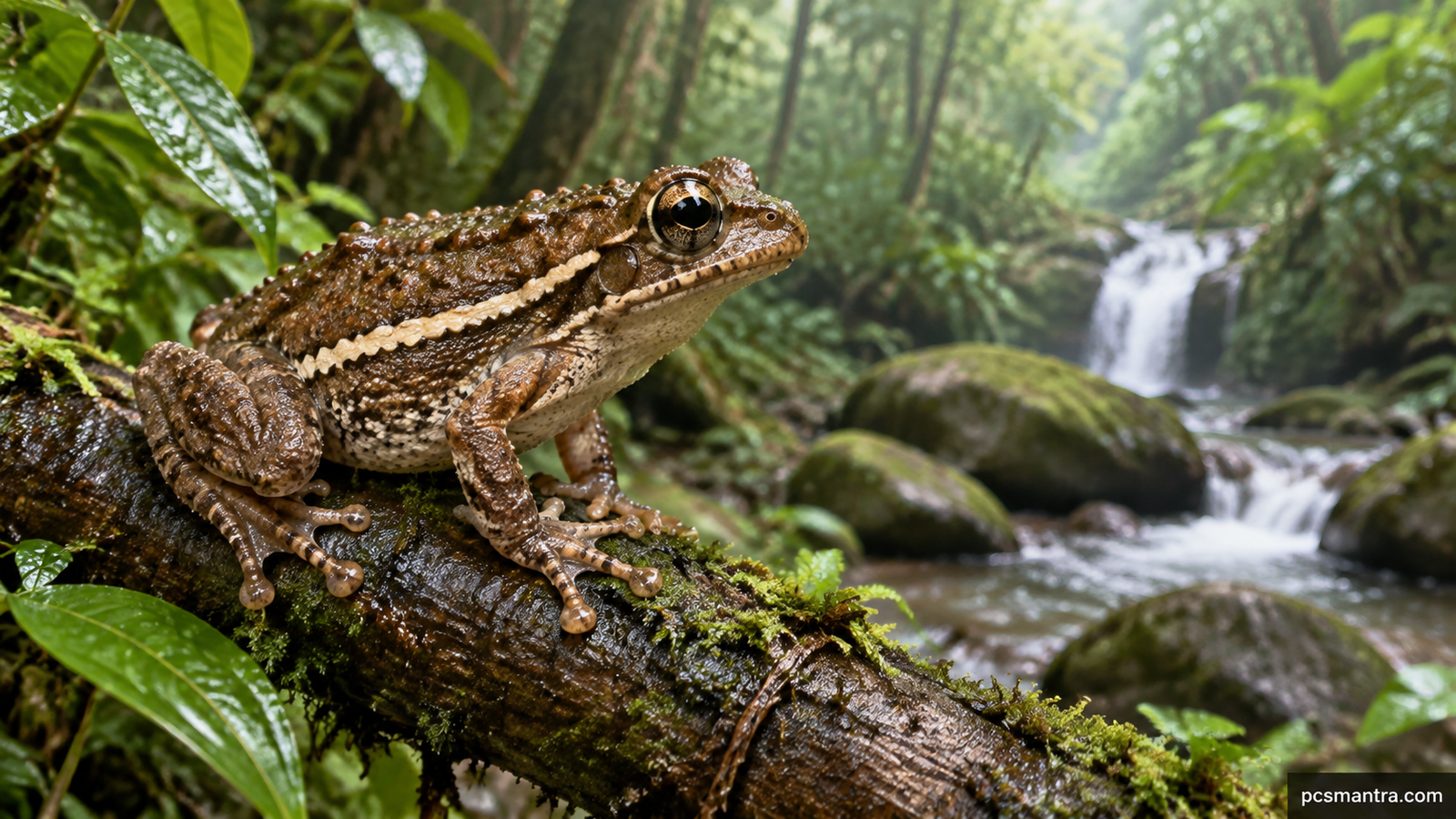
Why in the News
According to reports, Karnataka's Department of Forest, Ecology and Environment signed an order on 27 October 2026 declaring the Malabar Tree Toad (Pedostibes tuberculosus) the state amphibian. In a report of 3 November, a senior official of the department confirmed that the order had been signed. According to the same report, the gazette notification was then awaited, and Karnataka was described as the first state to declare an official state amphibian in this way.
Limit of the source: the state's original order and the text of the gazette were not available for review for this article. So the details of the declaration are report-based. The scientific details of the species' distribution and conservation have been checked from separate research sources.
Identifying the Malabar Tree Toad
Scientific name: Pedostibes tuberculosus. It is an amphibian of the toad family Bufonidae. In Kannada it is called Malenadina Mara Gantikappe, and popularly 'Petu'. The scientific community's species list gives its IUCN status as Endangered.
Amphibians: a group of vertebrates whose lives are generally tied to moist terrestrial and aquatic conditions. Arboreal: the habit of living on trees and plants. The toad's arboreal nature ties it to the combined protection of forest canopy, moisture and breeding sites.
Where It Is Found
It is an endemic species of India's Western Ghats. Endemic means distribution limited to a specific natural region, not necessarily found in only one state. The Western Ghats spread across several states; so becoming Karnataka's state symbol does not make it an animal found only in Karnataka.
A 2024 scientific study described it as a rarely seen, arboreal and endemic amphibian. Annual rainfall was found to have an important influence on its distribution. Vegetation, water streams, moisture and connectivity between different habitats are important for its conservation.
The Difference Between a State Symbol and Legal Protection
State symbol: a means of raising a species' identity and public awareness. Legal protection: determined by the relevant law, schedule and notification. Declaring a symbol does not by itself create a new penalty or a protected area.
The news report describes its special ability to climb trees and its role as an indicator of forest health. But an overly broad claim such as 'the world's only tree-climbing toad' has not been made a scientific conclusion here. Similarly, without seeing the original legal list, the news description regarding schedules has not been treated as the final legal classification.
What the Climate Study Says
The 2024 study: using data from the citizen-science 'Mapping Malabar Tree Toad' programme, it modelled the current distribution and the potential suitable habitat for 2061-2080. Results differed across emission scenarios and modelling methods. In high-emission scenarios, the estimated suitable distribution within protected areas showed a decline of 33.5% to 68.7%; some increase was also shown in low-emission scenarios.
A necessary distinction: this is a model-based estimate of future habitat/distribution suitability, not a measured 68.7% decline in the current population. It should not be read as a certain future or as a single universal percentage. The study stated the need for better surveys inside and outside protected areas.
The Role of Citizen Science
Citizen science: ordinary people take part in scientific study through systematic observation and data collection. This can help in understanding the distribution of rarely seen species. But checking the identification, location and quality of records remains essential. Merely receiving more photographs is not by itself proof of a growing population.
What Is Needed for Conservation
- The whole habitat: protect not just the animal but the trees, the moist micro-habitats and the water streams tied to breeding.
- Habitat connectivity: attention to connectivity between fragmented forests and to suitable places outside protected areas.
- Continuous monitoring: long-term records of weather, rainfall, distribution and breeding should be maintained.
- Awareness: the recognition of a state symbol should be tied to habitat-based conservation and local participation.
Prelims Practice Questions
Question 1. Consider the following statements with reference to the Malabar Tree Toad:
Statement 1: It is an endemic species of the Western Ghats.
Statement 2: Being declared a state symbol means the species is found only in that state.
Statement 3: Protecting forest habitat and moist conditions is important for its conservation.
Which of the above statements are correct?
(a) Only 1 and 2
(b) Only 2 and 3
(c) Only 1 and 3
(d) 1, 2 and 3
Answer and Explanation
Answer: (c) The Western Ghats are the natural region of its endemism; the honour of a state symbol does not limit the distribution to a state's boundary. Protecting forest and moisture is important.
Question 2. Which statement is correct about the estimate of future suitable habitat derived from climate models?
(a) It is equivalent to a direct count of the current animal population
(b) It gives a certain and identical result in all emission scenarios
(c) It should be read along with the model's assumptions and scenarios
(d) It ends the need for field surveys
Answer and Explanation
Answer: (c) Habitat-suitability models give an estimate of possible future distribution. They are not a count of the current population and are a complement to surveys.
Sources
Download This Article: PDF

PCSMANTRA Editorial Team
Research and Editing
We prepare current affairs analysis, exam updates and study material in Hindi and English for UPSC, State PCS, PCS-J and other competitive examinations. Every article is verified against official sources before publication; sources are listed at the end of each article.
Read our editorial policy