
Published: 26 November 2026
In this article
News Reference: Announcement of National Gopal Ratna Award (NGRA) 2026 winners, Department of Animal Husbandry and Dairying, 20 November 2026
Why in the News
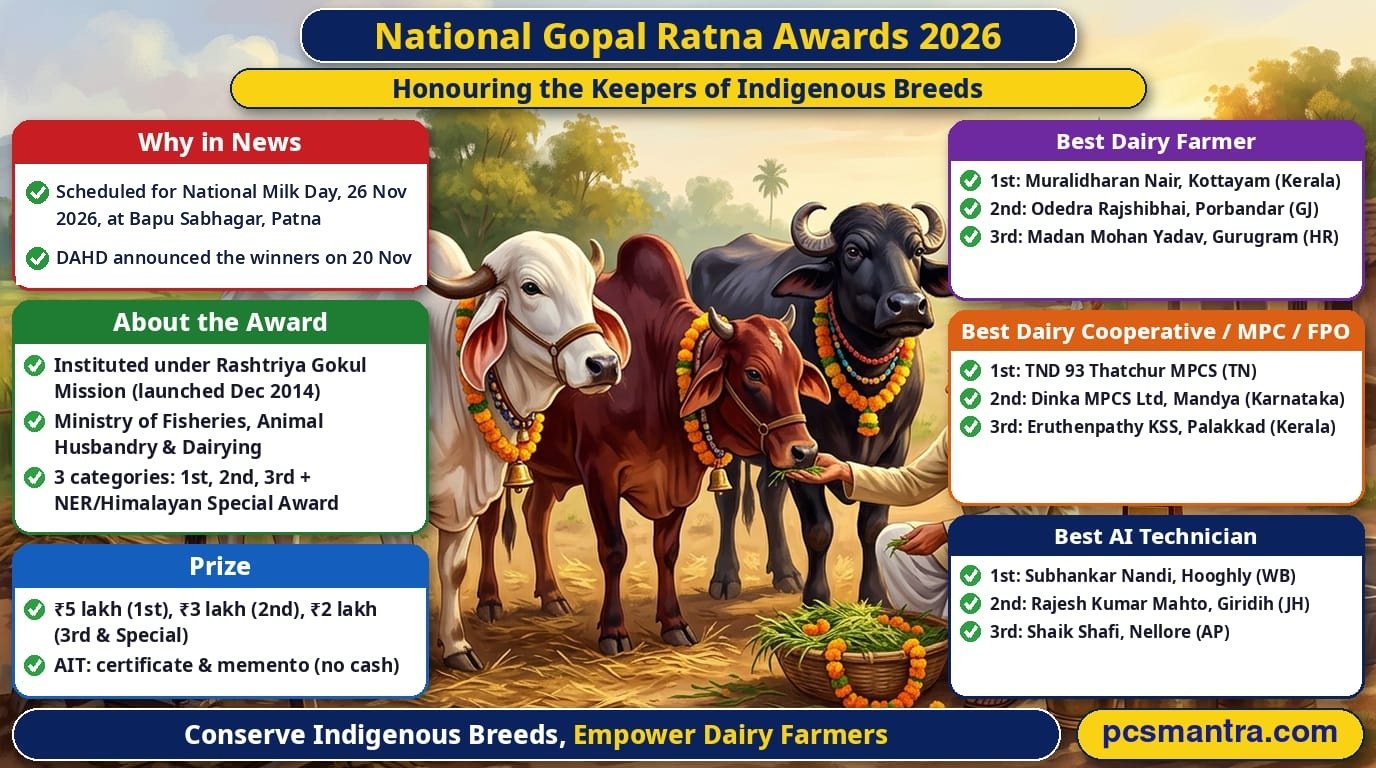
The Department of Animal Husbandry and Dairying announced the winners of the National Gopal Ratna Award (NGRA) 2026 on 20 November 2026. Applications were invited from 10 August to 30 September 2026 and 1,583 were received.[1]
The awards are to be conferred on 26 November 2026 at Bapu Sabhagar, Patna (Bihar), as part of National Milk Day 2026. National Milk Day marks the birth anniversary of Dr Verghese Kurien, called the Father of the White Revolution in India.[1][2]
Who the award is for
Purpose: The Department is promoting the conservation and development of indigenous bovine breeds in a scientific manner. The Rashtriya Gokul Mission (RGM) was launched for this in December 2014, and the award was instituted under it.[1]
Three categories: (1) Best Dairy Farmer rearing indigenous cattle/buffalo breeds, (2) Best Dairy Cooperative Society/Milk Producer Company/Dairy Farmer Producer Organisation (FPO), (3) Best Artificial Insemination Technician (AIT).[1]
Special award: Besides the 1st, 2nd and 3rd ranks, each category has a Special Award for the North Eastern Region and Himalayan States, to boost dairy development there.[1]
Applications: Through the online portal awards.gov.in, developed by the Ministry of Home Affairs.[1]
Prize money
In the first two categories (Dairy Farmer, and Dairy Cooperative Society/Milk Producer Company/FPO) the award is a certificate of merit, a memento and cash:[1]
- 1st rank: Rs 5,00,000
- 2nd rank: Rs 3,00,000
- 3rd rank: Rs 2,00,000
- Special Award for NER/Himalayan States: Rs 2,00,000
AIT category: A certificate of merit and a memento only, no cash prize.[1]
List of winners
| Category | Rank | Winner |
|---|---|---|
| Best Dairy Farmer rearing indigenous cattle/buffalo breeds | 1st | Muralidharan Nair, Kottayam, Kerala |
| 2nd | Odedra Rajshibhai, Porbandar, Gujarat | |
| 3rd | Madan Mohan Yadav, Gurugram, Haryana | |
| Special (NER/Himalayan) | Sagar Singh Rawat, Udham Singh Nagar, Uttarakhand | |
| Best Dairy Cooperative Society/Milk Producer Company/Dairy FPO | 1st | TND 93 Thatchur MPCS, Kallakurichi, Tamil Nadu |
| 2nd | Dinka Milk Producers Cooperative Society Ltd, Mandya, Karnataka | |
| 3rd | Eruthenpathy Ksheerolpadaka Sahakarana Sangam, Palakkad, Kerala | |
| Special (NER/Himalayan) | The Chak Devia Dairy Cooperative Ltd, Kathua, Jammu and Kashmir | |
| Best Artificial Insemination Technician (AIT) | 1st | Subhankar Nandi, Hooghly, West Bengal |
| 2nd | Rajesh Kumar Mahto, Giridih, Jharkhand | |
| 3rd | Shaik Shafi, Sri Potti Sriramulu Nellore district, Andhra Pradesh | |
| Special (NER/Himalayan) | Sudhesh Kumar, Udham Singh Nagar, Uttarakhand |
The list follows the PIB release.[1]
Background: Rashtriya Gokul Mission
Revised RGM: In March 2025 the Union Cabinet approved the revised Rashtriya Gokul Mission. With an additional outlay of Rs 1,000 crore, the total budget became Rs 3,400 crore for the 15th Finance Commission period (2021-22 to 2025-26).[3]
Ongoing activities: Strengthening semen stations and the AI network, bull production and breed improvement using sex-sorted semen, skill development, Centres of Excellence and Central Cattle Breeding Farms.[3]
Exam analysis
The chain the award links: The award recognises the farmer, the cooperative and the AI technician, the whole chain of breed conservation. This is analysis based on the facts in the source.
- Incentive: Cash and recognition make keeping indigenous breeds more attractive.
- Inclusion: A separate award for NER and Himalayan States tries to reduce regional imbalance.
- Limit: The number of awards is small; the real effect on breed conservation depends on implementation of the Mission's schemes.
For Mains
Question: "Conservation of indigenous cattle breeds and dairy development complement each other." Evaluate with reference to the National Gopal Ratna Award and the Rashtriya Gokul Mission. (Answer in 150 words) | 10 marks
Answer Outline
Introduction: The Rashtriya Gokul Mission (December 2014) was launched for scientific conservation of indigenous breeds, and the Gopal Ratna Award honours farmers, cooperatives and AI technicians under it.
Main body:
- Complementarity: Conservation of indigenous breeds, breed improvement and the AI network connect to dairy productivity and farmer income.
- Role of the award: Three categories recognise the whole chain; a special award for NER and Himalayan States.
- Challenges: Few awards; balance between conservation and productivity; implementation of schemes.
Conclusion: The awards encourage conservation, but lasting results depend on effective implementation of the Mission's schemes.
Prelims Practice Questions
Question 1: With reference to the National Gopal Ratna Award (NGRA) 2026, consider the following statements:
1. The award aims to encourage conservation and development of indigenous bovine breeds.
2. It has three categories, with a special award for the North Eastern Region and Himalayan States.
3. In the Best Artificial Insemination Technician category the 1st rank carries Rs 5,00,000.
Which of the statements given above is/are correct?
Answer and explanation
Answer: (b)
- Statement 1 is correct: the Department instituted the award to encourage conservation of indigenous bovine breeds.
- Statement 2 is correct: there are three categories, and each has a Special Award for NER/Himalayan States.
- Statement 3 is incorrect: the AIT category gets only a certificate and a memento; cash prizes are in the first two categories.
Syllabus Mapping:
Mains: GS-3 (agriculture, animal husbandry and dairying; farmers' income); GS-2 (government policies and interventions)
Prelims: Economy (agriculture and allied sectors); government schemes and awards
Sources
- PIB, Department of Animal Husbandry and Dairying: Announcement of National Gopal Ratna Award 2026 winners (20 November 2026)
- PIB, Ministry of Fisheries, Animal Husbandry and Dairying: National Milk Day 2026 (24 November 2026)
- PIB: Cabinet approves revised Rashtriya Gokul Mission (20 March 2025)
Frequently Asked Questions (FAQ)
Summary answer: The National Gopal Ratna Award honours farmers, dairy cooperatives and AI technicians who conserve indigenous bovine breeds. 1,583 applications were received for 2026.
Question: How many applications did NGRA 2026 receive?
1,583, invited from 10 August to 30 September 2026, per the Department of Animal Husbandry and Dairying.
Question: How many categories does the Gopal Ratna Award have?
Three: Dairy Farmer, Dairy Cooperative Society/Milk Producer Company/FPO, and Artificial Insemination Technician. Each has a special award for NER/Himalayan States.
Question: What is the prize for the first rank?
Rs 5,00,000 in the Dairy Farmer and Dairy Cooperative/Milk Producer Company/FPO categories. The AIT category has no cash prize.
Download this article: PDF