
Published: 26 November 2026
Background study, not a new news event. The original document date is stated below.
In this article
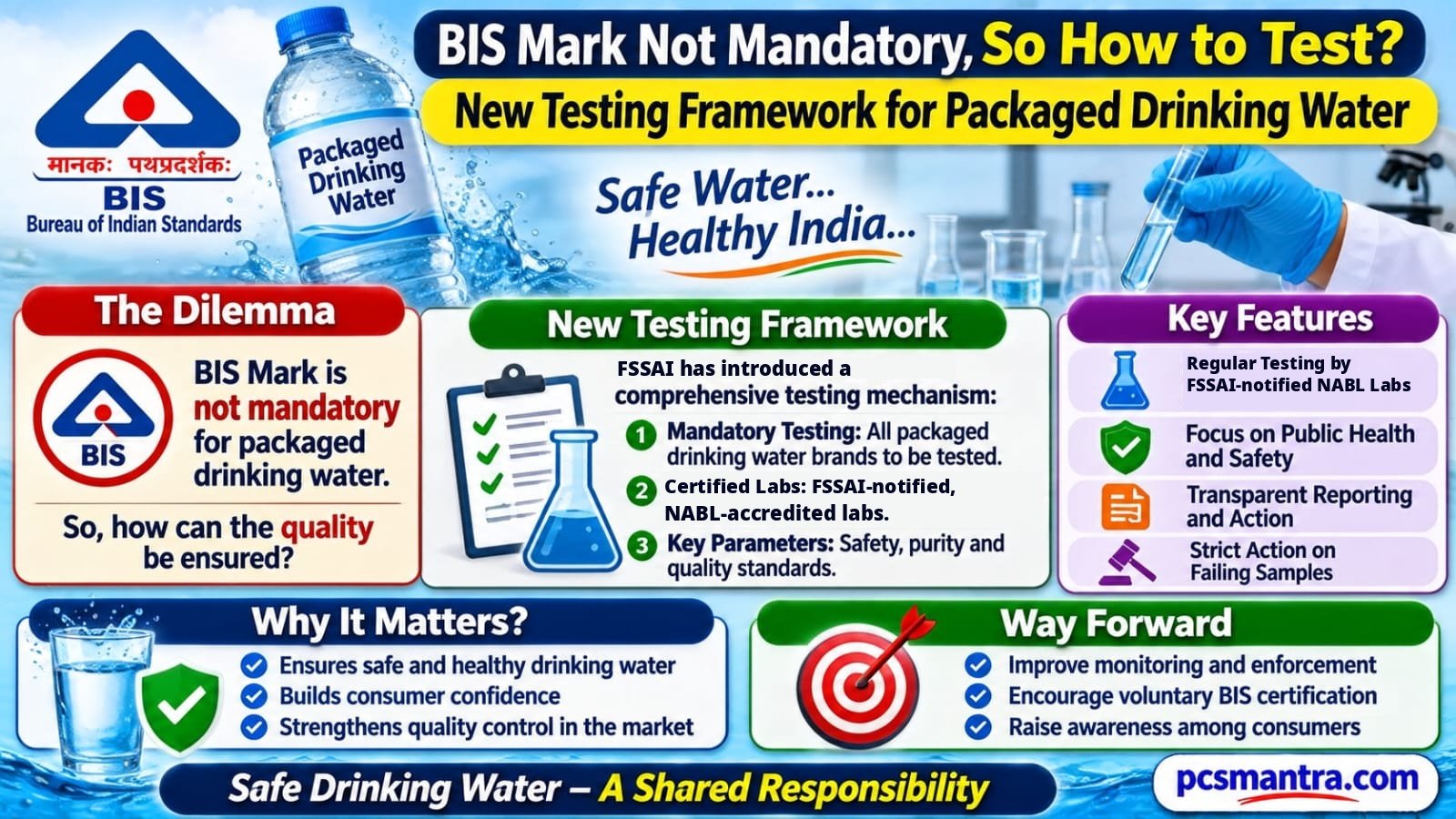
The removal of the mandatory BIS mark from bottled water does not mean the water will no longer be tested. With an advisory dated 17 December 2025, the Food Safety and Standards Authority of India (FSSAI) has prescribed a detailed Scheme of Testing for Packaged Drinking Water (PDW) and Mineral Water (MW), which every Food Business Operator (FBO) must follow from 1 January 2026.
Why in news
- 17 October 2024: FSSAI gazette notified an amendment to the Food Safety and Standards (Prohibition and Restriction on Sales) Regulation, 2011, removing the provision for mandatory BIS certification for PDW and MW.
- 17 December 2025: through an advisory (File No. RCD-15001/19/2025-Regulatory-FSSAI), FSSAI directed all FBOs to strictly comply with the Scheme of Testing from 1 January 2026. The advisory is signed by Dr. Satyen Kumar Panda, Executive Director (Compliance Strategy).
First clear the confusion: the end of the mandatory BIS mark is not the end of quality checks. Packaged drinking water stays under FSSAI licensing and standards; the change only removes the duplicate mandatory BIS certification. Regularity now comes from the Scheme of Testing: which test, how often, through which laboratory and with what records, all in writing.
What the testing scheme says
- Scope: the entire production of the factory is covered, and the whole output must conform to Schedule IV of the Food Safety and Standards (Licensing and Registration of Food Businesses) Regulation, 2011.
- Records: test records must be maintained for every test; batch wise consumption of added minerals, with invoices and test certificates, must also be kept.
- Standards: FSSR 2.10.8 for packaged drinking water and FSSR 2.10.7 for mineral water (Food Safety and Standards (Food Products Standards and Food Additives) Regulation, 2011).
- Laboratory: all prescribed tests must be done through FSSAI notified, NABL accredited (ISO/IEC 17025) laboratories.
Which test, how often
| Test group | Key parameters | Frequency |
|---|---|---|
| Microbiological | Coliform; faecal streptococci and Staphylococcus aureus; sulphite reducing anaerobes; Pseudomonas aeruginosa; aerobic microbial count; yeast and mould; Salmonella and Shigella; Vibrio cholerae and V. parahaemolyticus | Once a month |
| Chemical and undesirable substances | Barium, copper, iron, manganese, nitrate, nitrite, zinc, aluminium, calcium, magnesium, phenolic compounds, mineral oil, anionic surface active agents, sulphide, antimony, borates | Once in three months |
| Pesticide residues | Each pesticide individually, and total pesticide residue | Once in six months |
| All standard parameters | Every parameter defined under FSSR 2.10.8 (per condition 12 of the licensing regulation) | Once in six months |
What happens on non-compliance
- Microbiological failure: the stock sample is rechecked and released only after conformity is ensured. The operator must investigate the contamination fully and take corrective action; production and dispatch restart only after 5 consecutive batches show satisfactory results. Complete records of each such instance must be kept for FSSAI review for at least 5 years.
- Failure in a six monthly report: the testing frequency for that parameter rises to monthly, until 3 consecutive batches pass.
- Consecutive six monthly failures: the plant attracts a risk based inspection by FSSAI.
- Radioactive residues: the raw water source must be abandoned at once, the product recalled immediately, and the Food Authority informed immediately.
Source water and packaging rules
- Source water: before use in production, the source water must be tested for all parameters; a changed or new source can enter regular production only after full testing shows compliance.
- Remineralisation: if minerals are added back during treatment, the ingredients must be food grade or pharma grade, with test certificates submitted to FSSAI; the disinfection method must be declared.
- Reused containers: only plastic containers of 5 litres or more and glass bottles that are durable and easy to clean or disinfect.
- Packaging material: plastic bottles, pouches, glass bottles, paper based cartons and aluminium cans carry prescribed levels of control under the Packaging Regulation, 2018 (most tests once in six months).
Exam importance
- The institution: FSSAI was set up under the Food Safety and Standards Act, 2006 and works under the Ministry of Health and Family Welfare.
- Jurisdiction: the BIS (quality certification) versus FSSAI (food safety) divide is asked repeatedly in Prelims; this episode is its latest example.
- Three dates: mandatory BIS removed on 17 October 2024; testing scheme advisory on 17 December 2025; scheme effective 1 January 2026.
Sources
Note: the full scheme (levels of control, forms and notes) is annexed to this advisory.
Prelims Practice Questions
Question 1: With reference to the regulation of packaged drinking water, consider the following statements:
Statement 1: The provision for a mandatory BIS certification mark for packaged drinking water and mineral water was omitted through a notification dated 17 October 2024
Statement 2: FSSAI's Scheme of Testing applies to both packaged drinking water and mineral water
Which of the statements given above is/are correct?
Answer and Explanation
Answer: (c) Both 1 and 2
Statement 1 is correct: FSSAI's gazette notification of 17 October 2024 omitted the mandatory BIS certification provision from the Prohibition and Restriction on Sales Regulation, 2011.
Statement 2 is correct: the Scheme of Testing issued with the 17 December 2025 advisory covers packaged drinking water (FSSR 2.10.8) and mineral water (FSSR 2.10.7) alike, and is mandatory for all FBOs from 1 January 2026.
Question 2: With reference to FSSAI's Scheme of Testing, consider the following statements:
Statement 1: It prescribes monthly testing for microbiological parameters
Statement 2: It requires pesticide residues to be tested every three months
Statement 3: Prescribed tests must be conducted through FSSAI notified NABL accredited laboratories
Which of the statements given above are correct?
Answer and Explanation
Answer: (b) 1 and 3 only
Statement 1 is correct: all microbiological parameters, including coliform, Pseudomonas aeruginosa and Salmonella and Shigella, are to be tested once a month.
Statement 2 is incorrect: pesticide residues (individual and total) are tested once in six months; the three monthly frequency applies to chemical and undesirable substances.
Statement 3 is correct: all prescribed tests under the scheme are to be done through FSSAI notified NABL accredited (ISO/IEC 17025) laboratories.
Frequently Asked Questions
Is the BIS mark still required on packaged drinking water?
No. The notification of 17 October 2024 removed the mandatory BIS certification mark for PDW and MW. But FSSAI licensing, the FSSR standards and the Scheme of Testing effective 1 January 2026 remain fully applicable.
When did the testing scheme take effect and whom does it cover?
The scheme is effective from 1 January 2026 and is mandatory for all Food Business Operators. It covers both packaged drinking water and mineral water.
Who gets the water tested and who monitors it?
Testing is the operator's responsibility, but every prescribed test must be done through an FSSAI notified NABL accredited laboratory. Records must be kept for FSSAI review and inspection; repeated failure attracts a risk based inspection.
Download this article: PDF