
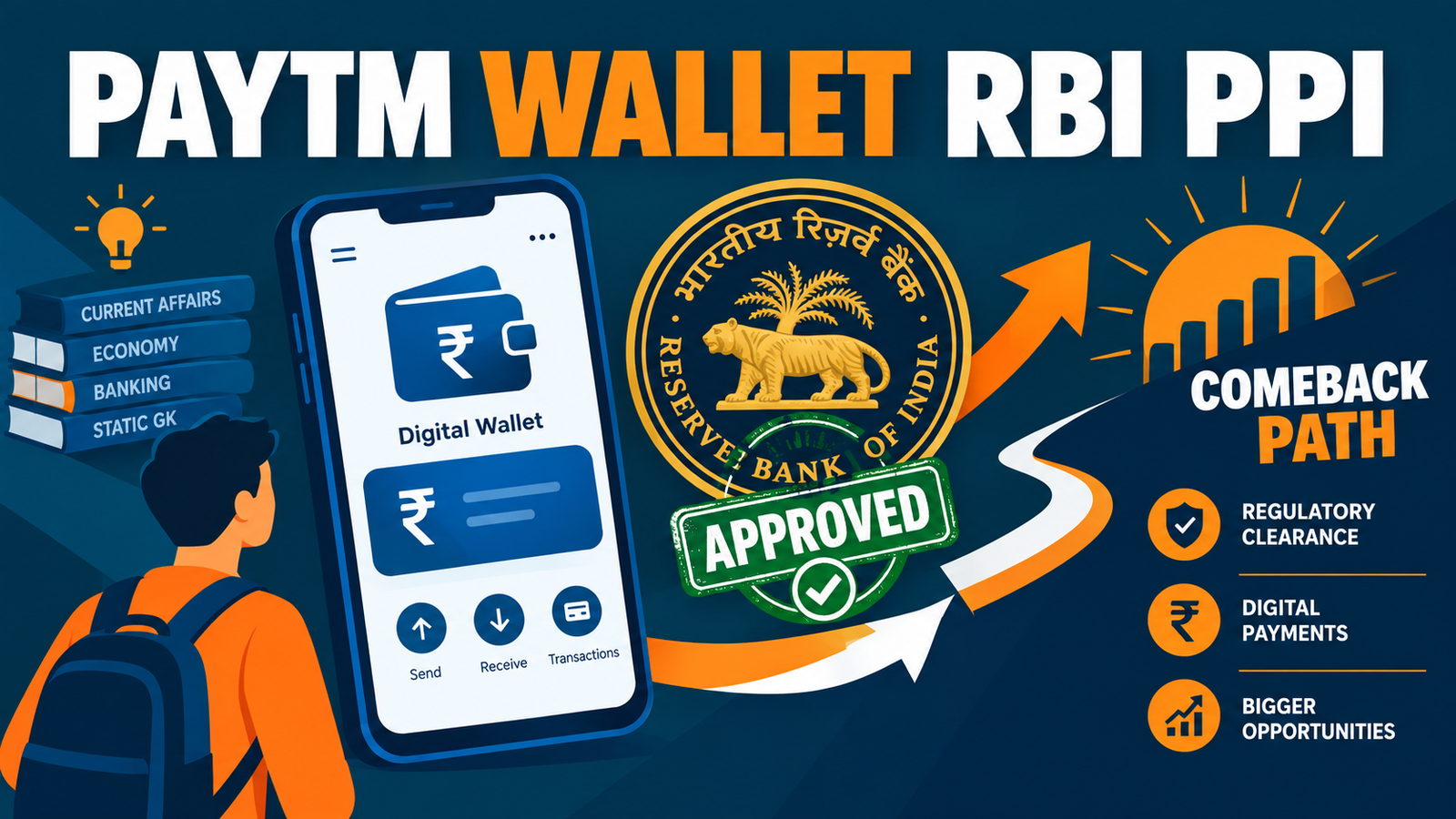
13 November 2026: The Reserve Bank of India (RBI) has granted in-principle authorisation to Paytm Payments Services Ltd (PPSL) - a wholly-owned arm of Paytm's parent One 97 Communications - to set up and operate a payment system for issuing Prepaid Payment Instruments (PPIs), including digital wallets. This comes over two-and-a-half years after RBI's restrictions on Paytm Payments Bank effectively shut down Paytm's wallet services; if finalised, the wallet - once India's largest - would return, this time under PPSL instead of the bank.
What the in-principle approval actually means
- Not final: PPSL cannot commence wallet operations yet. A Certificate of Authorisation comes only after it fulfils specific conditions.
- Key conditions: A system audit, including a cybersecurity audit, via a CERT-In empanelled auditor or qualified information systems auditor; compliance with RBI's Master Directions on Cyber Resilience and Digital Payment Security Controls (5 November 2026) for non-bank Payment System Operators; and compliance with the 6 April 2018 circular on storage of payment system data.
- Deadline: The audit report must be submitted within six months of RBI's letter; failure means the in-principle authorisation lapses automatically. Any future change in shareholding must follow RBI's July 2022 directions on prior approval for takeovers of non-bank payment system operators.
- Market response: PPSL had applied in December 2025; after the announcement, One 97 Communications' shares rose 1.1% to close at Rs 1,945 on the BSE.
Background: how the wallet ran into trouble
- 2017 separation: Paytm transferred its prepaid instruments business to Paytm Payments Bank, complying with RBI norms requiring payments banks to house such operations separately.
- Regulatory timeline: 2018 - KYC-violation scrutiny (a single PAN linked to multiple accounts); June 2018 - audit found onboarding gaps, new-customer onboarding halted; March 2022 - formal bar on onboarding; October 2023 - Rs 5.39 crore penalty; January 2024 - bar on deposits, top-ups, wallets, FASTags and NCMC cards after 29 February 2024, citing persistent non-compliance and the failure to maintain a 'Chinese wall' with One 97 Communications; April 2026 - banking licence cancelled under Section 22(3)(c) (operations detrimental to depositors' interest) and Section 22(3)(e) (no useful purpose in continuation) of the Banking Regulation Act, 1949.
Impact on One 97 Communications
- Immediate hit: The stock plunged 40-50%; wallets, merchant settlements, FASTag and autopay services were disrupted.
- Restructuring: The company partnered with banks such as Axis Bank and YES Bank, migrated users and infrastructure, and absorbed higher compliance costs; some users temporarily moved to rivals, but the model eventually became leaner and partner-driven.
Why it matters for exams
- Prelims facts: PPSL and One 97 Communications; PPIs and RBI authorisation; Banking Regulation Act, 1949, Section 22(3); CERT-In audit condition; the 2018 data-storage circular.
- Mains theme: Growth versus compliance in Indian fintech; RBI's conditional, trust-rebuilding approach as a regulatory model.
Quiz: Test your knowledge
Q1: Consider the following statements about RBI's in-principle approval to PPSL: 1. It relates to issuing Prepaid Payment Instruments. 2. It is the final approval, so wallet operations can start immediately. 3. PPSL is a wholly-owned subsidiary of One 97 Communications. How many of the above statements are correct?
(a) Only one
(b) Only two
(c) All three
(d) None
Answer and explanation: (b) Statements 1 and 3 are correct. Statement 2 is wrong - final authorisation comes only after conditions such as a CERT-In empanelled system audit are met.
Q2: When and under which law was Paytm Payments Bank's licence cancelled?
(a) 2024 - RBI Act, 1934
(b) April 2026 - Section 22(3) of the Banking Regulation Act, 1949
(c) 2023 - Payment and Settlement Systems Act, 2007
(d) 2025 - Public Financial Institutions Act
Answer and explanation: (b) In April 2026, RBI cancelled the licence under Sections 22(3)(c) and 22(3)(e) of the Banking Regulation Act, 1949.
Frequently Asked Questions (FAQ)
In short: RBI has given PPSL in-principle approval to issue PPIs/digital wallets; a final certificate follows only after conditions, including a system audit within six months, are met.
Question: What is PPSL?
Paytm Payments Services Ltd - a wholly-owned arm of One 97 Communications, which applied for the PPI authorisation in December 2025.
Question: How is in-principle approval different from final approval?
In-principle approval does not allow operations to start; the Certificate of Authorisation comes only after RBI's conditions - including a CERT-In empanelled system/cybersecurity audit - are fulfilled.
Question: What happened to Paytm Payments Bank?
Regulatory action ran from 2018 onwards; deposits/wallets/FASTag were barred in January 2024, and in April 2026 the licence was cancelled under Section 22(3) of the Banking Regulation Act, 1949.
Sources:
- Business Standard: Paytm gets RBI's in-principle approval to issue prepaid wallets (13 November 2026)
- Indian Express Explained: Paytm wallet services may return - what RBI's in-principle approval means (13 November 2026)
Download this article: PDF