News context: 5 November 2026
Published: 7 November 2026
Prelims: Science and Technology: Defence Research
Why in the News
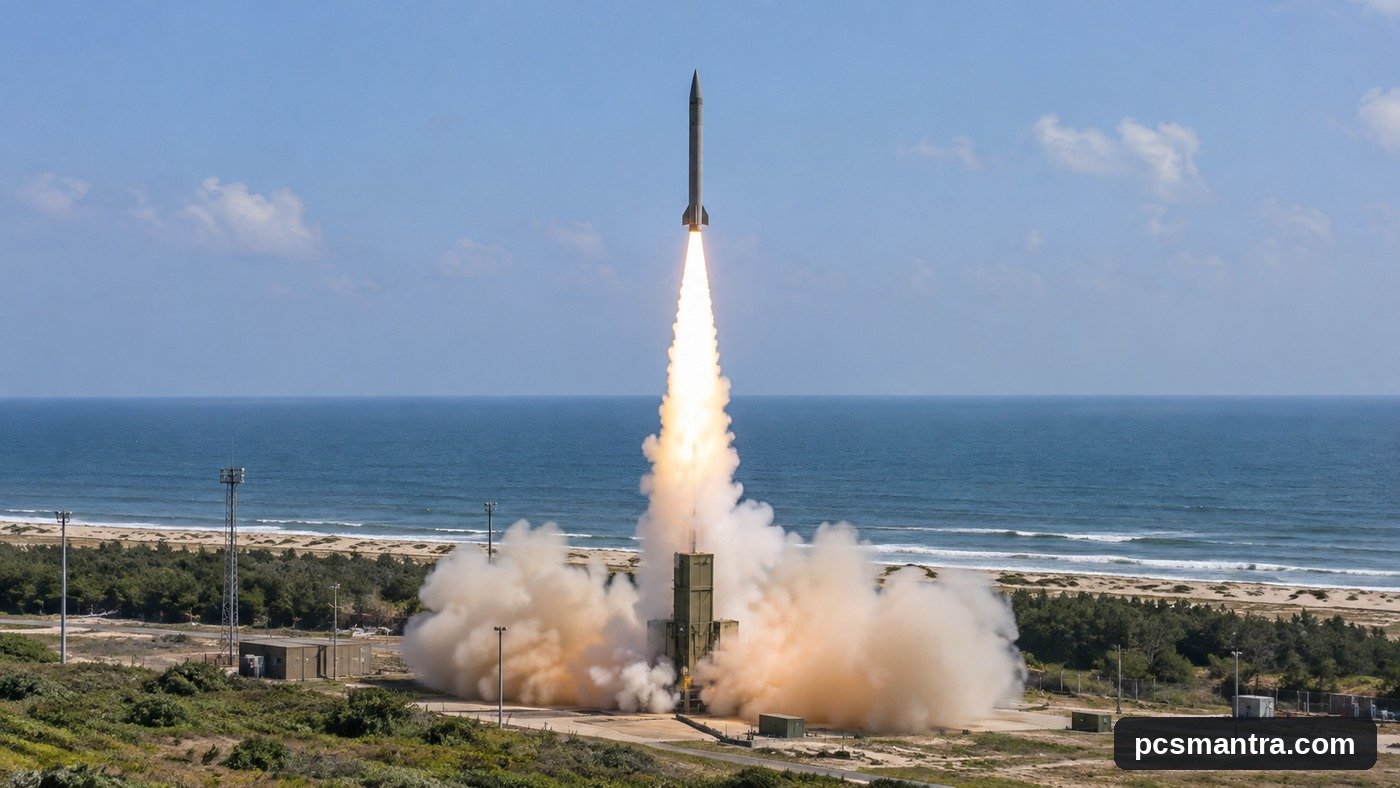
The Defence Research and Development Organisation (DRDO) on 5 November 2026 successfully flight-tested the Pralay missile from Dr. A.P.J. Abdul Kalam Island near the Odisha coast. According to the Ministry of Defence, all objectives of the test, held at about 11:10 am, were met. It was part of the user evaluation trials. The release mentioned the possibility of the system being inducted soon; this should not be taken as proof that it was formally inducted on the same day.
The Meaning of Quasi-Ballistic
In a ballistic trajectory, after the initial push is received, a large part of the flight is determined by gravity and momentum. Quasi-ballistic refers to a missile trajectory that may differ from a purely ballistic path and keeps room for controlled change. It cannot be called a cruise missile or a space launch vehicle merely by name. It is not right to add claims of speed, strike range or specific combat use beyond the information given in the official release of this test.
Who Developed and Built It
Research Centre Imarat (RCI), Hyderabad developed it indigenously along with other DRDO laboratories. Bharat Dynamics Limited (BDL) is among the development-cum-production partners and produced the system. The roles of the research organisation and the production partner are different; do not treat the two as one organisation.
How the Success of the Test Was Checked
Various range instruments of the Integrated Test Range (ITR), Chandipur recorded the flight data. On the basis of these data the Ministry gave the information that the objectives were met. Evaluation means checking performance against set standards. A successful test is an important stage of capability development, but the questions of full operational deployment, performance in every condition and formal induction are separate.
Importance for the Exam
In Prelims, the correct relation of DRDO-RCI-BDL, the test site and the quasi-ballistic classification can be asked. While reading defence news, understand development, production, testing, user evaluation and deployment as separate stages.
Prelims Practice Questions
Question 1. In the context of the Pralay test of 5 November 2026, consider the following statements:
Statement 1: The test was conducted from Dr. A.P.J. Abdul Kalam Island.
Statement 2: RCI, Hyderabad played a role in its development along with other DRDO laboratories.
Statement 3: The release of a successful test is itself proof that its deployment in all operational units was completed on the same day.
Which of the above statements is/are correct?
(a) 1 and 3 only
(b) 1, 2 and 3
(c) 1 and 2 only
(d) 2 and 3 only
Answer and Explanation
Answer: (c) 1 and 2 only
Statement 1: Correct. The official release mentions this island near the Odisha coast.
Statement 2: Correct. RCI and other DRDO laboratories are linked to the indigenous development.
Statement 3: Wrong. The release is of a user evaluation trial; the test and full deployment are separate stages.
Question 2. Which of the following is mentioned as a development-cum-production partner of the Pralay system?
(a) Central Pollution Control Board
(b) Bharat Dynamics Limited
(c) Indian National Centre for Ocean Information Services
(d) Indian Space Research Organisation
Answer and Explanation
Answer: (b) Bharat Dynamics Limited
Option (a): Wrong. CPCB is a body related to pollution control.
Option (b): Correct. BDL produced the system and is a development-cum-production partner.
Option (c): Wrong. INCOIS is a body related to ocean information services.
Option (d): Wrong. In this release, BDL, not ISRO, is mentioned as the production partner.
Sources
Download This Article: PDF

PCSMANTRA Editorial Team
Research and Editing
We prepare current affairs analysis, exam updates and study material in Hindi and English for UPSC, State PCS, PCS-J and other competitive examinations. Every article is verified against official sources before publication; sources are listed at the end of each article.
Read our editorial policy